
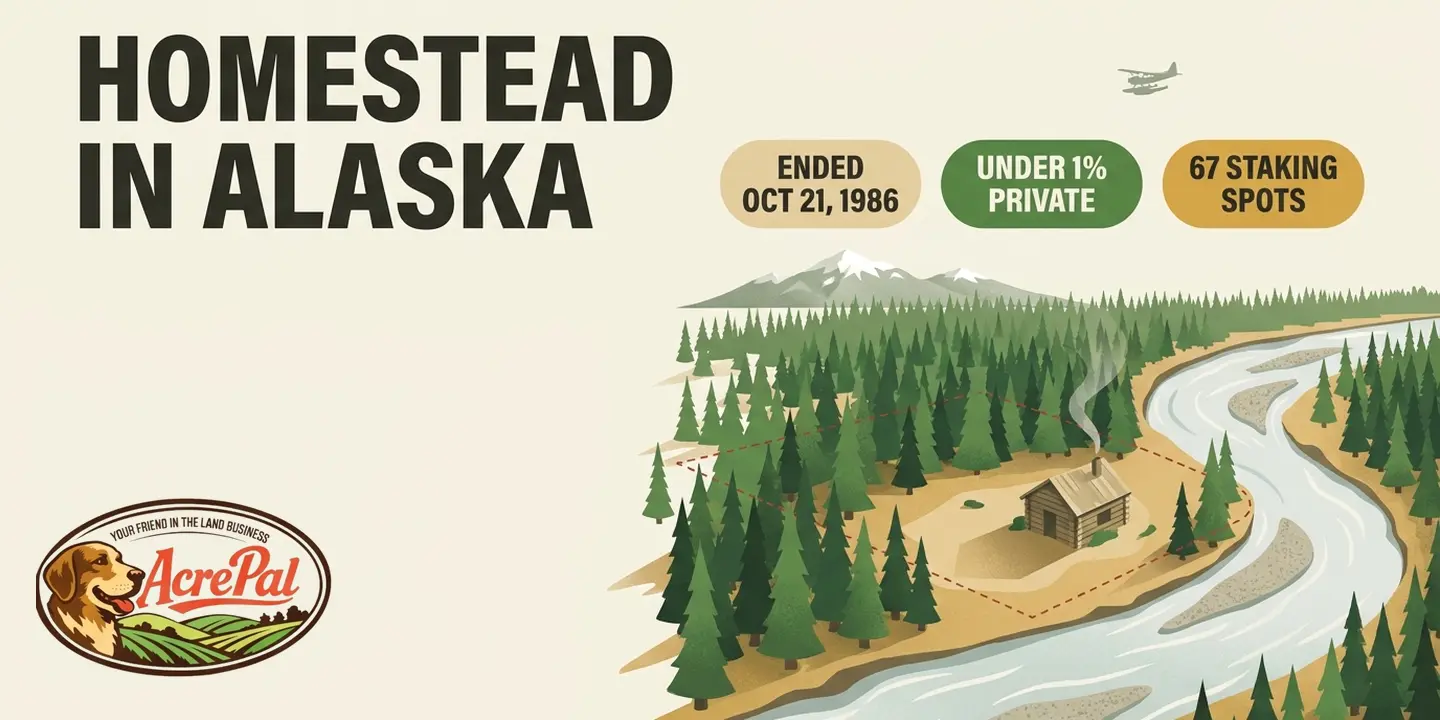
No, you cannot claim free land in Alaska. Nobody has been able to file a homestead claim there since 1986, and the state does not run a replacement program. If you are researching a homestead in Alaska, that is the short answer, and it has been settled for nearly forty years.
The dates matter more than most articles on this topic admit. The Federal Land Policy and Management Act passed on October 21, 1976 and repealed the homestead laws nationwide. Alaska received a ten year extension, so the last day anyone could file a claim there was October 20, 1986.
The question underneath the free land question is the useful one. Which of Alaska's remaining land routes can somebody who does not live in Alaska actually use? Two are open to you. The two that get talked about most are not.
We went to BLM's homesteading brochure and FAQ, Alaska DNR's live land sales and staking pages, and the state's own land ownership fact sheet, and we quote them throughout. Start with the date.
The Last Day Anyone Could File a Homestead Claim in Alaska
The law that ended homesteading is ten years older than the date almost everyone repeats. Homesteading arrived late here to begin with, since Congress did not extend the homestead laws to Alaska until May 14, 1898. It then ended in two steps.
"Homesteading officially ended on October 21, 1976 with the passage of the Federal Land Policy and Management Act of 1976. On that day, all homestead laws were repealed nationwide, however, a 10-year extension was allowed in Alaska since it was a new state with fewer settlers. The last time anyone could file any type of homestead claim in Alaska was on October 20, 1986. After that day, no more new homesteading was allowed on federal land in Alaska."
Two dates, two different jobs. The Act is 1976, and it repealed the homestead laws in every state at once. The 1986 date is the expiry of Alaska's extension, which BLM's FAQ sums up as "Homesteading has not been possible on federal lands in Alaska since Oct. 21, 1986, although it was allowed for 88 years before that."
It was never free in the way the word suggests. A claimant had to "1. live on the claimed land for most of five consecutive years, 2. live in a habitable dwelling (a tent would not count), and 3. cultivate at least one-eighth of the land." That tent clause is worth sitting with if you are picturing an off grid cabin.
Very few people finished. BLM counts fewer than 3,500 homestead patents awarded to individuals in Alaska between 1901 and 1988, and the National Park Service reports that "3,277 homesteads had been conveyed in the state which equaled over 360,000 acres or less than 1% of the total land in Alaska." Set that against Alaska's 365,481,600 acres and the whole history of homesteading here covers under one tenth of one percent of the state.
Word that the door was closing produced a rush, helped along by a 1986 Oprah Winfrey show. The last man through was Kenneth W. Deardorff, who filed in 1974 and, BLM says, "received a homestead patent on May 5, 1988 to 49.97 acres of land on the Stony River near Lime Village in southwestern Alaska."
The date tells you when homesteading stopped. It does not tell you why nobody reopened it, and that answer starts with who already owns Alaska.
Who Owns Alaska, and Why Almost None of It Is Private
"The State of Alaska contains a total of 365,481,600 acres." Almost none of that is land an ordinary buyer can purchase, and that is what closed the door on homesteading long before Congress got around to it.
Alaska DNR's land ownership fact sheet says "The federal government is still the largest landowner in Alaska with 61.3% of the total area (approximately 224 million acres)." DNR footnotes that share to a 2017 Congressional Research Report using 2015 data, so treat it as a snapshot from 2015 and not a live count.
Two events took most of the rest. At statehood in 1959 the federal government granted the new state 28 percent of Alaska's total area, roughly 105.8 million acres, of which about 100.5 million has been conveyed so far. Then came the law that reshaped everything. "In 1971 Congress passed the Alaska Native Claims Settlement Act (ANCSA). This law granted 44 million acres and 1 billion dollars to village and native corporations created under the act."
| Owner | Acreage as DNR reports it | Basis |
|---|---|---|
| Federal government | About 224 million acres, 61.3 percent | 2017 report using 2015 data |
| State of Alaska | 100.5 million acres received of about 105.8 million granted | Statehood grants, still in progress |
| Alaska Native corporations | 44 million acres, about 12 percent | ANCSA, 1971 |
| Private, other than Native land | Less than one percent | DNR fact sheet, July 2021 |
These figures come from different years and different processes, so they do not total 100 percent. Read each with its own basis attached.
Here is the part almost nobody gets right. DNR states plainly that "Native lands are private lands," and 44 million acres works out to about 12 percent of the state. So when DNR reports that "Land in private ownership (other than Native land) comprises less than one percent of the total land in Alaska," that under one percent figure excludes Native corporation holdings. Collapse those two categories and you will misread every ownership statistic you meet on this topic.
The state is not finished selling. It reports "There are approximately 3.15 million acres currently in the state's land disposal bank for eventual lease or sale." BLM describes the same squeeze from the other side. Tens of millions of acres of federal land were withdrawn from homestead entry so the state and Native corporations could make their selections, and by BLM's account, "Very little land had been available for homesteading for more than a decade before Oct. 21, 1986, when no new homesteads could be filed in Alaska."
The free land question was settled by who already owned Alaska, not by a change of heart in Congress.
How the State of Alaska Sells Land, and Which Routes Non-Residents Can Use
Two of the state's land sale routes are open to non-residents. The general auction and the staking program are not. DNR also closes the loophole readers go looking for after reading the history. "Homesteading programs no longer exist."
| Route | Who can buy | The catch |
|---|---|---|
| Over the counter | Anyone, resident or non-resident | These are parcels that already failed to sell at auction |
| Sealed bid auction | Alaska residents with one year of residency | Closed to non-residents, and you bid against locals |
| Agricultural auction | Alaska residents or non-residents | Covenants and conditions attached to the land |
Over the counter has no residency test at all. DNR says "The Over-The-Counter (OTC) program allows anyone (resident or non-resident) to purchase available land at a fixed price in designated areas." The inventory is what it sounds like. "Land becomes available 'over-the-counter' when it has been offered in a sealed bid auction but not sold. Remaining parcels are made available Over-the-Counter on a first come, first served basis for the appraised fair market value." It is the leftovers list, which is why it is worth asking what the bidders who passed already knew.
The general sealed bid auction is residents only. "The State of Alaska's Land Auctions allow Alaska residents to bid on parcels of State land that have been surveyed and appraised," and the test is specific. "For the auction and Remote Recreational Cabin Sites program, Alaskans who have resided in the state for at least one-year prior to the auction or authorization drawing can participate." DNR's wording elsewhere is that "Most auctions are limited to Alaska residents," not all. We read the agricultural auction as the reason for that hedge, though DNR does not say so itself.
That agricultural auction is the exception nobody reports. "This program allows Alaska residents or non-residents to bid on parcels of State agricultural land that have been surveyed and appraised. Agricultural land has covenants and conditions so please read the brochure before bidding or purchasing." The covenants are the price of admission, which is why DNR tells you to read the brochure before you bid.
Both run on the same calendar this cycle. "The bidding period for Auction #498 is between June 10 and September 30, 2026. The auction event will be held on October 21, 2026," and Agricultural Auction #499 follows those dates. Federal homesteading ended in Alaska on October 21, 1986, so the 2026 auction lands forty years to the day after it, a coincidence of the calendar and nothing more.
We are not reprinting a parcel, an acreage or a price from the current offerings, because DNR loads that data through its own tools and we could not verify a single figure on the page. Pull the current brochure from DNR before you plan around any of it. If you live outside Alaska, start with the over the counter list, the only route with no residency test and no bidding calendar.
How Alaska's Remote Cabin Site Staking Program Actually Works
Sixty seven. That is the total number of staking authorizations the state offered in its current Remote Recreational Cabin Sites round, across 365 million acres, and you have to live in Alaska to enter the drawing.
DNR is blunt about eligibility. "Only current Alaska residents are eligible to participate in the Remote Recreational Cabin Sites Staking Program." Elsewhere it calls the thing what it is. "This is the 'stake-it-yourself' program for Alaska residents." The same one year residency rule from the auction applies.
DNR spells out the sequence so nobody expects a shortcut.
"In order to purchase a parcel in this program, you must apply in the drawing, win a staking authorization, stake a parcel on the ground, submit a lease application, enter a 3-year lease, make lease payments (while the parcel is surveyed and appraised), and at the end of the lease you may purchase the parcel. Financing is available."
"You will make 12 quarterly payments while DNR surveys and appraises the parcel," applied toward the lease rental fee, the survey deposit and the appraisal deposit. The current DNR page does not publish an annual rent figure, so we will not invent one.
What you pay at the end is the part participants misunderstand. "After the parcel has been surveyed and appraised, you then have the opportunity to purchase the parcel at the appraised market value or a minimum of $1,000 over the actual survey cost, whichever is greater," and "This purchase typically occurs within three to four years from the time of lease issuance." So the program gets you a parcel at market value with a payment plan attached, and no discount for the years of work. If the remaining balance lands at $2,000 or less you cannot finance it and must pay in full.
The current offering put up two areas, Lost Creek II with 28 staking authorizations and Selatna II with 39. The application window ran to December 1, 2025 and the drawing was held on December 18, 2025, so nobody can enter that round now.
DNR says the program is usually offered every other year. Watch for the next one and confirm the terms with DNR directly. Do not trust a secondhand figure, including this one a year from now.
Buying Private Land in Alaska, the Route Open to Everyone
The first hour you spend shopping for Alaska land teaches you something uncomfortable. You cannot find out what anything actually sold for. Alaska does not require sellers to disclose closing prices, so there is no public record of the sale down the road to measure an asking price against.
That has a direct consequence for your research. Every undated per acre figure you find for Alaska land, on any site, tells you what somebody hoped to get. None of them tell you what anybody paid. Treat them accordingly, including the ones that sound authoritative.
The private market here is also small, so the genuinely accessible parcels are the contested ones, and almost everything listed is raw ground with nothing run to it. If you have not bought unimproved land before, that is the category you are shopping in.
Conventional lending on remote land is limited, and seller financing is more common than bank financing. Ask any agent directly how many acres of remote property they have personally sold, because generalists are a real risk in this niche. And do not buy a parcel you have not walked. A poster on the Alaska Outdoors Forums warned buyers never to purchase land without walking it first, describing parcels marketed for sale that turned out to be near vertical mountainside.
We should disclose where we sit on that financing point. AcrePal sells owner financed rural land in Mohave and Apache counties in Arizona, Costilla County in Colorado, Elko County in Nevada, Modoc County in California and Putnam County in Florida, and we do not sell land in Alaska, which is why nothing in this guide points at our own inventory.
The Susitna Valley and Mat-Su, Where Most Buyers Actually Land
If you are buying your first piece of Alaska land, look at the Matanuska-Susitna Borough first. Road access is what turns a parcel from a daydream into a project, and the Mat-Su has it.
The state's own remote offerings show the other end of the spectrum. Lost Creek II sits "approximately 75 miles north of Fairbanks on the north side of the Dalton Highway," and Selatna II sits "approximately 30 miles southwest of McGrath and 57 miles northeast of Stony River, along the Kuskokwim and Selatna Rivers." Neither is somewhere you drive on a Saturday to check on your gate.
Talkeetna, on the Susitna River, sits inside the Mat-Su Borough, and this is the part of Alaska first time buyers keep landing in. Credit where it is due, akhomehq.com is the only other guide we read on this topic that gets down to borough level rather than treating Alaska as one undifferentiated place.
The Susitna Valley also gives you a live lesson in parcel level diligence. On July 23, 2026 the Mat-Su Borough Assembly declared a local flood emergency for Talkeetna under Resolution 26-065, ahead of a National Weather Service flood watch as the Susitna River rose toward flood stage, according to alaskasnewssource.com. The declaration came before flooding actually occurred.
The money behind it shows how serious the erosion has become. The same report puts a $2 million FEMA grant requiring a $500,000 local match behind flood protection planning, plus a $1.8 million NRCS program requiring roughly $604,000 in local match for voluntary property buyouts. Some private riverfront land there is being bought back because it is eroding into the river.
None of that is a reason to write off the region. Public Works Director Tom Adams told matsusentinel.com the borough is not trying to scare Talkeetna or suggest the community will be uprooted, and the buyout targets roughly a two mile stretch of river. Flood risk here works parcel by parcel, and the town level picture will not tell you what you need. Check FEMA flood zone status and erosion history on the specific parcel, and confirm the building envelope sits above ordinary high water, because spring breakup regularly pushes Alaska rivers over their banks.
Road system land in the Mat-Su trades on its access, and you feel the value of that the first time you need lumber delivered. Fly in land is cheaper for exactly the reason it is harder.
Permafrost, Access, and What Makes an Alaska Parcel Buildable
The parcel that looks like a bargain on a satellite map is usually the one nobody can get a loaded truck to in April.
Start under the ground. Commission a professional soil and permafrost evaluation before you close rather than after, because the result decides whether the site needs elevated or pile foundation methods instead of a conventional foundation. That single check is what separates a cheap parcel from an expensive project.
Then confirm access in writing. You want legal, recorded, year round road access, either public road frontage or a recorded easement, because trail access or summer only access can leave a parcel effectively unbuildable even when the deed is clean. A parcel with no legal way in is a landlocked property, and that is a title problem rather than an inconvenience.
Percolation testing tells you whether a septic system is viable, and it should happen before you assume one is. Water, power and waste are a separate project with their own budget, and our guide to living off the grid covers the general shape of that work.
Seasons close the roads too. remotepropertiesalaska.com describes two access gap windows when routes are not safe to travel, roughly a month during spring breakup and about two months during freeze up. Ask the seller and the neighbors what those windows look like on this specific road.
Bring a local builder in before closing to price site prep, clearing, driveway and foundation work, so you never evaluate the land price in isolation from the development cost. Proximity to Anchorage, Wasilla, Palmer or Fairbanks matters more than it looks, because permitting and construction logistics get materially simpler near them. Whether a parcel sits in an organized or an unorganized borough also changes who plats it, who permits construction and who taxes it.
Four questions to take to a seller or an agent.
- Has a soil or permafrost evaluation ever been done here, and can I see it
- Is the access a recorded easement or public road frontage, and is it maintained in winter
- Has percolation testing been done on this parcel, and did it pass
- Which borough is this in, and who issues the building permit
Why the Parcel Price Is the Smallest Number in Your Budget
Freight is the number that reprices everything else. remotepropertiesalaska.com puts summer barge freight to remote Alaska sites at up to $5.00 per pound and says the gap between an accessible parcel and a comparable inaccessible one can be $100,000. One company published those figures, so read them as a direction of travel and not a market rate. Every board, every appliance and every gallon of fuel is priced by how hard your parcel is to reach, which is why access shows up in your budget twice.
People already living it say the same thing. A poster on the Alaska Outdoors Forums wrote that many people assume rural Alaska is cheap, on grid or off, and that Alaska is very expensive. That is one resident's opinion and not a dataset, but it lines up with the cost drivers above.
There is one real cost advantage. Many remote unserviced parcels sit in the unorganized borough, where no borough property tax is levied, though that depends entirely on the parcel. Confirm the status with the borough or the state before you count on it.
You will not find Alaska specific figures for wells, septic systems, foundations or utility hookups here. We could not verify a single one to a primary or firsthand source. In a state that does not require closing prices to be disclosed, any undated dollar figure on this topic deserves the same scrutiny. For the general anatomy of those costs, our guides to drilling a well and getting utilities to a parcel are national baselines, and Alaska will run higher than both.
Build the budget backward from access, then go look at parcels. The cheapest parcel on the map is usually the one that makes every later number bigger.
Frequently Asked Questions About Homesteading in Alaska
Can you still homestead in Alaska?
No. BLM answers it directly, "Homesteading ended on all federal lands on October 21, 1986. The State of Alaska currently has no homesteading program for its lands." DNR says the same from its side, "Homesteading programs no longer exist." Buying is the only route left, either from the state or from a private seller.
What is the Alaska homestead exemption and is it the same thing?
No, they are unrelated. Under Alaska Statute 09.38.010 an individual may claim an exemption on an interest in property used as their principal residence, and the statute says "the value of the homestead exemption may not exceed $54,000." It shields a residence from creditors and has nothing to do with claiming land. We retrieved that text from a republisher because the state's own statute site returns an error, so check the current statute yourself.
Can a non-resident buy land directly from the State of Alaska?
Yes, on two routes. Over the counter sales are open to anyone, resident or non-resident, at the appraised fair market value. The agricultural auction is open to Alaska residents or non-residents, though those parcels carry covenants and conditions. The general sealed bid auction and the Remote Recreational Cabin Sites staking program are limited to Alaska residents.
Is the remote cabin site staking program open right now?
The current round is closed. Its application window ran to December 1, 2025 and the drawing was held on December 18, 2025, so no new applications are being taken for it. DNR says the program is usually offered every other year, so watch for the next offering and confirm the dates with DNR directly.
Does Susitna Valley riverfront land carry flood risk?
Yes, and there is a current example. The Mat-Su Borough declared a local flood emergency for Talkeetna on July 23, 2026 under Resolution 26-065, and a federally backed voluntary buyout targets roughly a two mile stretch of river. Check flood zone status and erosion history parcel by parcel. A general statement about the town will not tell you enough.
If homesteading is over, where can you still homestead?
Nowhere under the original federal program, in any state. FLPMA repealed the homestead laws nationwide in 1976, and Alaska got the only extension, which ran out in 1986. What people mean by homesteading today is buying land outright and doing the work themselves, which makes it a purchase and not a claim. If you are looking beyond Alaska, our roundup of homesteading states is a reasonable place to start.