
You can own forty acres with a creek running through the middle of it and have no legal right to use a drop of it. You can also own five acres with no creek, no pond, and no spring, and still find that the state will not let you drill a well.
Those are two different problems. The second one decides most land purchases.
Water rights are permission to use water from a specific source, for a stated purpose, in a stated amount. They are not ownership of the water itself. Across most of the West the water is public property and what a landowner holds is permission to use some of it. That distinction sounds academic right up until you are standing on a parcel working out whether you can put a house on it.
Most guides on this subject spend their length on the creek. We went and read the well statutes in the five states where we sell land, which are Arizona, Colorado, Nevada, California, and Florida, and we quote them below with section numbers so you can check every one of them yourself.
By the end you will know what the word exempt actually means in your state, which question to ask about a specific parcel, and who to ask it.
What a Water Right Is, and What It Is Not
Nevada's legislature says it about as plainly as a legislature can. Under NRS 534.020(1), "All underground waters within the boundaries of the State belong to the public, and, subject to all existing rights to the use thereof, are subject to appropriation for beneficial use only under the laws of this State relating to the appropriation and use of water and not otherwise."
Read that last clause again. Not otherwise. The water under your land is public property, and the only way to reach it is the way the state says.
A Right to Use, Not a Right to Own
A water right gives you permission to take a set amount of water, from a set source, at a set place, for a set purpose. You never own the water. Lawyers call this a usufructuary right, which just means a right to use something that belongs to somebody else.
That permission comes with a condition attached, called beneficial use. You have to actually use the water for the purpose the right was granted for, and if you stop, you can lose it.
Nevada spells this out. Under NRS 534.090(1), five successive years of nonuse "works a forfeiture" of the right, to the extent of the nonuse. There is a warning first. After four consecutive years of nonuse the State Engineer notifies the owner, who then has one year to resume beneficial use and prove it.
This is why "use it or lose it" gets repeated so often out west. The phrase describes a statute.
Water Rights Can Be Sold Away From the Land, Just Like Mineral Rights
Mineral rights are the right to extract what sits under the surface, and they can be sold separately from the surface itself. That is why a deed can hand you a parcel while somebody three states away still owns the oil, gas, or coal underneath it.
Water works the same way across much of the West. A water right is a separate piece of property. It can be sold, leased, or held back by a previous owner, and the land can change hands repeatedly without it.
The practical consequence is that you have two records to check, not one. The deed tells you part of the story. The state's water records tell you the rest.
Riparian and Prior Appropriation, and Why the Label Decides Less Than You Think
Almost every guide sorts the country into two buckets and stops there. The buckets are real and worth understanding. They also will not tell you whether you can drill a well.
Riparian Rights Follow the Land
Across most of the eastern United States, if your property touches a river, stream, or lake, you may make reasonable use of that water. The right attaches to the land automatically. You do not buy it separately, and in most states you cannot sell it separately either.
Reasonable is the whole game. You may water livestock or irrigate a garden. You may not take so much that you harm the people downstream who hold the same right you do.
Prior Appropriation Runs on Seniority
West of roughly the Great Plains, the rule flips. Water goes to whoever put it to beneficial use first, which is where "first in time, first in right" comes from.
Every appropriative right carries a priority date. In a dry year the oldest rights are filled completely before the newer ones get anything, so a right established in the 1800s can leave a right established last decade with nothing at all. Because the right is separate property, it can be bought and sold without the dirt it came from.
Even the Experts Disagree About Which State Is Which
We are not going to print a tidy count of prior appropriation states, because the sources we checked do not agree on one.
The National Agricultural Law Center lists the doctrine as used in "Alaska, Colorado, Idaho, Kansas, Montana, Nevada, New Mexico, North Dakota, Oregon, South Dakota, Utah, Washington, and Wyoming." That list leaves out Arizona, which every other source we checked treats as an appropriation state, and it includes several states those same sources file under hybrid systems instead.
If the specialists cannot agree on the map, the map is not what you should be relying on.
And do not read riparian as unregulated. Florida is a riparian state, and Fla. Stat. 373.219(1) reads, "The governing board or the department may require such permits for consumptive use of water and may impose such reasonable conditions as are necessary to assure that such use is consistent with the overall objectives of the district or department and is not harmful to the water resources of the area. However, no permit shall be required for domestic consumption of water by individual users."
One subsection, two rules. The state may require permits for consumptive use, and it exempts household use by individuals. The label told you how Florida thinks about water. The subsection told you what you can actually do.
The Question That Actually Decides Whether You Can Live There
You can read four articles about riparian doctrine and still not learn whether you can put a house on the five acres you are looking at.
A water right and a domestic well are two different legal objects, and most coverage blurs them together.
Whitetail Properties is the one guide in the top results that draws the line clearly, through Jerrod Meyer, a land specialist in Colorado. "So, I explain up front that surface water rights, irrigation water rights, and sometimes livestock-only water rights are separate from a domestic water well, or anything like that," Meyer said. No other guide in the top results puts it that plainly, and Meyer deserves the credit for it.
The same article then closes with this. "So, for most buyers and sellers, water rights won't matter, anyway."
In the narrow sense Meyer means it, discussing whether a formal irrigation right attaches to a mountain property, that is fair enough. As a takeaway for somebody buying a small rural parcel, it points the wrong way.
A buyer with no irrigation operation has no senior water right to fall back on. Their entire water supply is one well and one permit. Water law reaches them more directly than it reaches a rancher with decades of seniority on file.
Two statutes show what the exposure looks like. In Nevada, once the State Engineer designates a basin, NRS 534.120(4) authorizes the State Engineer to "Limit the depth of domestic wells," and to prohibit new domestic wells outright where a public entity can furnish water. In Colorado, one subsection can put your well application in a queue with every other lot in your subdivision, which we come to shortly.
Across the five competitor pages we were able to download in full, the phrase "exempt well" does not appear once, navigation and footers included. The exempt well is the mechanism deciding whether a rural buyer gets water, and the guides ranking for this subject never name it.
If you are buying a small rural parcel, the sentence that matters is not about the creek. It is about the well.
What Exempt Means in the Five States We Sell Land In
Exempt is the most misunderstood word in this subject. It does not mean unregulated, and in Colorado it does not even mean you skip the permit.
The five states where we sell land treat a household well five different ways.
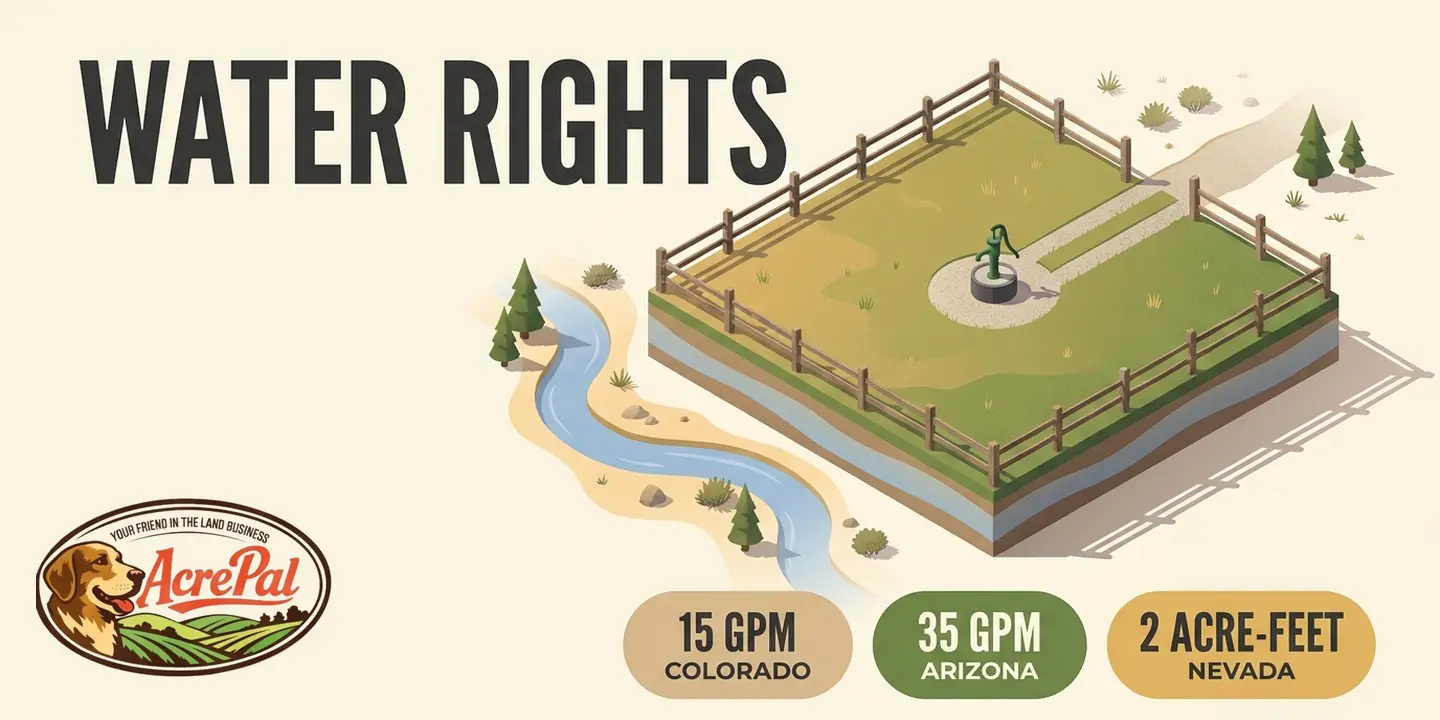
| State | Exemption keyed to | The number | Permit still required |
|---|---|---|---|
| Colorado | Rate of production | 15 gallons per minute | Yes, and a household well application costs $100 |
| Arizona | Pump capacity | 35 gallons per minute | Notice of intention to drill, plus registration |
| Nevada | Annual volume | 2 acre-feet per year | No permit for domestic use within the cap |
| California (Modoc County) | County permit | Set locally | Yes, from Modoc County Environmental Health |
| Florida | Category of use | Domestic use by individual users | No consumptive use permit, construction permit still applies |
Colorado Sets a Pumping Rate, Not an Acreage
Colorado's exemption turns on how fast the well produces. C.R.S. 37-92-602(1)(b) covers "Wells not exceeding fifteen gallons per minute of production and used for ordinary household purposes, fire protection, the watering of poultry, domestic animals, and livestock on farms and ranches and for the irrigation of not over one acre of home gardens and lawns but not used for more than three single-family dwellings."
You may have read that Colorado requires 35 acres for a domestic well. Meyer says as much in the Whitetail piece. "In Colorado, a domestic water well typically requires a 35-acre minimum threshold to qualify for that."
The statute is more specific than that. Under C.R.S. 37-92-602(3)(b)(II)(A), thirty-five acres is one of three alternative routes to a presumption that your well will not injure existing water rights. One route is a well that is the only one on a residential site and is "used solely for ordinary household purposes inside a single-family dwelling and will not be used for irrigation." Another is a well that "will be the only well on a tract of land of thirty-five acres or more." The third covers qualifying cluster development lots.
So a five-acre parcel is not disqualified. What changes is what the well may be used for.
On a small lot you are generally looking at water inside the house, with no garden irrigation and no livestock. At thirty-five acres or more you reach the fuller bundle in subsection (1)(b). Either way, the presumption can be rebutted.
Exempt also does not mean permit free. Under 37-92-602(3)(a)(II), since July 1, 2006 these wells "may be constructed only upon the issuance of a permit," and a household well application costs one hundred dollars. The state engineer has forty-nine days to rule.
Arizona Measures the Pump
Arizona draws its line at the pump. A.R.S. 45-402(8) defines an exempt well as one "that has a pump with a maximum capacity of not more than thirty-five gallons per minute and that is used to withdraw groundwater pursuant to section 45-454."
The heading of A.R.S. 45-454 is "Exemption of small non-irrigation wells." If your plan involves irrigating a market garden, an exempt well is not the tool for it. Inside an Active Management Area, non-irrigation uses other than domestic purposes and stock watering are capped at ten acre-feet per year.
Colorado and Arizona both publish a gallons per minute figure, and the two measure different things. Colorado limits production. Arizona limits pump capacity.
Nevada Caps the Year, Then Keeps the Right to Limit You
Nevada has the cleanest exemption of the five. NRS 534.180(1) provides that the permitting chapter "does not apply in the matter of obtaining permits for the development and use of underground water from a well for domestic purposes where the draught does not exceed 2 acre-feet per year." That spelling of draught is the statute's own.
The State Engineer keeps a lever, though, and nobody mentions it. In a designated basin, NRS 534.120(4) allows the State Engineer to "Limit the depth of domestic wells," deny new appropriations where a public entity already serves, and require water rights to be relinquished in connection with parcel map approval. A well drilled since July 1981 can also be ordered plugged once a public supply reaches within 1,250 feet of it.
The exemption spares you the application. It does not put your well beyond the State Engineer's reach.
California Sends You to the County
California does not issue your well permit. Your county does.
In Modoc County the office is Environmental Health, which runs a "Wells Program" covering "well construction, modification, and destruction permits." They sit at 202 West 4th Street in Alturas, and the phone number is 530-233-6310.
Go looking for a California state well permit portal and you will not find one. Start at the county.
Florida Exempts the House and Permits Everything Else
Florida's domestic exemption is the one quoted earlier from Fla. Stat. 373.219(1). Household use by an individual user needs no consumptive use permit.
Well construction is a separate question, and in Putnam County the answer is unusual. The county sits partly in the St. Johns River Water Management District and partly in the Suwannee River Water Management District.
St. Johns has handed permitting down to local health departments, noting that "The District has 16 water well permitting delegation agreements with local health departments..." Putnam is on that delegated list, so a buyer who calls the district office may be calling the wrong desk.
Find your state's number before you find your favorite parcel.
The 1972 Line That Quietly Kills Well Permits
A date buried in a Colorado statute can decide whether a lot gets water, and it never shows up in a listing.
C.R.S. 37-92-602(3)(b)(III) reads, "Except as specified in subsection (3)(b)(IV) of this section, if the application is for a well, as defined in subsection (3)(b)(II) of this section, which will be located in a subdivision, as defined in section 30-28-101 (10), and approved on or after June 1, 1972, pursuant to article 28 of title 30, for which the water supply plan has not been recommended for approval by the state engineer, the cumulative effect of all such wells in the subdivision shall be considered in determining material injury."
Three conditions have to stack up. The parcel sits in a subdivision as Colorado defines one. That subdivision was approved on or after June 1, 1972. Its water supply plan was never recommended for approval by the state engineer.
When all three are true, the state engineer stops looking at your house. The question becomes what happens if every lot in that subdivision drills a well. One family is harmless. A few thousand platted lots are a different question, and the statute requires that question to be asked.
This bears directly on the kind of land people shop when they are trying to spend less. The 1970s produced a great many rural subdivisions platted for buyers who never arrived, and those lots are still on the market at prices that look too good to pass up. We sell land in Colorado, so this touches inventory in our own market too.
We verified the statute. We did not verify how any particular county applies it to any particular subdivision, and we are not going to guess in print.
What you can do is call the Colorado Division of Water Resources office for Division 3, which administers the upper Rio Grande basin, and ask something specific.
Is this parcel in a subdivision approved on or after June 1, 1972 whose water supply plan was never recommended for approval? Say the statute number out loud. You will get a faster answer than if you ask whether the land has water.
How to Check a Parcel Before You Make an Offer
Advice on this subject usually stops at contacting your state water agency. That leaves out which agency, what to search for, and what to say when somebody picks up. Run this sequence instead.
Where to Look, and What to Ask
- Split the question in two before you start. Is there a water right attached to this land, and can I get a well on it? On a small parcel with no surface water, only the second question bears on whether you can live there.
- Search the well records. Colorado publishes the tools directly, noting that "Information on all registered well permits can be found through our Well Permit Search Tool and our Map Viewer Tools." In Nevada a domestic well's priority date is set by the driller's log filed with the State Engineer under NRS 534.080(4), so a well with no log on file is a real gap rather than a paperwork technicality.
- Find the office that actually issues the permit. Arizona and Colorado run theirs at the state level. Modoc County, California issues its own. Wells in Putnam County, Florida are permitted by the county health department under the delegation described above.
- Ask what a permit would actually cover. Indoor household use only is a materially different property from a permit covering livestock and a garden. Whether a permit is available at all is the easy half of that question.
- In Colorado, ask the subdivision question from the section above, with the statute number in hand.
- Read the deed, and know its limits. One of the guides ranking for this topic tells you to start with the deed because it spells out which water rights come with the land. A deed can absolutely reveal that a previous owner reserved or severed the rights, which is worth finding. What a deed cannot do is establish that a usable right exists, because in an appropriation state the authoritative record belongs to the state agency and not the county recorder. Read the deed, then go find the record that settles it.
- Put every answer in writing before you close. A seller's verbal assurance about water is worth nothing at a closing table.
What to Do If the Answer Is No
Sometimes the parcel cannot get a well, or the permit will not cover what you had in mind. None of that is automatically a dealbreaker, but it changes the math.
Hauled water into a cistern is the usual fallback, and plenty of people live comfortably that way. A shared well with a neighbor can work too, but it needs to be a recorded written agreement rather than a handshake.
Rainwater is the option people overestimate. In Colorado, C.R.S. 37-96.5-103 permits "No more than two rain barrels with a combined storage capacity of one hundred ten gallons or less," and the same article provides that "A person shall not use precipitation collected under this article for drinking water or indoor household purposes." One hundred ten gallons of outdoor-only water will keep a garden going. It will not supply a house.
If the well answer comes back no and you still want the parcel, price the water into your offer before you sign, not after.
Frequently Asked Questions About Water Rights
What are water rights?
Water rights are legal permission to use water from a specific source, for a defined purpose and in a defined amount. They are not ownership of the water itself. Nevada states the principle bluntly, declaring that all underground water in the state belongs to the public and may be appropriated only under state water law. What you can hold is a right to use, and that right carries conditions, including an obligation to actually use it.
Do water rights transfer automatically when you buy land?
It depends on the state and on that parcel's own history. In eastern riparian states, rights generally attach to the land and come with it. In western appropriation states they are separate property that a previous owner may have sold or reserved, so they frequently do not transfer. For most small rural parcels, though, the well permit matters considerably more than the answer to this question.
Does an exempt well mean you do not need a permit?
No, and assuming otherwise gets expensive. In Colorado an exempt well still requires a permit and a household application costs one hundred dollars. Exempt there means exempt from the water rights adjudication article, not from paperwork. Nevada's domestic exemption is genuine but capped at 2 acre-feet per year, and even then the State Engineer can limit well depth in a designated basin.
How do you buy water rights?
In appropriation states, water rights are bought, sold, and leased separately from land, and a transfer generally needs approval from the state engineer or state water agency before it counts. Standalone rights rarely come up in small quantities, because they usually move with a farm or ranch. Expect to hire a water rights attorney. This is not a do-it-yourself purchase, and the priority date and permitted volume determine what you are actually paying for.
Is 35 acres the minimum to have a well in Colorado?
No. Under C.R.S. 37-92-602(3)(b)(II)(A), thirty-five acres is one of three alternative routes to a presumption that a well will not injure existing rights. A smaller parcel can qualify through the route covering ordinary household use inside a single-family dwelling, which excludes irrigation. The acreage changes what the well may be used for, not whether you can have one at all.
What is the difference between water rights and mineral rights?
Both are interests that can be severed from the surface estate and sold separately, which is why a deed can convey land without either one. Mineral rights cover extracting what lies underground, such as oil, gas, or coal. Water rights cover using water from a specified source. A deed will show a reservation if a previous owner recorded one, but for water in an appropriation state the state agency holds the record that settles it.