
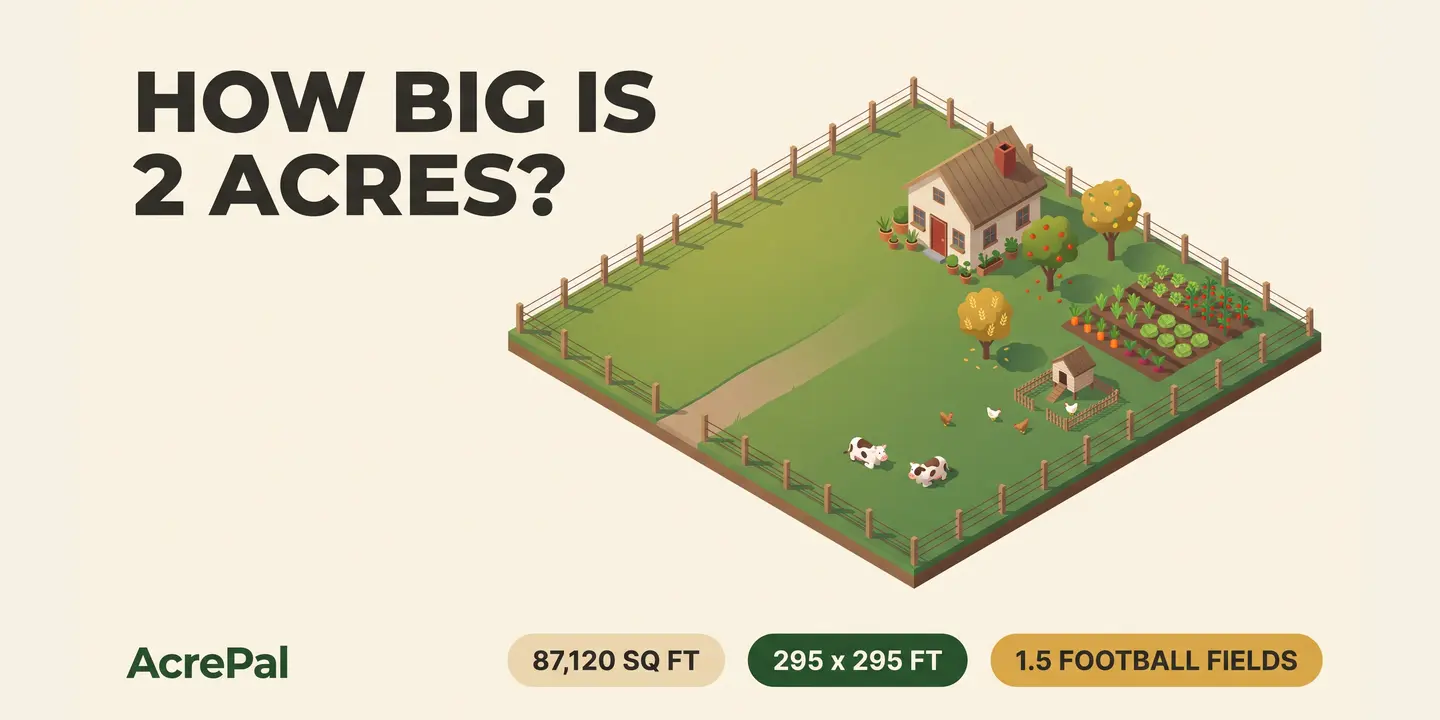
How big is 2 acres? It is 87,120 square feet, which works out to a square about 295 feet on each side, or roughly 1.5 American football fields including the end zones. To put that in everyday terms, 2 acres is about 8 times the median suburban house lot in the US, which sits around 10,871 square feet. So if you are moving off a quarter-acre yard, you are stepping up to eight times the land.
Most pages stop right there, at the math. We go further because you are probably not converting units for fun. You want to know what 2 acres actually costs in 2026, what you can realistically build, grow, and raise on it, and how it stacks up against half an acre, 1 acre, 2.5, 3, and 5 acres. All of that is below, in plain language, with real numbers.
The Quick Answer Plus a 2-Acre Conversion Table
The math is simple. One acre equals 43,560 square feet, so 2 acres is 43,560 x 2 = 87,120 square feet. Every other unit is just a conversion of that same area.
87,120 square feet
About 8,094 square meters
0.809 hectares
0.003125 square miles (1/320th of a square mile)
295 feet on each side as a perfect square
1,180 feet around the perimeter, just under a quarter mile
Real lots are almost never perfect squares, so treat the 295-foot figure as the square-shape baseline. It comes straight from the area, since the square root of 87,120 is 295.16 feet. If your parcel is a long rectangle, the sides will differ, but the total area stays 87,120 square feet either way.
The square-mile line is a handy scale check. One square mile holds 640 acres, so 2 acres is 1/320th of a square mile, meaning 320 two-acre parcels would fit inside a single section of land. It reads small on a county map yet lives large on the ground.
One number worth flagging early is the perimeter. A square 2-acre lot has about 1,180 feet of edge, which is just under a quarter mile. That figure matters the moment you start pricing out a fence.
What 2 Acres Looks Like in Real Life
The football field comparison is the one most people reach for, so let us get it right. A standard field including both end zones is about 57,600 square feet, or roughly 1.32 acres. That makes 2 acres about 1.51 fields with the end zones counted, or close to 1.8 fields if you measure only the playing area between the goal lines. Plenty of pages get sloppy and skip the end-zone distinction, which is why their numbers drift.
A few more anchors that actually help you feel the size. Two acres is about 8 median suburban home lots set side by side, since the typical US lot runs around 10,871 square feet. It is also close to one average US city block in raw area, though a city block usually packs in 20 to 40 homes while 2 rural acres is normally one house with plenty of room to spare.
For a body-scale check, walking is the easiest. At a normal 3 mph pace you cross one 295-foot side in about a minute, and a full lap around the perimeter takes roughly 4.5 minutes. Two acres is land you can walk in minutes, not a vast frontier.
We are skipping the gimmicky comparisons on purpose. Counting how many Teslas, iPhones, or king beds fit on 2 acres makes for a fun headline, but none of it helps you picture standing on the land or planning where the house and garden go.
Dimensions, Shape, and Perimeter of a 2-Acre Lot
Start with the clean baseline. A perfect 2-acre square is about 295 x 295 feet. From there, real parcels stretch into all kinds of rectangles that still total 87,120 square feet. Common ones include 210 x 415 ft, 263 x 331 ft, and 149 x 584 ft.
Those shapes live very differently even at identical acreage. A near-square 263 x 331 lot gives you a compact, usable block where a centered house sits well back from every line. A long, skinny 149 x 584 strip is the same 2 acres on paper, but it can feel cramped side to side while running deep front to back. Shape gets decided by how the land was subdivided, where the road frontage falls, and the terrain, which is why two listings at the same price and acreage can be worth very different things to you.
Privacy follows from shape too. On a square 2-acre lot, a house parked in the middle sits roughly 120 to 150 feet from any property line, which is the big-yard buffer most rural buyers are after.
Then there is fencing. The perimeter of a square 2-acre lot runs about 1,180 feet, just under a quarter mile, so fencing the boundary means buying roughly that much fence plus posts and gates. A long narrow lot has more perimeter than a square of the same area, so that 149 x 584 strip costs more to fence than the tidy square does, even though both are 2 acres.
How Much Does 2 Acres of Land Cost in 2026?
It depends, but not in a hand-wavy way. The number is driven by location, access, and utilities, and real listings show the spread clearly. Remote raw parcels with no utilities in cheap markets run roughly $3,000 to $8,000, with real examples like Costilla County, CO around $3,499 to $3,800, the Bisbee, AZ area around $3,000 to $3,497, and West Texas near Cornudas around $3,995. Development-ready lots closer to towns tend to run $15,000 to $50,000 and up, while suburban or semi-rural ground near metros can hit $50,000 to $300,000 or more.
For a sanity check, USDA 2026 figures give per-acre anchors. Pastureland averages about $2,000 per acre, which pencils to roughly $4,000 for 2 acres. Cropland averages $6,020 per acre and overall farm real estate about $4,500 per acre, though raw undeveloped land usually comes in lower since those figures include buildings.
The price drivers are predictable. Location and state matter most, then legal road access (paved access can cost 2 to 5 times more than a dirt road or a landlocked parcel), then utilities and zoning. There is also a small-parcel premium, where 1 to 5 acre lots routinely cost 30 to 100 percent more per acre than nearby 20-plus acre tracts.
The land is often the smallest cost, which catches first-time buyers off guard. A $5,000 raw lot can need $15,000 to $39,000 to run utilities, $15,000 to $30,000 for a well and septic, and $3,000 to $36,000 for foundation and site prep. Making raw land livable routinely adds $30,000 to $75,000 or more on top of the purchase price, so budget for the whole project, not just the parcel. Buyers who learn this the hard way will tell you the same thing, that finding cheap land was the easy part and everything after it was the expensive part.
What You Can Actually Do With 2 Acres
Two acres is a specific tier with real capacity. You can fit a 2,000 to 2,500 square foot house plus a detached garage, a 24x32 barn or workshop, and a chicken coop, and still keep more than an acre of yard and garden. That is a comfortable layout, not a tight squeeze. Most builders consider 2 acres a large, private lot.
On the growing side, there is room for a sizable garden plus a small orchard. Think 12 or more raised beds, 7 or 8 berry bushes, and 10 to 15 dwarf or semi-dwarf fruit trees, producing 2,000 to 4,000 pounds of food a year. A well-run quarter-acre garden can grow all the vegetables a family of four eats, so the rest of the acreage goes to fruit, animals, and outbuildings.
Animals fit too, within reason. Two acres comfortably supports 10 to 25 laying hens, plus 2 to 4 dairy goats or 2 to 4 pigs with supplemental feed, and a beehive or two. There is also ample space for an RV or a manufactured home, where a single-wide averages about $88,200 and a double-wide about $161,200, plus the septic field and setbacks they need.
Now the honest limits. Two acres is marginal for a horse. Extension guidance is 1.5 to 2 acres of well-managed pasture per horse in the East, and once the house, driveway, garden, and yard take their cut, 3-plus acres is the comfortable floor, with 2 acres falling short in the drier West. It is too small for a cow without leaning hard on bought hay, and it will not deliver full grain-and-calorie self-sufficiency. For perspective, the B&R Homestead family runs chickens, bees, pigs, ducks, goats, a garden, and an orchard on just half an acre, so 2 acres, four times bigger, is very workable for a starter homestead.
If you are shopping for ground like this, AcrePal sells owner-financed rural land in Mohave and Apache counties in Arizona, Costilla County in Colorado, Elko County in Nevada, Modoc County in California, and Putnam County in Florida.
How 2 Acres Compares to 1/2, 1, 2.5, 3, and 5 Acres
Buyers rarely look at just one size, so here is how the neighbors stack up.
Half an acre (21,780 sq ft, about 147 ft square). Chickens, a garden, bees, small livestock. No horse.
1 acre (43,560 sq ft, about 209 ft square). House, large yard, garden, small livestock. Marginal for a horse.
2 acres (87,120 sq ft, about 295 ft square). House, yard, garden, orchard, chickens, goats or pigs.
2.5 acres (108,900 sq ft, about 330 ft square). Same as 2 acres plus a rotation buffer for one horse.
3 acres (130,680 sq ft, about 361 ft square). 1 to 2 horses in the East, real rotational grazing.
5 acres (217,800 sq ft, about 467 ft square). 2 to 3 horses, a small beef setup with hay.
Half an acre is small but productive, with room for a full mix of small animals and a garden but no horse. One acre adds a real house-plus-yard footprint and stays solo-manageable. At 2.5 acres you get about 25 percent more room, enough for a single horse and a rotation paddock, and 3 acres (50 percent more) crosses into comfortable grazing.
Five acres, 2.5 times the size of 2, opens up multiple horses or a small beef operation, but cost and upkeep climb fast, with mowing alone at 3 to 5 hours a week. On price, 3 acres typically runs 40 to 60 percent more than 2 acres in the same market, the small-parcel premium easing slightly as size grows. For the bigger jumps, see our guides on 5 acres in square feet and how big 10 acres is.
The Bottom Line on 2 Acres
Two acres is 87,120 square feet, about 1.5 football fields and roughly 8 suburban lots. It is big enough for a house with real privacy, a productive garden and orchard, and a few small animals, but marginal for a horse and too small for a cow or full self-sufficiency. If that matches your plan, it is a strong size to buy. Just remember that the land price is usually the smallest cost, so budget for access, utilities, a well, and septic before you sign anything.
2 Acres FAQ
How big is 2 acres in square feet
Two acres is exactly 87,120 square feet. Shaped as a perfect square, each side runs about 295 feet, a little shorter than a football field. As a rectangle it could be 210 x 415 ft, 263 x 331 ft, or many other combinations, but the total stays 87,120 square feet.
How big is 2 acres in football fields
Two acres is about 1.5 standard American football fields counting the end zones, since one full field with end zones covers roughly 57,600 square feet, or 1.32 acres. Measure only the playing area between the goal lines and 2 acres comes closer to 1.8 fields. The end-zone detail is where comparisons usually go wrong.
What are the dimensions of a 2-acre lot
A square 2-acre lot is about 295 x 295 feet. Common rectangular shapes include 210 x 415 ft, 263 x 331 ft, and 149 x 584 ft, all of which still total 87,120 square feet. The perimeter of the square version runs about 1,180 feet, just under a quarter mile, the figure to use when pricing fence.
How much is 2 acres of land
It swings widely with location, access, and utilities. Remote raw parcels in cheap states like NM, WY, CO, and AZ often sell for $3,000 to $8,000. Development-ready lots near towns run $15,000 to $50,000 and up, and lots near metros climb much higher. Expect a small-parcel premium of 30 to 100 percent over larger tracts nearby.
Is 2 acres enough for a homestead
Yes for most starter goals. Chickens, a couple of goats or pigs, a productive garden, a small orchard, a house, and outbuildings all fit comfortably. It falls short for a horse (marginal at best), a cow (too small without heavy hay), or full self-sufficiency. Homesteaders run a full animal mix and an orchard on just half an acre.
How big is 3 acres and how much does it cost
Three acres is 130,680 square feet, a square of about 361 x 361 feet, 50 percent more land than 2 acres. In the same market it usually costs about 40 to 60 percent more than a 2-acre parcel. At the USDA pastureland average of $2,000 per acre, 3 acres pencils to roughly $6,000, and it handles a horse and rotational grazing far better.
How big is 1/2 acre
Half an acre is 21,780 square feet, a square of about 147 x 147 feet, roughly twice the median US suburban lot. It is small but productive. Homesteaders run chickens, bees, pigs, ducks, goats, a garden, and an orchard on half an acre, and a quarter-acre garden alone can feed a family of four. No room for a horse.
How many horses can you keep on 2 acres
Extension service guidance is 1.5 to 2 acres of managed pasture per horse for year-round Eastern grazing, so 2 acres is the tight technical floor for a single horse. That is before subtracting the house, driveway, garden, and yard, which is why experts recommend 3-plus acres for one comfortable horse. In the drier West, 2 acres is not enough.