In September 2023, buyers in Fort Lauderdale paid $350,000 for a vacant lot advertised for "new construction, build to suit residential." The only road reaching it turned out to be privately owned rather than public. The city zoning department later put it in writing, saying the city "requires access to a public right of way" and that "It appears the lot may be unbuildable."
One buyer said it plainly. "I found out that I don't actually have a legal access to this road."
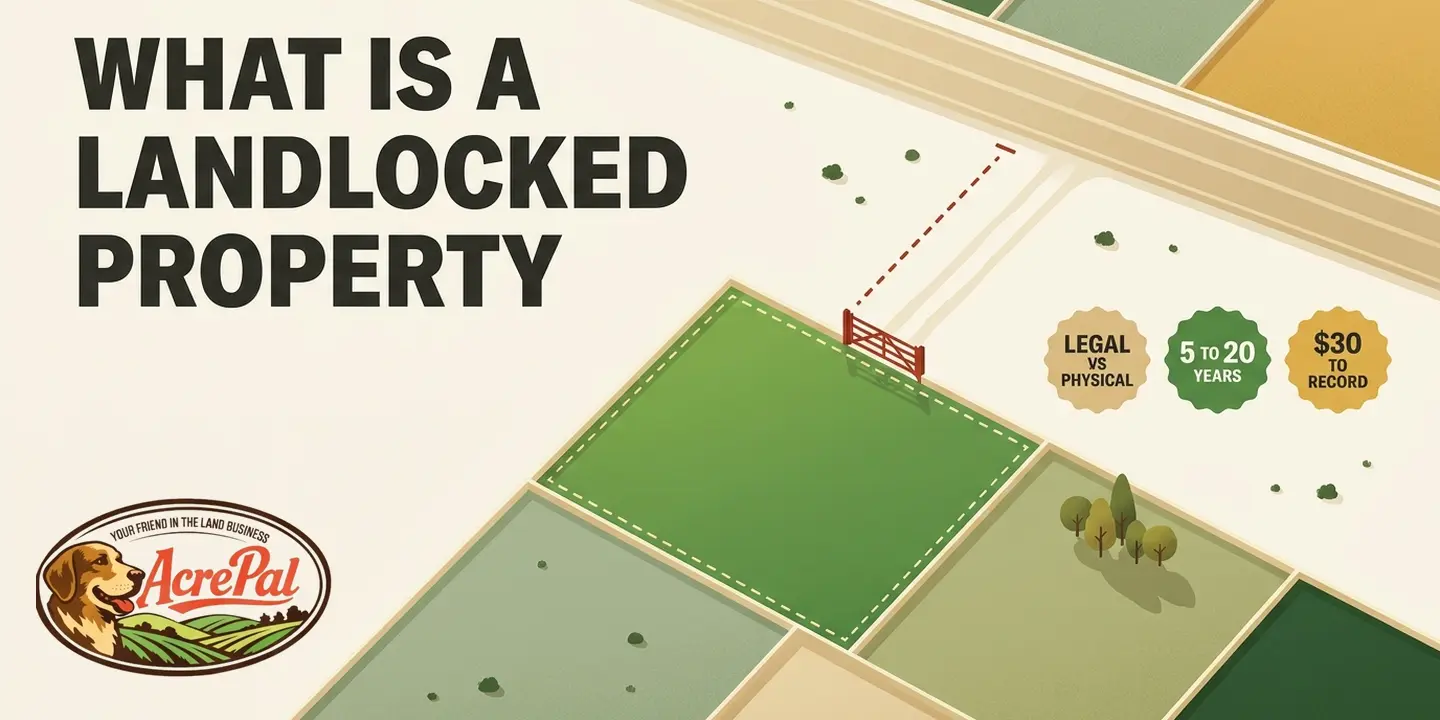
So what is a landlocked property? It is a parcel with no legal right of way to a public road. Not remote, not hard to reach, not sitting at the end of a rough two track. Nothing in the public record gives you the right to cross whatever sits between you and the nearest public road.
The buyers sued the seller and the real estate agent, alleging failure to disclose "critical limitations, specifically the lack of road access." Those are allegations, and the defendant's attorney denied all claims. What matters for you is not who wins, but that the paperwork deciding whether that lot was buildable sat in a county office the entire time.
Most writing on this subject explains the doctrine in the abstract and then tells you to call a lawyer. We pulled the statutes for the five states we sell land in and printed what they actually say, including where they say less than people assume. Below is what landlocked means, why a parcel ended up that way, which easements are genuinely available, how long each state's clock runs, what happens when your neighbor is the federal government, and how to check a parcel before you wire money.
What Landlocked Means and Why Legal Access Is Not Physical Access
A parcel you can drive to this afternoon can still be legally unreachable, and you cannot see the difference from the roadside. Satellite imagery will not show it, and neither will a dirt track running right up to the corner stake. The answer lives in recorded documents at the county and nowhere else.
Legal Access and Physical Access Are Two Different Questions
Legal access is a recorded right to cross, either frontage on a public road or an easement written into the record. Physical access is whether a truck can get there today. The two move independently, and a parcel is landlocked when the legal half is missing, no matter how easy the drive.
Three separate land investing creators lead their videos with this exact distinction, each with a real deal of their own. It is also the trap the Fort Lauderdale buyers fell into. There was a road. There was no right to use it.
| What you have | What it means |
|---|---|
| Legal yes, physical yes | A normal parcel. Frontage or a recorded easement, plus a road you can drive. |
| Legal yes, physical no | You hold the right on paper and nobody has built the road. That is a construction problem, not a legal one. |
| Legal no, physical yes | The dangerous combination. You drive in freely right up until the day a gate goes up. |
| Legal no, physical no | Landlocked, with a road bill stacked on top of the legal problem. |
Missing legal access is the classic rural deal killer, and it shows up the moment you start comparing what acreage is worth with access and without it.
An Easement Is an Interest in Land, Not a Document
You will read in places that an easement is a legal document. It is not. An easement is an interest in land, a right that attaches to the ground and travels with it. The recorded instrument is the paper that creates or evidences that right, which is not the same as the right itself.
That sounds academic until you look at how Arizona handles it. A.R.S. 12-1202 lets a landowner "condemn and take lands of another" for a private way of necessity. You cannot condemn a document. The statute treats access as property because access is property.
One rule follows, and most people have it backwards. Being landlocked does not by itself give you any right to cross a neighbor. You establish access affirmatively, through the record or through a court. Nothing about the shape of your parcel creates it for you.
Why a Parcel Became Landlocked Decides Which Easement You Can Get
The most famous remedy for a landlocked parcel is not available to many parcels that need it. What decides that is not how landlocked you are. It is one fact buried in the chain of title, and you can look it up before you make an offer.
How Parcels End Up With No Way In
Four stories cover nearly all of it.
A split sold off the wrong piece. Someone divided a larger tract, sold the road frontage, and kept the back half without writing an easement into the deed. Splitting a parcel is the moment access has to be created, and when it gets skipped there it stays missing.
The parcel was born landlocked. Old surveys and the wildcat splits that carved up the West in the 1960s and 1970s routinely produced interior lots with no access. Arizona has plenty of these, from years before the state required recorded public access on a split.
A road disappeared. A county vacated a right of way, or a road drawn on an old plat was never actually built.
The federal government drew the line first. Parcels patented out of the public domain a century ago were severed with no thought for driveways, and the ground around them stayed federal.
Easement by Necessity Turns on Common Ownership
Easement by necessity is the doctrine people mean when they say a court will let you out. The Colorado Lawyer, the Colorado Bar Association's journal, states the rule cleanly. "an easement may be implied by necessity where a parcel of land under common ownership is severed and the only reasonable means of accessing the severed property requires crossing the adjoining tract."
Common ownership first, then severance. A parcel that was landlocked from birth, never carved out of an accessible neighbor, gets nothing from this doctrine no matter how hemmed in it is.
Two popular claims die on that rule. The first is that courts will usually grant a landlocked owner an easement by necessity. They will not, because for a whole category of parcels the doctrine never applies.
The second is that necessity is the fix for a neighbor who refuses to grant access. A neighbor's attitude has nothing to do with it. Availability turns on severance history, not anyone's mood.
The same journal adds two refinements. "physical inability to reach the property benefited by the easement is not required," so total impossibility is not the test. Courts will also decline to imply necessity "if a property can be reached through reasonable alternative means of ingress and egress," so a second route, even an ugly one, can sink the claim. Courts differ on how absolute the necessity has to be.
Easement Implied From Prior Use Is a Separate Doctrine
A different doctrine sits beside necessity, and most write ups collapse the two. Easement implied from prior use looks at what was happening on the ground before the split. If a driveway, a track, or a drainage line was already in use and visibly obvious when the parcels separated, the argument is that both parties expected it to keep working that way.
Implied from prior use does not require the parcel to be landlocked at all, which is why it sometimes reaches situations necessity cannot. Both doctrines turn on the moment of severance, which is why the first documents to pull are the old deeds, not the newest one.
Prescriptive Easements and How Long the Clock Runs in Your State
Read three articles about prescriptive easements and you will collect three different answers. One says about 10 years. Another says 5 to 20. A third says 10 to 20.
Not one of them cites a statute, and we have run into the same disagreement between sources writing about other states.
Here are five states with the authority attached.
| State | Period | Authority |
|---|---|---|
| Nevada | 5 years | NRS 11.070 and NRS 11.150 |
| California | 5 years | Code of Civil Procedure 321 |
| Arizona | 10 years | A.R.S. 12-526 |
| Colorado | 18 years | C.R.S. 38-41-101, plus The Colorado Lawyer's reference to the "18-year prescriptive period" |
| Florida | 20 years | Downing v. Bird, 100 So. 2d 57 (Fla. 1958), as stated by The Florida Bar Journal |
Five real states, and the spread runs 5, 5, 10, 18, and 20. A Colorado buyer who reads that the answer is about 10 years on a Texas law firm's blog is off by eight years, which is most of a decade of somebody using a track across land that buyer may be about to own.
Be precise about what these numbers are. For Nevada, California, Arizona, and Colorado, the figure is that state's adverse possession limitation period, which prescriptive easement doctrine borrows. Colorado is the only one of those four where a published authority ties the number to easements by prescription specifically. Florida's 20 years comes from case law rather than from the adverse possession statute at all.
Prescription and adverse possession get conflated constantly, and The Florida Bar Journal is blunt about it. "Prescriptive easements are often erroneously referenced as easements arising by adverse possession, and, while many elements of prescriptive easements are akin to adverse possession claims, there are significant differences." Adverse possession takes the land. A prescriptive easement takes only a right to use it.
One more thing to sit with. A prescriptive claim is something you prove in court, not a status you quietly already hold, and the clock is the easy part of the proof. It runs the other direction too. If a two track crosses a parcel you are about to buy and somebody has been driving it for years, that is a claim pointed at you, which is a good reason to walk the ground and ask who uses what.
What the Statutes Actually Say in Arizona, Colorado, Nevada, California, and Florida
Arizona's private way of necessity statute spends its second half on driving cattle across a neighbor's range land. You only find that by opening the statute, and all five are worth opening.
Arizona Lets You Condemn a Way of Necessity
A.R.S. 12-1202(A) covers an owner whose land sits so that "it is necessary for its proper use and enjoyment to have and maintain a private way of necessity over, across, through, and on the premises" of a neighbor. That owner "may condemn and take lands of another" for the road. Private eminent domain against another private party surprises nearly everyone. It is real and statutory.
Condemnation means a court case and paying the neighbor, so it is a reason to hire a lawyer, not a way around one. A.R.S. 12-1203 makes violating 12-1202 a petty offense with damages owed to the injured person. More on that history in our Arizona land guide.
Colorado Names Private Ways of Necessity in Its Takings Statute
C.R.S. 38-1-102(3) provides that "private property may be taken for private use, for private ways of necessity, and for reservoirs, drains, flumes, or ditches on or across the lands of others for agricultural, mining, milling, domestic, or sanitary purposes." Private ways of necessity sit right beside the ditches and flumes. Treat the subsection number as a pointer, not an exact address, since the published text warns that the legislature occasionally skips outline levels.
Nevada Lists Byroads and Not Much Else
Nevada is the honest gap, as useful as the two positives above. NRS 37.010 lists the public uses for which eminent domain may be exercised, and subsection (1)(f) reads in full, "(f) Byroads. Byroads leading from highways to residences and farms." Nothing else in the section aims at private ways of necessity or landlocked access. We will not tell you Nevada has a statute like Florida's or Arizona's, because it does not appear to have one.
California Covers Utilities, Not Driveways
California ran the opposite way from what we expected. Civil Code 1001 lets any owner of real property "acquire by eminent domain an appurtenant easement to provide utility service to the owner's property," which reads like a clean private condemnation route. Then subsection (a) defines the term as a closed list. "'utility service' means water, gas, electric, drainage, sewer, or telephone service."
A driveway is not on that list, so the statute hands a California owner a condemnation route for a sewer line and, as written, not for a road. Common law necessity and implication still exist there, and that is where a California access claim starts.
Florida Has a Statutory Way of Necessity
Florida is the one state of the five with a statute built for this problem. Fla. Stat. 704.01(1) says the common law implied grant "is hereby recognized, specifically adopted, and clarified." More interesting is 704.01(2), a statutory way of necessity that does not depend on unity of title, so it reaches the parcel that was landlocked from birth and gets nothing under the common law.
Its limits are written into it. The statute covers land "being used or is desired to be used for a dwelling or dwellings or for agricultural or for timber raising or cutting or stockraising purposes," so a parcel held purely to resell later does not obviously fit. It is compensated, and Fla. Stat. 704.04 lets the court award attorney fees and costs for "unreasonable refusal to comply," which cuts both ways.
All of this is general information. Access turns on the specific parcel, the specific chain of title, and the specific state, and the only answer that counts comes from someone who has read your documents.
When the Land Around You Belongs to the Federal Government
In the interior West your neighbor is frequently not a person. Long stretches of Mohave, Elko, and Modoc counties sit against Forest Service or BLM ground, and when the land between your parcel and the nearest public road is federal, none of the private doctrines above describe your situation. There is a federal statute written for it. It says your access shall be provided, and the catch is in the same sentence.
The statute is 16 U.S.C. 3210, section 1323 of ANILCA. Subsection (a) covers non federal land inside the National Forest System, and subsection (b) covers non federal land surrounded by BLM managed public lands. The operative language in (a) is that the Secretary "shall provide such access to nonfederally owned land within the boundaries of the National Forest System as the Secretary deems adequate to secure to the owner the reasonable use and enjoyment thereof." Subsection (b) says the same thing about BLM land.
The catch is not small. The access is only what the Secretary "deems adequate," it comes "subject to such terms and conditions as the Secretary of Agriculture may prescribe," and it is conditioned on the owner following the agency's rules for getting in and out. That is agency discretion over route, width, season, and use. Shall provide is a long way from go ahead and drive.
BLM right of way applications also carry cost recovery processing fees, so treat it as an application, not a form. If a parcel touches federal ground, find out which agency manages the land around it before you buy, because that decides who you would even be asking. Checkerboard ownership makes this more common than it sounds, and a two track drawn on a map is not a right to drive it.
How to Check Legal Access on a Parcel Before You Wire Money
You can start today with a parcel number and a free county website, and most of it costs nothing. Run the steps in order, because each one tells you what to look for in the next.
- Read the legal description on the deed. Recorded instruments are indexed by book and page or by instrument number, and a legal description will often reference the recording number of an easement if one exists. A line naming a 30 foot road and utility easement at a specific book and page is exactly what you want.
- Pull the recorded plat or parcel map. Look for dedicated roads and platted rights of way serving the parcel. A plat that dedicates a road to the public is legal access. A plat showing a private road with no easement language is not.
- Search the recorder for the easement itself, then read the older deeds. Experienced land buyers work backward through the chain, because an easement named in a 1968 deed sometimes stops being repeated in later, sloppier ones. Pull the prior deeds, the old plats, and any surveys on file.
- Order a title commitment and read Schedule B. Schedule B is where an access problem shows up as an exception, and the policy's covered risks are expressly subject to those exceptions. Ask the title company what establishes access on this parcel. Our deed versus title breakdown covers the fundamentals if that distinction is fuzzy.
- Confirm the route connects all the way through. Trace the access from the parcel to a public road and ask the county which agency, if any, maintains it. County GIS is the right tool to start with and the wrong one to finish with, since a parcel viewer is not a survey and does not establish boundaries or legal access.
- Get the permitting answer in writing. Ask the county or city building department whether a permit can be issued for this specific parcel, and ask for the reply by email. The Fort Lauderdale zoning department's written line that the city "requires access to a public right of way" turned a vague worry into a documented problem, and a written answer does the same job for you.
- If the parcel touches federal ground, identify the agency. Forest Service and BLM are separate applications under the statute above. Find out which one you would be dealing with before you commit.
A disclosure, since we sell rural land ourselves. AcrePal sells parcels in these same states, and you should run this check on ours exactly the way you would run it on anyone else's. A seller telling you access is fine is not access. The recorded documents are.
What Title Insurance Covers About Access and What It Does Not
The clause your title policy uses to protect your access is nine words long. You can read it in three seconds, and most buyers never do. What those nine words leave out is the entire rural land problem.
What the Standard Policy Says About Access
From the ALTA Owner's Policy of Title Insurance, 2021 v. 01.00, Covered Risk 4, complete and verbatim.
"4. No right of access to and from the Land."
That is the whole provision. It does insure a legal right of access, which is more credit than most of the internet gives it. What it does not do is say where the access runs, whether you can physically drive it, whether it reaches any particular road, or whether it is adequate for what you plan to build. A right of access down a wash no truck can climb still satisfies Covered Risk 4.
The covered risks are introduced by language making all of them "SUBJECT TO THE EXCLUSIONS FROM COVERAGE, THE EXCEPTIONS FROM COVERAGE CONTAINED IN SCHEDULE B, AND THE CONDITIONS." An access exception listed in Schedule B carves that protection back out, which is why step four above says read Schedule B and not skim it.
What the Access Endorsement Adds
Set those nine words next to ALTA Endorsement 17-06, Access and Entry, adopted 6-17-06.
"The Company insures against loss or damage sustained by the Insured if, at Date of Policy (i) the Land does not abut and have both actual vehicular and pedestrian access to and from [insert name of street, road, or highway] (the "Street"), (ii) the Street is not physically open and publicly maintained, or (iii) the Insured has no right to use existing curb cuts or entries along that portion of the Street abutting the Land."
The endorsement names an actual street. It insures that your land touches that street, that you have real vehicular and pedestrian access to it, and that the street is open and publicly maintained. Put the two texts side by side and the gap explains itself. Ask your title company what is available for your parcel and what it costs.
How to Get an Easement for a Landlocked Property in Writing
Thirty dollars records the easement. In Mohave County, our largest market, the recorder's published fee schedule effective July 1, 2019 says "ALL DOCUMENTS, UNLESS OTHERWISE SPECIFIED $30.00." Everything expensive happens before that line item.
Most owners who fix a landlocked parcel negotiate with a neighbor and record the agreement, and that route needs no court. The statutory and condemnation routes above exist for when negotiation fails, and they are slower and compensated. Start with the conversation.
What the document has to settle is not guesswork. A legislature already wrote the list. Fla. Stat. 704.04 directs a court to "determine all questions, including the type, duration, extent, and location of the easement, the amount of compensation ..."
Use it as your checklist even outside Florida, then add the terms rural land needs settled in the same instrument, the width of the corridor, whether utilities can run inside it, who maintains the road, and whether the right binds future owners. Put those last two to the attorney drafting it, and know that road maintenance arrangements carry their own complications with lenders.
Then record it. A handshake with a friendly neighbor is worth nothing the day either parcel changes hands, and recording access at the moment of a split is the step most often skipped.
Budget for a boundary survey, since the easement needs a legal description. Roughly $500 to $2,000 is a typical rural range, not a quoted price. ContractsCounsel puts legal fees for a simple easement agreement at roughly $2,000 to $5,000. Then thirty dollars to record it in Mohave County.
Legal access is the one thing you cannot fix after closing on your own terms. The morning after you sign, the neighbor holds every card. Settle it before the money moves, in writing and recorded, and price the fix into your offer instead of hoping for it later.
Frequently Asked Questions About Landlocked Property
What is a landlocked property?
A landlocked property is a parcel with no legal right of way to a public road. Physical access does not cure it. If you can drive to the land today across a neighbor's ground with nothing recorded giving you that right, the parcel is still landlocked and the drive ends whenever the neighbor decides it does.
Does a landlocked owner automatically have the right to cross a neighbor's land?
No. Being landlocked creates no right by itself, and access has to be established affirmatively through the record, an agreement, or a court. The Colorado Lawyer and Cornell's Legal Information Institute state the same rule, that an implied easement by necessity depends on the parcels once having been under common ownership.
How do you get access to a landlocked property?
Four routes. Negotiate an easement with a neighbor and record it. Claim an easement by necessity if the parcels were once under common ownership and later severed. Use a state statutory or condemnation route where one exists, as Arizona and Florida have. Apply to the managing agency where the surrounding land is federal.
How long does a prescriptive easement take?
It depends entirely on the state, and the spread is wider than most sources admit. Nevada and California run 5 years, Arizona 10, Colorado 18, and Florida 20. See the table above for the authority behind each number, and remember that a prescriptive claim is something you prove rather than something you hold.
Does title insurance cover lack of legal access?
A standard ALTA owner's policy insures the right of access in nine words, Covered Risk 4, "No right of access to and from the Land." What it does not do is promise a usable road or name a particular street, and Schedule B exceptions can carve it back out. Endorsement 17-06 is the form that names a street.
Does a seller have to disclose that a property is landlocked?
Lack of legal access is the kind of material fact that leads to non disclosure lawsuits, and the Fort Lauderdale buyers made exactly that claim against their seller and agent. The defense denied all claims. Disclosure rules vary by state, so verify access yourself rather than relying on them.