You are scrolling land listings. Most of them say cash only. Then one says owner will carry, or just "OWC," and you have no idea whether that is an opening or a warning.
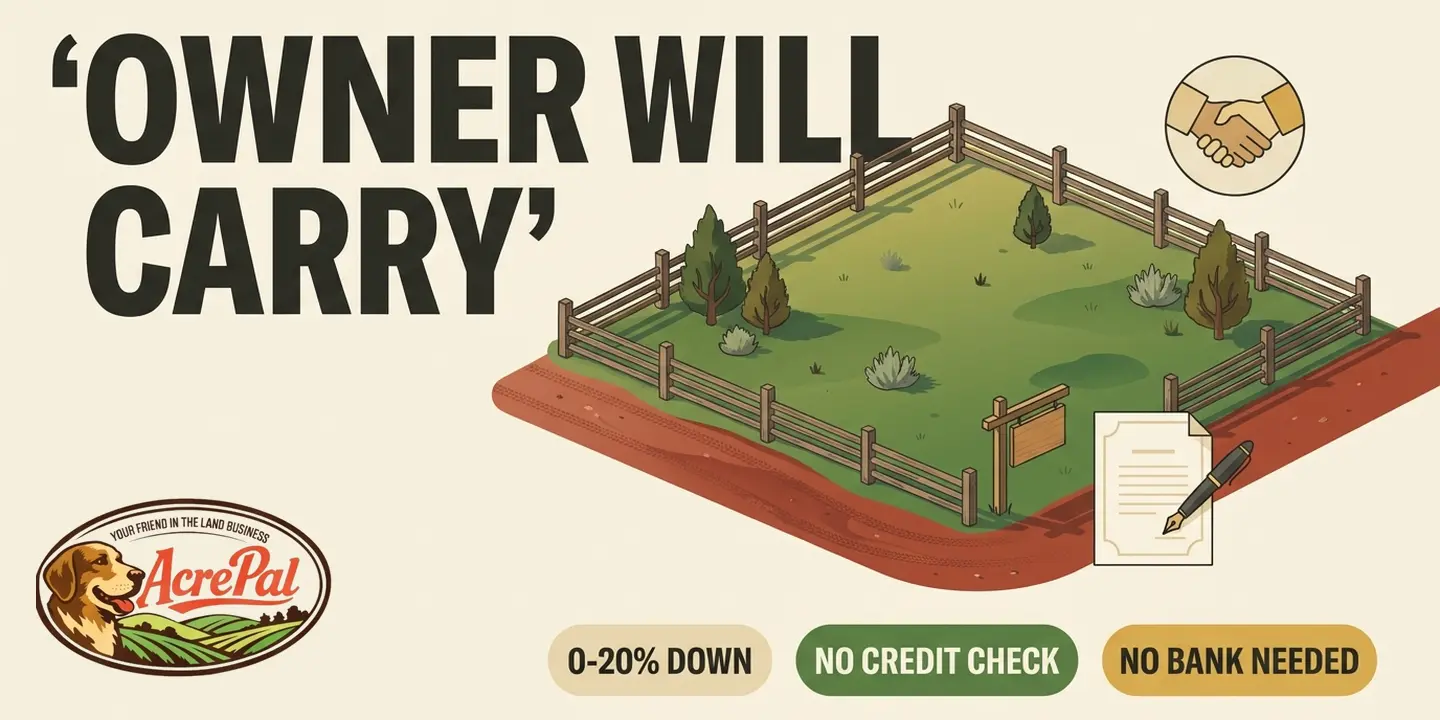
It means the seller is acting as the lender. You put money down, then pay the seller directly every month, with interest, until the balance is gone. No bank, no mortgage application.
That phrase does more work on vacant land listings than on any other kind of property, and there is a specific reason almost nobody explains. Banks are slow and reluctant to finance raw land, and when they do, they often want a 700-plus credit score and 30 to 50 percent down, which prices most regular buyers out before they start.
What follows is the deal in dollars, the two very different ways it can be papered, and the short list of things to verify before you send anyone money.
What Does Owner Will Carry Mean?
What does owner will carry mean? It means the seller finances the purchase themselves instead of sending you to a bank. You agree on a price, put down a down payment, sign a promissory note, and then pay the seller monthly, usually with interest, until the balance is cleared. There is no lender application, no underwriting committee, and on most land deals no credit check.
The seller sets the terms, you negotiate them directly, and the whole thing is papered between the two of you. Land educator Matt at MS Partners LLC pitches it to sellers as the moment "you become the bank." Note investor Eric Shuraga puts it the same way, that "seller financing just means that you act as the lender."
The wording changes from listing to listing, but the deal does not.
- OWC, the standard listing abbreviation for owner will carry
- Owner carry and owner carryback
- Seller carry-back and seller will carry
- Owner financing and seller financing
- Owner terms
Watch the word "carryback," though. It sometimes signals the seller is carrying only part of the price behind an existing first loan rather than the whole thing, which changes your position completely. Ask which one you are looking at before you get attached to the numbers.
Owner will carry is not rent-to-own, and it is not a lease option. In both of those you are a tenant with a right to buy later, and you do not own anything yet. Under an owner carry deal you are the buyer from day one, holding an ownership interest a tenant never gets.
It is also not a loan the seller arranges for you through an outside lender. The seller is the lender.
Set it next to a bank land loan and the differences are easy to see. The seller underwrites you instead of a loan officer. The seller holds the note instead of a bank. And your payment goes to the person who sold you the land, not to a servicing department three states away.
Why Owner Will Carry Shows Up on So Many Land Listings
Most people assume a land loan works roughly like a mortgage. It does not. In one land-financing breakdown, The General Family lays out what banks actually ask for on raw land, meaning no utilities and no road access. A 700-plus credit score, 30 to 50 percent down, a 10 to 15 year term, and an interest rate between 7 and 12 percent.
Step up one tier to unimproved land, where there is some road access or utilities nearby, and the bar softens a little. Credit in the 680 to 720 range, 25 to 40 percent down, terms of 10 to 20 years, and rates of 6 to 10 percent, often with a survey showing utility access and a zoning check on top. Per that same breakdown, banks see land as riskier than a house "because it's harder to sell if someone defaults on the loan."
Even a lender that specializes in land keeps a floor under it. AgSouth Farm Credit says it typically requires "a minimum of 15% down," and that is on the friendly end of the market.
Eric Shuraga, a note investor who says he has purchased more than 150 land notes, puts the cause and effect plainly. Land is well suited to seller financing precisely because banks are unwilling and slow to finance it. The owner carry market on land is a consequence of the banking gap, not a convenience somebody invented for buyers.
You can watch it play out across the whole price range. Land listed in the past year includes 5.02 acres in Ramah, New Mexico marketed with no-credit-check owner financing, 10 acres in California City, California at $15,000 with owner financing available and $72 a year in property taxes, and 32.2 acres in Dudley, North Carolina at $170,000 offered as either cash or owner financed. A $15,000 parcel and a $170,000 tract, same tool.
We carry paper on the land we sell for the same reason, because financing it ourselves is usually the only way a parcel reaches a working buyer instead of sitting for two years waiting on somebody with cash.
None of this makes owner will carry a warning sign on a land listing. It is the normal way land changes hands in a category banks mostly decline to serve.
How an Owner Carry Land Deal Actually Works, Step by Step
One land seller, Vibrant Vistas, walks buyers through the whole process in five steps.
- Tell the seller which price you want. Most owner will carry listings have two prices, a cash price and a financed price, and the cash price is usually discounted. Say which one you are after before anything else happens.
- Agree on the down payment. Listings quote a minimum, but you can almost always put down more, and every extra dollar cuts the principal you pay interest on.
- Pay the down payment and any doc fee. The seller sends a secure payment link, and the down payment plus the fee typically go through as a single transaction.
- Review and sign the closing documents. In this seller's process there are three, a purchase agreement, a promissory note spelling out the financing terms, and one more supporting financing document.
- Make the monthly payments until the balance is clear. Full title transfers when the last payment lands.
Numbers make it real. MS Partners LLC uses a $20,000 parcel as its worked example. Five thousand down leaves $15,000 financed, and the buyer pays roughly $400 a month for several years, usually with interest folded into that payment.
At $400 a month, $15,000 of principal by itself runs a little over three years, and the interest stretches it out from there. You take possession up front while the seller holds the note.
Then budget for the doc fee. Vibrant Vistas charges a flat $249 on every transaction, collected together with the down payment before any contracts get generated. Doc fees are not universal. Some owner finance companies charge them, some do not, and the amount varies, so ask what the fee is and whether there are others before you agree to terms.
The promissory note is the document that decides what your next few years look like. It should state the amount financed, the interest rate, the payment amount and due date, the length of the term, and exactly what counts as a default. If any of those five items is missing or fuzzy, that is a conversation to have before you sign, not after.
Ask to see all three documents in full before you send anyone money, doc fee included.
Typical Owner Carry Terms, From Down Payment to Balloon
The word most likely to cost you the parcel is the one you will skim right past. Balloon. The payment looks manageable for years, and then on one specific date the entire remaining balance comes due at once.
Owner will carry listings commonly advertise 0 to 20 percent down, with 5 to 20 percent the usual ask. Hold that next to the 30 to 50 percent a bank wants on raw land and the appeal is obvious. On rates, the land lender Serious Land Capital publishes a clear range, stating that "Seller financing rates vary widely based on negotiation and market conditions, typically ranging from 4-10%." Terms commonly run three to ten years, short next to a 30 year mortgage but close to bank land loans, which the same source puts at "most ranging from 5-15 years instead of 30 years."
So are owner carry rates higher or lower than a bank's? Higher, usually. These rates are negotiated rather than posted, published ranges sit roughly between 4 and 10 percent, and many carries price above what a comparable bank loan would cost.
The creator behind 7 Kin Homestead calls high interest the downside a lot of people do not talk about. A handful of land companies run 0 percent programs, so it is always worth asking. You are buying access and speed here, not a better price.
Balloons are where the math turns on you. Plenty of deals set the monthly payment on a 20 or 30 year amortization schedule while the full remaining balance comes due at year three, five, or seven. Take a $40,000 balance amortized over 30 years at 9 percent. The payment is about $322 a month.
Five years in you have paid roughly $19,300, the balance is still just over $38,000, and on balloon day that entire amount is due at once. Refinancing out of a raw land balloon means walking straight back to the same banks that want a 700-plus score and 30 to 50 percent down.
If the down payment is the part blocking you, we cover low and no money down approaches in our guide to buying land with no money.
Best for buyers who can clear the balance or refinance well before a balloon date. Skip it if the only way the deal works is hoping a bank says yes in year five.
The Two Ways an Owner Carry Deal Can Be Structured
Two owner will carry land listings, same wording, same terms. One hands you the deed on closing day. The other hands you nothing for five years. The listing will not tell you which one you are looking at.
Structure A. A promissory note plus a mortgage or deed of trust. You get the deed at closing, recorded in your name at the county. The seller records a lien against the property, exactly the way a bank would.
If you stop paying, the seller has to go through your state's foreclosure process to take it back. It behaves most like a normal mortgage, and on land it is generally the structure to prefer.
Structure B. An executory contract. The seller keeps legal title until your final payment. You hold equitable title in the meantime, which means the right to use and possess the parcel, but the deed stays with the seller. The name changes by state, not the structure.
Scott Horne of Owner Finance Network notes that Texas calls it a contract for deed, Arizona an agreement for sale, and other states a land contract, all the same underlying instrument. Tim Collins, a licensed real estate professional, calls the split between legal and equitable title the most important mechanic to understand, because your protection rests on the contract terms and the seller's trustworthiness rather than on any third party.
If the difference between a deed and a title is still fuzzy, we break both down in our guide to deed vs title.
The difference only shows up when something goes wrong, and then it decides everything. Structure A routes a default through a legal process built to be predictable, with notice, defined steps, and usually a chance to cure. Structure B can route it through forfeiture instead.
The National Consumer Law Center, in its 2021 summary of state land contract statutes, writes that "When forfeiture is allowed without restriction, a buyer that defaults can lose everything and be evicted like a tenant." That report covers home sales, and the same forfeiture mechanic can apply to bare land.
Miss a payment under Structure A and you are in a foreclosure with a clock and a way out. Miss one under Structure B and you can lose the parcel and everything you paid into it.
Is Owner Carry Land Safe? What to Check Before You Sign
In a bank-financed purchase, an underwriter, an appraiser, and a title company all review the deal before anyone signs. In an owner will carry land deal, none of them are in the room.
Some of that is by design. The federal loan originator rules that came out of Dodd-Frank live in Regulation Z, and 12 CFR 1026.36(b) states that "Paragraphs (d) through (i) of this section apply to closed-end consumer credit transactions secured by a dwelling." Reg Z defines a dwelling as "a residential structure that contains one to four units, whether or not that structure is attached to real property."
A bare parcel with nothing built on it is not a dwelling. Sellers financing houses rely on the one-property and three-property exclusions at 1026.36(a)(4) and (a)(5) to stay outside the loan originator definition. A seller carrying financing on raw land is generally outside that framework to begin with.
That carve-out comes with caveats. State law still governs the deal, and several states regulate these contracts directly. If the parcel has a residence on it, including a mobile home used as a residence, different rules can apply. And this is an explanation, not legal advice, so have a real estate attorney review your deal.
Nobody is vetting this purchase for you, so run this list yourself.
- Confirm which structure you are signing. Deed at closing with a lien, or deed after the last payment. It sets your entire downside.
- Verify the seller owns the parcel free and clear. If they still have a loan on the land, find out exactly what happens to your position if they stop paying it.
- Get every term in writing. Tim Collins puts this near the top of his own list, and a seller who will not put the agreement on paper is disqualified.
- Check comparable land prices. Pricing far above nearby parcels is a red flag, and easy financing hides a bad price.
- Have a real estate attorney review the contract. A few hundred dollars is cheap against a multi-year obligation.
- Find out whether your state requires the contract to be recorded, then record it. Nevada makes it an unfair or deceptive practice for a seller to fail to record within 30 calendar days of accepting the buyer's first payment, and Texas requires recording within 30 days, backed by $500 a year in liquidated damages.
One scam deserves naming. The National Consumer Law Center describes sellers who "plan to churn the property through multiple would-be homeowners" and who avoid recording the contract so they can "more easily remove the buyer after a default and get a new person into the home with another down payment." The deed never moves.
Three things are non-negotiable. A written contract, verified free and clear ownership, and an attorney review before any money moves.
Owner Will Carry FAQs
Is owner carry the same as seller financing?
Yes. Owner carry, owner will carry, seller financing, owner financing, and carryback all describe the same arrangement, where the seller lends you the purchase price instead of a bank. The label changes by region and by whoever wrote the listing. The deal underneath does not.
Do I need a credit check or a big down payment for an owner carry loan?
Usually no credit check, and down payments on owner financed land are commonly advertised between 0 and 20 percent, against the 30 to 50 percent banks often want on raw land. Easier to qualify for is not the same as easier to pay. If income or savings problems blocked a bank loan, they follow you into an owner carry loan.
Who pays the property taxes on owner financed land?
Usually the buyer. Sometimes you pay the county directly, sometimes you reimburse or escrow with the seller. Your contract states which one applies, so read that clause before you sign.
Can I pay off an owner carry loan early?
Usually yes, and no prepayment penalty is one of the most commonly advertised selling points in owner financed land. The 7 Kin Homestead creator paid off an owner financed parcel in about half the scheduled time and cut total interest sharply while keeping the low required payment available for tight months. Confirm it in the promissory note rather than assuming.
What happens if the seller dies before I finish paying?
Your contract does not disappear. The note is an asset of the seller's estate, and payments generally continue to the estate or whoever inherits it, with the obligation to deliver the deed passing along too. This is exactly why a written, recorded instrument matters. Verify the contract is recorded, per the checklist above.
Where can I find owner carry land for sale?
Search "owner finance land in [your state]," then work the marketplaces that specialize in owner financed parcels, comparing down payment, doc fee, monthly payment, and interest rate property by property. Ask about doc fees before you commit. We sell owner financed rural land at AcrePal in Mohave and Apache County, Arizona, Costilla County, Colorado, Elko County, Nevada, Modoc County, California, and Putnam County, Florida.