
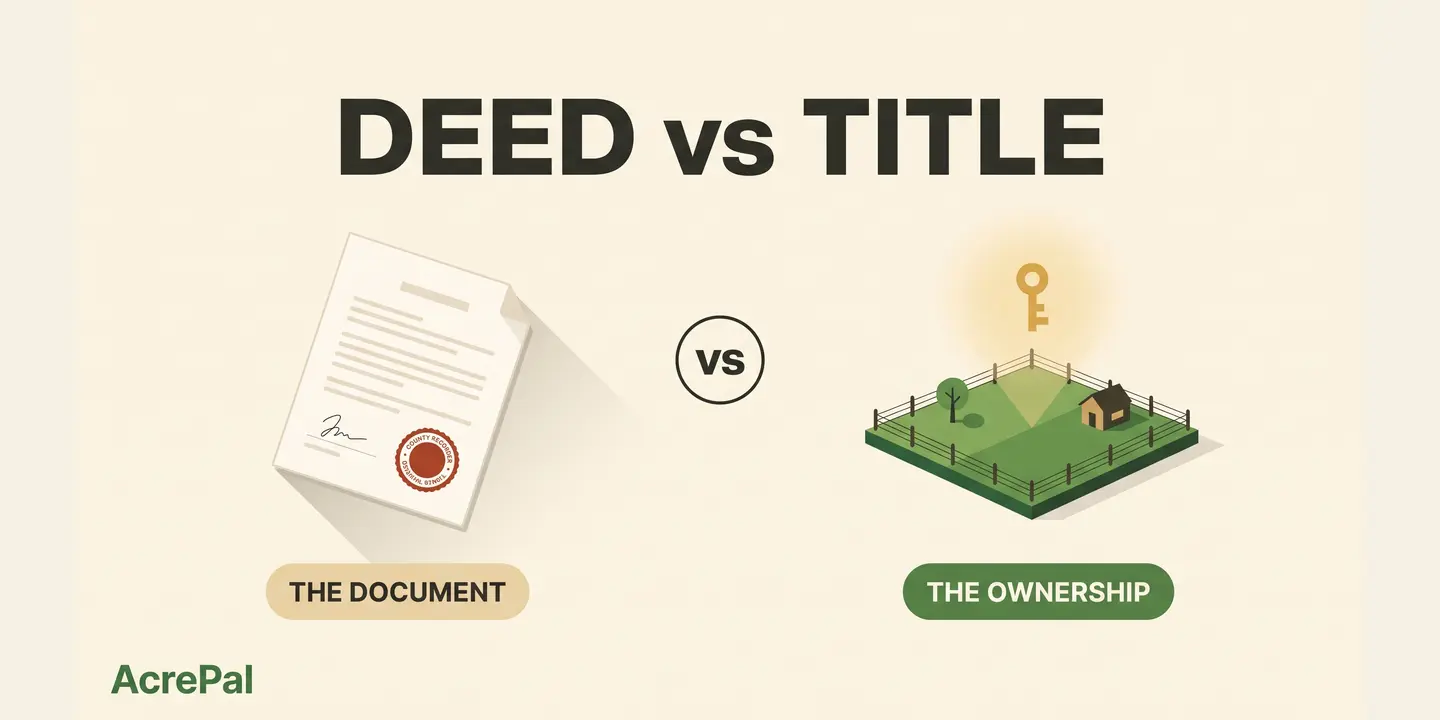
A deed vs title question almost always comes down to one clean distinction. A deed is the signed, notarized, and recorded document that transfers ownership of property from the seller to you. A title is the legal ownership itself, the bundle of rights you hold once that deed is recorded. People use the two words as if they mean the same thing, and they do not.
Most guides explain this around buying a house with a bank mortgage. We sell rural land, so we walk through it the way it plays out when you buy vacant or owner-financed land, where who holds the deed and title during payoff is the whole ballgame. We cover deed types, title insurance on a cheap parcel, the two owner-financing models, how to hold title, and how to confirm the seller really owns it. This is general information, not legal advice, and specifics vary by state.
The Quick Answer Plus a Deed vs Title Comparison
The deed is the physical, signed, recorded document that transfers ownership. The title is the legal concept of ownership itself, the bundle of rights you get once that deed is in your name. A simple way to remember it is the book analogy. A book is a physical object you can hold, like a deed, and every book carries a title, but you cannot hand someone the title separately from the book. Said another way, the title is the right and the deed is the paper.
What it is. A deed is a physical legal document, while a title is a legal concept, the bundle of rights.
What it proves. A deed proves ownership was transferred, while a title proves you are the owner.
Form. A deed is paper you can hold and record, while a title is intangible legal status.
When you get it. You get the deed when a valid deed is signed and recorded in your name, and you hold the title from the moment that deed is recorded.
One without the other. You can hold a deed and still not have clear title if defects exist, but you hold title because a valid deed conveyed it.

So do you need both? Yes, and they work together. The deed is how you get the title. Owning the title means you hold five rights, the right of possession, the right of control, the right of exclusion, the right of disposition, and the right of enjoyment.
What Is a Deed and Which Deed Type a Land Buyer Should Want
A deed is only valid when it has the basics, the names of the grantor (seller) and grantee (buyer), a legal description of the property, the grantor's signature, notarization or witnessing, and recording at the county recorder. That office goes by different names depending on where the land sits, including register of deeds, county clerk, or land records office. And losing the paper deed is not the same as losing the land. The recorded original stays in county records permanently, unlike a car title.
The type of deed decides how protected you are. A general warranty deed gives the most protection, because the seller warrants the title for all time, including periods before they owned it, and you get legal recourse if a defect surfaces. A special or limited warranty deed only warrants the seller's ownership period, which is common in commercial deals and weaker for land with a long history. A quitclaim deed carries zero warranties, fine for clean family transfers but a red flag from a stranger selling cheap land, because it often means the seller will not stand behind the title.

By state you may also see bargain-and-sale or grant deeds. Keep in mind that a deed of trust and a mortgage are not ownership deeds at all, they are security instruments, liens that secure a loan.
Always ask for a general warranty deed first. Accept a special warranty deed only with a clean title search, and treat a stranger's quitclaim as a reason to slow down.
One buyer took a quitclaim deed and later learned the seller owned just 50% of the parcel, which left them co-owning with a sibling they had never met. Insist on a general warranty deed and a title search regardless of price.
What Is a Title, Clear vs Clouded Title, and Title Insurance for Land
Title is the legal status of your ownership, and it comes in two flavors, clear and clouded. A cloud on title is any lien, claim, encumbrance, or irregularity that blocks a clean sale, such as unpaid property taxes, judgment liens, undisclosed mortgages, competing heirs, forged or misfiled deeds, boundary errors, or easements. A serious cloud can require a quiet title lawsuit to clear.
This is where buyers get burned. A deed does not equal clear title. In one real case a buyer held a valid deed, but a lien recorded under a slightly misspelled name slipped past the search and cost thousands to fix years later.
A title search is how you find these problems. It is an examination of public records that produces an abstract of title, done by a title company or attorney, and it typically runs about $75 to $300.

Title insurance is the next layer, and it matters just as much on raw land as on a house. The same forged documents, survey errors, unpaid taxes, and unknown heirs can hit a vacant parcel. It is a one-time, backward-looking premium priced on a sliding scale around $2.65 to $2.95 per $1,000, so a $15,000 parcel runs roughly $100 to $150 and a $50,000 parcel roughly $200 to $350. An owner's policy protects you, while a lender's policy protects a lender.
Is it worth it on a cheap parcel? Usually yes. On a $15,000 lot, title insurance around $100 to $150 plus a $59 current-owner search keeps you under about $200 to protect a purchase you cannot easily undo.
If the premium feels steep, cheaper alternatives include that current-owner or chain-of-title pull (about $59), an attorney title opinion, or a free DIY county recorder search by APN. One caveat, tax-deed parcels usually need a quiet title action before an insurer will write a policy.
Deed and Title Under Owner Financing for Land
Under owner financing, the deciding question is who holds the deed and legal title during the payoff period. There are two very different models, and which one you get changes your risk completely. Get this clear in writing before you sign anything.
Model A is the deed-and-note structure, sometimes called note plus mortgage or note plus deed of trust. The seller conveys legal title at closing with a recorded warranty deed, and you simultaneously sign a promissory note and a deed of trust or mortgage that serves as the seller's lien. You own the land legally from day one, you can sell or refinance, and if you default the seller has to foreclose through a formal process with cure rights and equity protection. This is the safer model, and it is structurally a bank mortgage with the seller acting as the lender.
Model B is the contract for deed, where the seller keeps legal title until your final payment and you hold only equitable title until then. It is common on cheap rural land and carries very different, and bigger, risks than the deed-and-note model.

Whichever model you are offered, get the structure in writing before you sign and confirm the seller is the recorded owner. For context, we sell owner-financed rural land in Mohave and Apache County Arizona, Costilla County Colorado, Elko County Nevada, Modoc County California, and Putnam County Florida, and these are exactly the questions a land buyer should be asking any seller.
What Is a Contract for Deed (Land Sale Contract)
A contract for deed is a private installment sale where you pay the seller directly over time and the seller keeps the legal title until your last payment. It goes by several names, including land contract, land sale contract, installment land contract, bond for deed, and agreement for deed. They all describe the same setup, you get possession and equitable title now, and the recorded deed only comes at payoff.
Buyers use it because the barrier is low. There is no bank, no credit check, a small down payment, and a fast closing, which is why it shows up so often on inexpensive rural parcels. That access is real, but the risk is heavier than most buyers expect.
The biggest danger is forfeiture. In many states, if you fall behind the seller can cancel the contract, keep every dollar you have paid, and have you removed within weeks. There is no foreclosure, and you do not get your equity back. Other common traps include balloon payments that come due years before the loan is paid off (about 14 percent of land contracts per Pew), the contract never getting recorded (only around 13 states require it) so you cannot prove your interest, owing property taxes while someone else holds title, and a seller whose own mortgage carries a due-on-sale clause the deal can trigger.
Protections vary by state. Some states now treat a contract for deed like a mortgage once you have paid in enough, which forces the seller to foreclose instead of simply evicting you. To protect yourself, record the contract at the county the day you sign, confirm the seller owns the land free and clear, watch for balloons, use an escrow or loan servicing company, and have an attorney review the paperwork. When you can, a deed-and-note structure where you receive the deed at closing is the safer way to buy on payments.
How to Hold Title and Why Vesting Matters for Land
Once a valid deed is recorded, how you are vested on title carries real probate, tax, and liability consequences. Sole ownership is the simplest, but the land goes through probate at death and gives you no liability shield. Joint tenancy with right of survivorship avoids probate because the surviving owner inherits automatically, though it requires equal shares and exposes the property to a co-owner's creditors or divorce. Tenancy in common allows flexible unequal shares for partners and investors, but each share passes to that owner's heirs through probate.
Married couples have better options in many states. Community property and community property with right of survivorship (in community property states such as Arizona, California, Nevada, Texas, and Washington) can avoid probate and deliver a full double step-up in basis, the best tax outcome. Tenancy by the entirety adds married-couple protection where it is available.
For investors, an LLC separates personal assets from the property, adds privacy, and suits someone holding multiple parcels, though it brings annual fees and a possible due-on-sale trigger. A revocable living trust avoids probate, adds privacy and continuity, and can even own an LLC, but on its own it gives no liability protection.

Tenancy in common is often called a bad default, because a deceased co-owner's share lands in probate instead of passing to the survivors. Community property cuts the other way on taxes. Buy land for $25,000, watch it grow to $100,000, and a surviving spouse under community property with right of survivorship can sell with essentially zero capital gains.
Match the vesting to your situation, a single buyer with a trust, a married couple with community property or a trust, partners with tenancy in common or an LLC, and a multi-parcel investor with an LLC per parcel or portfolio. As always, the specifics vary by state.
How to Verify the Seller Owns the Land and Get the Deed
You can confirm who legally owns a parcel in about 10 minutes, for free, in most counties. Start by getting the APN (Assessor Parcel Number) and legal description from the seller. Then go to the county assessor or recorder portal for that county, keeping in mind the office may be called the recorder, county clerk, register of deeds, or land records office. Search by APN, address, or owner name.
Next, confirm the seller's name matches the grantee on the most recently recorded deed. If the owner shows up as an LLC, a trust, an estate, or a different name, get documentation before you go further. Check for recorded mortgages, liens, judgments, or tax delinquencies, then pull or download the actual deed and verify the grantor signature, notarization, legal description, and recording stamp (the book and page or instrument number). For a fuller history, trace the chain backward using the recording references, or order a current-owner search (about $59) or an attorney chain-of-title pull on a cheap parcel.

One hard rule. If the seller is not the recorded grantee, or anything looks off, do not wire money until it is fully explained. If you are still sizing up the parcel itself, it helps to know how big 10 acres really is and to budget for basics like the cost of digging a well before you commit.
The Bottom Line on Deed vs Title
The deed is the document that transfers ownership, and the title is the ownership itself, so a deed is only as good as the title behind it. For land, the decisive questions are which deed type you receive (you want a general warranty deed), whether owner financing hands you the deed at closing or only at payoff, and whether you verified the seller is the recorded owner before sending a dollar.
Deed vs Title FAQ
What is the difference between a deed and a title?
The deed is the physical, signed, notarized document that transfers ownership from seller to buyer and gets recorded at the county. The title is the legal concept of ownership, the bundle of rights you hold once that deed is recorded. Think of a book. The book is the deed you can hold, and the title is the ownership it represents, which you cannot hand over separately.
Is a title deed the same as a deed?
Title deed is informal shorthand that blends the two ideas. In practice it usually means the deed that conveys title, such as a warranty deed or quitclaim deed. Technically a title is not a deed and a deed is not a title, but in everyday speech people say title deed to mean the recorded document that proves they own the property. The recorded deed is what you are referring to.
What deed should I get when buying rural land?
Ask for a general warranty deed. It gives the most protection, because the seller warrants the title against defects for the entire history of the property, not just their own ownership period, so you have legal recourse if a problem surfaces. If a stranger offers only a quitclaim deed, treat it as a red flag, since it means zero guarantees about title quality. Pair any deed with a title search.
Do I need title insurance on vacant land?
Yes. The same risks that hit a house can hit raw land, including unpaid liens, forged or misfiled deeds, survey errors, competing heirs, and undisclosed easements. Title insurance is a one-time premium covering problems that existed before closing but were unknown. On a cheap parcel the cost is small, often around $65 to $150, and at a minimum you should run a $59 current-owner search first.
What is a contract for deed and is it the same as owner financing?
A contract for deed is one type of owner financing, also called a land contract or bond for deed. The seller keeps legal title until your final payment, and you hold only equitable title and possession until then. The other common type, the deed-and-note, gives you a recorded deed at closing and secures the balance with a lien. They are not the same, since one delays your legal title and the other does not.
What does clouded title mean?
A cloud on title is any lien, claim, encumbrance, or irregularity that casts doubt on clear ownership or blocks a sale. Common clouds include unpaid property taxes, judgment liens, undisclosed mortgages, competing heirs, forged prior deeds, boundary disputes, and easements. A title search finds them. Clearing one may mean paying off a lien, negotiating with a claimant, or filing a quiet title lawsuit. Land that has changed hands often is more prone to clouds.
How do I find out who owns a piece of land before I buy it?
Get the APN from the seller, then go to the county assessor or recorder website for that county. Search by APN, address, or owner name, and confirm the seller matches the grantee on the most recently recorded deed. Check for recorded liens, mortgages, or tax delinquencies while you are there. Most county portals are free, and a service like EasyTitleSearch offers a nationwide current-owner search for about $59.
How should I hold title, sole, joint tenancy, or LLC?
It depends on your situation. A single buyer with one parcel can use sole ownership plus a living trust to skip probate. A married couple in a community property state often does best with community property with right of survivorship, which avoids probate and gives the strongest tax outcome. Partners can use tenancy in common or an LLC, and a multi-parcel investor usually wants an LLC for liability protection.