
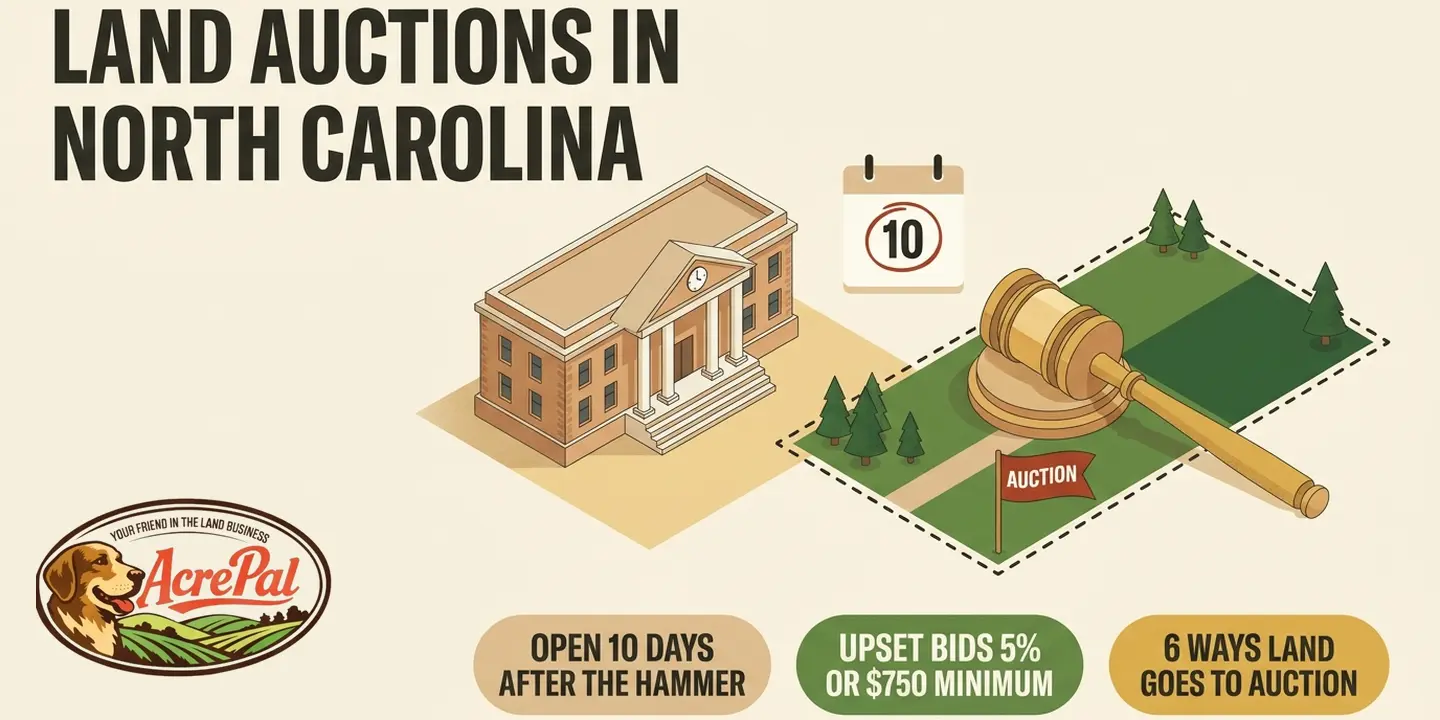
If you have spent any time looking at a land auction in North Carolina, you have probably read two contradictory sentences on the same county web page. All property is sold as is, where is, and all sales are final. Then, a few lines down, successful bids lie open for a 10-day period. Both are true.
Cheap rural land really does move through auctions here, through at least six separate channels that most listings never bother to distinguish. Every public land sale run through the North Carolina courts stays open to upset bids for ten days after the report of sale is filed, and every qualifying raise restarts that clock. The person who wins at the courthouse steps is often not the person who ends up with the deed. That gap between winning and owning is where first-time bidders lose money.
Six Kinds of North Carolina Land Auctions and How to Tell Them Apart
The same 12-acre tract can show up on a marketplace under a generic auction badge whether it is a sheriff's execution sale, a county surplus offer, or a private auction house lot. Your deposit, deadline, deed, and odds of keeping the land all change with the answer.
- County tax foreclosure at the courthouse. Two statutory tracks, judicial under G.S. 105-374 and strictly in rem under G.S. 105-375, both ending in a public sale with an upset window.
- County-owned surplus property. The county negotiates a price, then advertises that offer for upset bidding under G.S. 160A-269. Johnston County's surplus comes out of failed foreclosure sales, where "any negotiated sales price must be advertised and an opportunity provided for an upset bid", and the minimum asking price equals the taxes due plus costs.
- NCDOT remnant and residue parcels. Leftover slivers from highway projects, sold online and conveyed by quitclaim or non-warranty deed, with a minimum 10 business day waiting period per the broker running the program.
- State-owned real property. The NC Department of Administration State Property Office handles state property transactions through deeds, leases, and easements, and offers state land for sale "on occasion, with offers received until a suitable offer is accepted". NCDOR seized property is its own stream.
- Private auction houses. Absolute or reserve sales with a hard online bidding deadline instead of a statutory upset window.
- Marketplace auction filters on LandSearch, LandWatch, Land and Farm, and LandHub, which aggregate all of the above without telling you which is which.
One distinction saves real money. The State Surplus Property Agency you will hit first in most searches handles personal property, not real estate. State-owned real property runs through the State Property Office.
Surplus sales also run on different upset math. Under G.S. 160A-269 the offeror deposits "five percent (5%) of his bid", and then "within 10 days any person may raise the bid by not less than ten percent (10%) of the first one thousand dollars ($1,000) and five percent (5%) of the remainder". On a $20,000 surplus offer that is $100 plus $950, or $1,050, where a court sale raise on the same $20,000 is $1,000.
The Upset Bid Rule That Keeps Every Courthouse Sale Open for Ten Days
The hammer price at a North Carolina courthouse sale is an opening offer. The rest of the state gets ten days to beat it.
G.S. 45-21.27 lets any person outbid you after the auction is over. The upset bid has to exceed "the reported sale price or last upset bid by a minimum of five percent (5%) thereof, but in any event with a minimum increase of seven hundred fifty dollars ($750.00)". You file it with the clerk of superior court holding the report of sale, backed by cash or a certified or cashier's check worth at least 5 percent of the upset bid, never less than $750.
The deadline is "by the close of normal business hours on the tenth day after the filing of the report of the sale or the last notice of upset bid". Those are calendar days, not ten business days. The NCDOT online program separately uses a minimum 10 business day window.
Then the clock resets. The statute allows "successive upset bids each of which shall be followed by a period of 10 days for a further upset bid", so a parcel can stay live for months. The mechanics are identical on both court tracks, G.S. 1-339.25 behind G.S. 105-374 judicial tax foreclosures and G.S. 1-339.64 behind G.S. 105-375 in rem sheriff sales.
Wake County, which forecloses under G.S. 105-375, puts it in plain English. "Successful bids lie open for a 10-day period".
The in-person requirement filters the courthouse phase. Hosts of one tax sale investing show say showing up "just puts you within a rare, small group of people that have the ability to even do that", and call the upset window that follows "a secondary investment opportunity", open to anyone willing to travel or send a proxy. Chris Martin, a veteran North Carolina buyer on BiggerPockets, asks "why pay 5% more than necessary?"
Two things you will read online that are wrong
Investor education content circulates an increment of 10 percent on the first $1,000 and 5 percent after that, hedged in one tax sale webinar with "I've also seen some areas where they've done 750 to 10%". That is county surplus math from G.S. 160A-269, not court sale math.
Second, not every North Carolina upset bid resets. An Iron Horse listing for an NCDOT Residue Property Auction gives one 10-day upset period after the auction closes, and "the period does not re-set if an upset bid is placed". Court sales reset with every qualifying raise.
North Carolina's Two Tax Foreclosure Tracks, In Rem and Mortgage Style
Two neighboring counties can foreclose on identical parcels and run visibly different sales, because the state hands them a choice between two statutes.
G.S. 105-374 is the mortgage style, or judicial, track. The county files an action "in the nature of an action to foreclose a mortgage", and the sale runs at the courthouse door under Article 29A of Chapter 1. The judgment directs a sale "in fee simple, free and clear of all interests, rights, claims, and liens whatever", subject to listed exceptions.
G.S. 105-375 is the strictly in rem track, which the statute calls "a simple and inexpensive method" next to 105-374. The tax collector files a certificate with the clerk, and once docketed "the taxes, penalties, interest, and costs constitute a valid judgment against the real property". Execution issues three months to two years after indexing, and the sheriff runs it like any other execution sale. The purchaser takes "fee simple free and clear of all claims, rights, interests, and liens except" other unpaid taxes, C-PACE assessments, and conservation agreements.
Owner payoff is the second reason no sale is final. Under 105-374 a redeeming party must "pay ... at least all taxes on the real property that have at the time of discontinuance become due to the plaintiff unit, plus penalties, interest, and costs", and that right runs until the sale is confirmed. They are not buying it back from you afterward, they are cutting the sale off before it closes, right through the upset rounds. Under 105-375, payment before execution cancels the judgment.
What Deed You Actually Get and Whether You Can Insure It
A deed that transfers ownership and a deed a title company will insure are not the same document.
On the court sale tracks you get a commissioner's or sheriff's deed with no warranty attached. NCDOT conveys "via Quitclaim or Non-Warranty Deed", as is, and its bid instructions add that NCDOT makes "no representation of the condition or suitability of any property for any purpose". Johnston County prints it in capitals, "ALL PROPERTY SOLD AS IS-WHERE IS" and "NO TITLE CERTIFICATION OR OPINION ON ENVIRONMENTAL MATTERS GIVEN".
The statute wipes most liens off the parcel. The instrument itself carries nobody's promise. For how a deed differs from title, start here.
The gap bites at resale and insurance. One national tax title service says lenders and insurers frequently will not insure over a commissioner's deed without a quiet title judgment, puts a North Carolina action at "several months and costing upwards of $5,000 to $6,000", and warns that on vacant land the cost "can exceed the property's purchase price". A North Carolina firm takes a narrower view, that it is needed only when the recorded file leaves a defect a lender or insurer will not accept without a court order. Both are practitioner claims.
Some things survive regardless. Taxes owed to units not made parties, C-PACE assessments, and conservation agreements stay attached. So does a federal window. When a federal tax lien sits on the parcel and the United States is a party, 28 U.S.C. 2410(c) gives the government "120 days or the period allowable for redemption under State law, whichever is longer" to redeem.
Chris Martin's advice covers the rest, "unless you are skilled (or educated) in title work, get a title search done from a paralegal or attorney", because "Missing liens in discovery can be costly. I know from experience."
Due Diligence You Have to Finish Before You Raise Your Hand
There is no due diligence window after the hammer falls on a court sale. Coates' Canons, the UNC School of Government's guidance for the officials who run these sales, calls them final and buyer beware, with no withdrawing over regret or a title problem you find later. Everything below happens before you bid.
- No interior access, and on rural tracts often no legal right to walk the land. One North Carolina realtor says, "In many cases, you can't even get inside to see the property before you buy it."
- Legal access to a public road. Landlocked land is a broad North Carolina problem, not an auction-specific one, and it is the risk auction buyers can least inspect around, because you cannot negotiate an easement with a neighbor before the sale. A realtor specializing in landlocked tracts describes an inherited timber tract where letters to every adjoining landowner went unanswered for 18 months, until one sold an access easement at $30,000 per acre. Handshake access collapses the moment land changes hands and the new owner needs documented access to finance, build, or resell.
- Floodplain and mapping. Pull FEMA flood maps alongside county GIS. Kania Law Firm, which handles tax foreclosures for more than twenty North Carolina counties, tells first-time buyers to research first, drive by, and check the Register of Deeds.
- Deferred taxes on enrolled land. Under G.S. 105-277.4(c), "The deferred taxes for the preceding three fiscal years are due and payable" once the land loses its deferral, and they "are a lien on the real property".
- Septic feasibility. A perc test tells you whether the parcel supports a septic system, which on raw land usually decides whether you can build, so know what a perc test costs first.
- Parcel identity. Match the tract to its parcel number in county records, because the APN is the only reliable link between a listing and the actual dirt.
What You Need in the Bank on Auction Day
Most auction guides tell you to line up financing pre-approval first. At a North Carolina courthouse tax sale that is useless, because a property nobody can inspect is a property almost nobody will lend on.
Wake County is direct. "The successful bidder at this sale is required to make a cash deposit of 10% of the bid." You will find 5 percent and 20 percent quoted elsewhere.
Per Coates' Canons at the UNC School of Government, the number tracks the sale type. Mortgage style or power of sale foreclosures can require up to 20 percent within roughly 30 minutes, while in rem tax foreclosures often require full payment by end of business the same day.
Bring certified funds. The same realtor who warns about interior access says "All counties require a certified check", and on financing, "Most lenders won't even touch it."
Then the costs stacked on the bid.
- On the NCDOT channel, the broker running the bidding says the winner pays a non-refundable buyer premium of 10 percent or $350, whichever is greater.
- An Iron Horse listing for an NCDOT residue auction adds 10 percent earnest money within 48 hours, a 10 percent buyer's premium, a $100 credit card hold, a $31 electronic filing fee, and buyer-paid survey, title search, title insurance, and recording. Missing that deadline triggers a $2,500 administrative fee and blacklisting from future auctions.
- North Carolina is an attorney closing state, and one North Carolina buyer's guide puts attorney closing costs at roughly $500 to $1,500. Hire yours before the sale, not after.
- Upset bid money is a second pile, at least 5 percent of the upset bid and never under $750, on top of the original deposit.
One disclosure on the cash question. AcrePal sells owner-financed rural land in Arizona, Colorado, Nevada, California, and Florida, and we do not sell in North Carolina. If certified funds by morning is what rules you out, buying land with little money down is the wider conversation.
What Happens After You Win, From Report of Sale to Recorded Deed
The bidding takes minutes. Getting from report of sale to recorded deed takes weeks at the courthouse and up to half a year with NCDOT.
On a court sale the clock runs from the filing of the report of sale. If nothing lands, the sale moves toward confirmation, and by one North Carolina realtor's account you have roughly 10 days to pay in full, "though in some cases it can be up to a month", with the foreclosure attorney sending wiring instructions. County practice varies.
If someone upsets your bid, go back to the courthouse, file a return form, and your deposit is "typically returned within 2 weeks" per that same source. If you win and then default, Coates' Canons explains the county keeps your deposit only to cover resale costs and price differences, and the parcel is re-advertised and re-sold.
NCDOT runs much slower. Its single non-resetting 10-day upset window closes, then bids go for state approval. The broker running the program puts final approval at 60 to 90 days, then the Attorney General's office records the deed, another 45 to 60 days. A separate account puts completion at "a minimum of 3-4 months", with Board of Transportation and sometimes Council of State approval adding more.
After the 10 percent deposit, an NCDOT buyer's 60 day due diligence period begins at their own expense, the one place in North Carolina auction land with a real post-bid inspection window. An NCDOT win can run six months from bid to deed, on broker and auction house claims rather than statute.
What North Carolina Auction Land Actually Sells For
The eye-catching numbers circulating about North Carolina tax sales are mostly houses, and at least one was still in an open upset window when it got cited as a win.
On county surplus from failed foreclosure sales, Johnston County sets the minimum asking price at taxes owed plus costs, which is why opening numbers look so low.
The rest comes from a tax sale investing webinar, presenter claims rather than public records. A brick home on a full acre, county valued at $105,000 to $125,000, went for $4,100. A 5.5 acre lot with a small older home, combined county value around $220,000, went for $35,000. A 104 acre farm with a 2007 house, county valued at $1.2 to $1.6 million, showed an active upset bid in the $40,000 range, a figure the transcript renders inconsistently, so treat it as approximate.
Two cautions. Most of those are improved property, not raw land, so a land buyer should not expect the same ratios. And the $4,100 example was still in an active upset bid window in Scotland County at recording time, so even the headline number was not a final price.
In one NCDOT Coastal Division auction, 27 plus lots ranged from 0.02 to 4.03 acres, so a cheap NCDOT price often buys a roadside sliver, not a buildable site. United Country Blue Ridge listed a 6.24 acre home site at a $185,000 starting bid the auctioneer flagged as "not actual sales price". Starting bids are marketing, so work out what the land is worth yourself.
Where North Carolina Land Auctions Are Actually Posted
Nine places carry real North Carolina auction listings. Each maps back to one of the six channels.
- County tax office and Clerk of Superior Court pages, county by county. Sale calendars and results live here, including Wake County's G.S. 105-375 sheriff sale list.
- Courthouse postings and newspaper legal notices. Wake runs notice in The News and Observer and posts at the courthouse 20 days before the sale.
- Kania Law Firm in Asheville keeps a daily updated tax foreclosure sales list, though only for the counties that retain the firm.
- County surplus property pages, where negotiated offers get advertised for upset bidding under G.S. 160A-269.
- NCDOT. Carolina Land Experts runs the online remnant bidding on a one-time $2 account fee, and Iron Horse, Rogers Realty and Auction, and Johnson Properties run division residue sales. Terms shift because NCDOT rotates the firm running each round.
- The State Property Office at the NC Department of Administration handles state-owned real property, taking offers until one is accepted. The State Surplus Property Agency handles personal property.
- Private auction houses. Iron Horse in Rockingham, United Country Blue Ridge Land and Auction with its ncauctionpro.com portal, Dempsey Auction Company, and Country Boys Auction and Realty.
- Marketplace auction filters on LandSearch, LandWatch, Land and Farm, LandHub, and auction.com, which is where most searches for land for auction in NC start. Aggregators lag or duplicate the originating auction house and never say whether a listing is private or a government sale.
- Practitioner trackers, such as the weekly county upset bid list at ncdealreport.com.
One realtor's verdict, "the most reliable way to find your real foreclosures in North Carolina is to go directly to your county courthouse". If your budget rules out North Carolina, the cheapest places to buy land widens the search.
Frequently Asked Questions About North Carolina Land Auctions
How do I find out if someone upset my bid after I leave the courthouse?
Two ways, according to a practicing North Carolina realtor. Check with the Clerk of Superior Court at the courthouse in person, or search the NC Judicial System's online court records. Nobody calls you. The window closes at the end of normal business hours on the tenth day after the report of sale is filed, and any qualifying raise restarts it.
If I get outbid during the upset period, do I get my deposit back?
Yes. Go back to the courthouse and file a return form, and the refund is typically issued within about two weeks, according to one North Carolina realtor's account. County practice varies, so confirm with the Clerk of Superior Court handling your sale. Being outbid does not forfeit your deposit. Winning and then failing to pay does.
Can the former owner still get the property back after the auction?
Not after confirmation, but yes before it. Investor education content says North Carolina has no post-sale redemption period, which is half right. Under G.S. 105-374 the owner's payoff right runs until the sale is confirmed, upset rounds included, and under G.S. 105-375 payment before execution cancels the judgment. A federal tax lien with the United States as a party adds at least 120 days.
Can I finance a North Carolina auction purchase?
Practically, no. Interior inspection is usually impossible before the sale, and most lenders will not write a loan against a property nobody has been inside, which makes courthouse auctions a cash buyer's market. Certified funds are required at the sale itself, and the balance comes due within days of confirmation rather than weeks.
Do I need a quiet title action after buying at an NC tax foreclosure sale?
Not automatically. Practitioners say it is needed when the recorded file leaves a defect a lender or title insurer will not accept without a court order. When it is, one national tax title service puts the cost at roughly $4,500 to $6,000 or more and the timeline at 6 to 12 months, which on a cheap rural parcel can exceed what you paid.
Does an NCDOT upset bid work the same way as a county tax foreclosure upset bid?
No. A published NCDOT residue parcel auction's own terms state there is one 10-day upset period after the auction ends and that "the period does not re-set if an upset bid is placed". A county court sale upset window resets with every qualifying bid and can run for months. Same word, two separate systems.
If I win and then find a problem, can I back out?
No. Legal guidance written for the county officials who run these sales describes North Carolina tax foreclosure sales as final and buyer beware. Regret and newly discovered title issues are not grounds for withdrawal. Defaulting forfeits your deposit toward resale costs and price differences, and the property gets re-advertised and re-sold.