
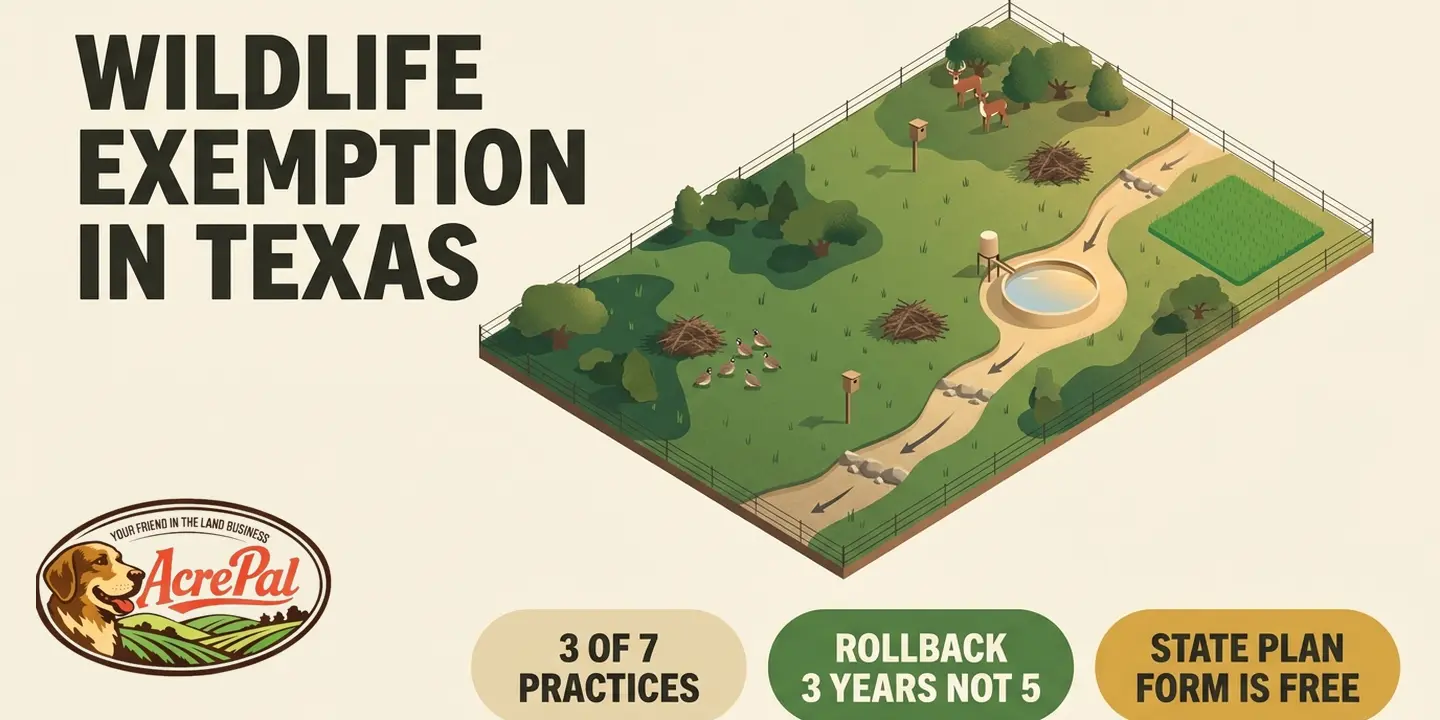
Spend five minutes searching the wildlife exemption in Texas and you collect a pile of answers that cannot all be true. One page promises savings of 50 to 80 percent, the next says 98 percent or more. A third says a new buyer can apply on raw land with no agricultural history, which the statute flatly does not allow. Somewhere else you will read that rollback taxes reach back five years, which stopped being the law in 2019.
Those pages disagree because most were written to sell wildlife management plans, not to explain the law. That does not make the vendors villains. It does mean you are reading marketing and grading it as a statute.
Everything below is tied to the Texas Tax Code, the Texas Administrative Code, or Texas Parks and Wildlife. Where a source conflicts with the statute, the statute wins and we say so.
Start with the correction that matters most. Converting from cattle to wildlife management does not trigger rollback taxes, and rollback has run three years plus 5 percent annual interest since September 1, 2019, not five years. We settle that below with the statute and the agency's own words.
It Is Not an Exemption, and That Is Not a Technicality
Nothing gets exempted. You keep paying property tax and the county keeps sending a bill. What changes is the number the tax rate applies to, because the land is appraised on productivity value instead of market value. Every page on this topic gets that far.
Texas Tax Code 23.51(2) defines agricultural use, runs through cultivating soil and raising livestock, then adds one sentence. "The term also includes the use of land for wildlife management." Wildlife management is not an alternative to agriculture under Texas law. It is agriculture by definition, and that one sentence answers the rollback question further down.
The history explains the awkward name. Before 1966, Texas farm and ranch land was taxed at market value. A 1966 amendment, Article VIII Section 1-d, brought productive valuation but only for people whose primary income and occupation was agriculture, and corporations were excluded. Section 1-d-1 arrived in 1978, dropped the occupation test, and is the program nearly every landowner is in today.
Voters made wildlife management eligible in 1995, the Tax Code picked it up in 1996, and in 2001 the Legislature directed Texas Parks and Wildlife to write real qualification standards under Tax Code 23.521(a). Keep one more distinction. The two programs recapture under different statutes, 23.46 for 1-d and 23.55 for 1-d-1, and you are almost certainly in 1-d-1.
Search for a wildlife tax exemption in Texas and you will find plenty written about it. The paperwork never uses that word. County sites and state forms say wildlife management use appraisal, which is the phrase to use when you want the official version of an answer.
The Gate: Your Land Must Already Have the Ag Valuation
The expensive version goes like this. You close on 30 acres in February, read that a wildlife exemption in Texas is the easy path, file in April, and open a denial letter in June. The window shut on April 30, so the next one is a year out and you pay market-value taxes meanwhile.
Texas Parks and Wildlife states the rule without hedging. "Only properties that are currently being appraised as agricultural lands or timber lands may convert to appraisal based on wildlife management." You are asking for a change in how you use land that already qualifies, not a new benefit you apply for cold.
The history requirement sits in Tax Code 23.51(1). Qualified open-space land must be currently devoted principally to agricultural use, and must have been so devoted, or in timber production, for five of the preceding seven years. That five of seven attaches to the agricultural or timber history, not to wildlife work. Your wildlife plan starts the year you convert.
You will read the opposite, and it is the most expensive sentence on this search. The most detailed article ranking for the term says new landowners can apply on previously non-exempt land, then contradicts itself by describing conversion from an existing ag valuation. It also turns five of seven into a 5 to 10 year period of demonstrated wildlife management, which is not a rule.
If you fail the gate, filing anyway will not fix it. Establish or continue a qualifying agricultural or timber use, build the history, get the 1-d-1 valuation, then convert.
Best for owners whose land already carries that valuation and can convert this tax year. Skip it if you just closed on raw land with no agricultural history, because for you this is a two to five year plan, not a this-spring plan.
Switching From Cattle Does Not Trigger Rollback Taxes
Almost nobody converts because they got tired of cattle. They convert because the old use got expensive. One plan vendor documents a Milam County landowner who inherited 200 acres and faced more than $20,000 in fence repairs just to keep a neighbor's herd there.
So you sell the cattle and convert to wildlife. Does the county come back for years of taxes?
No.
Start with the statute. Tax Code 23.51(2) says agricultural use "also includes the use of land for wildlife management," which puts it inside the qualifying class rather than outside. Rollback under 23.55(a) triggers on a change of use, and moving from grazing to wildlife does not take the land out of agricultural use. Nothing changed, so nothing gets recaptured.
Texas Parks and Wildlife says the same in its legal summary. "When a landowner elects to convert the primary use of their land from farming or ranching to wildlife management there is no change in the amount of property taxes assessed against the property, only a change in the qualifying agricultural practice, therefore, appraisal based on wildlife management use is revenue neutral."
Rollback taxes are real, they just attach to a different event. Take the land out of agricultural use entirely, sell to a developer or cut it into a subdivision, and 23.55(a) recaptures the difference between what you paid and what you would have paid at market value for each of the three years preceding the change, plus 5 percent annual interest.
That has been the rule since House Bill 1743 took effect on September 1, 2019. Before that it was five years and 7 percent. HB 1743 amended 23.55 and 23.76 and left 23.46 untouched, so the change hit 1-d-1, not 1-d.
The repealed version is still circulating in 2026, and not only on pages selling plans. One gives the previous five years plus 5 percent interest, the new rate bolted onto the old year count. Two others hedge to 3 to 5 years. A post dated 2024 from a Texas firm that practices agricultural tax law gives the 1-d-1 period as five years at 7 percent, then works an example, a $20,000 annual tax difference producing $100,000 in rollback taxes and a penalty that could exceed $140,000.
Under current law that same difference recaptures over three years, so the base is $60,000 rather than $100,000, at 5 percent rather than 7. We are not printing an interest-inclusive total because the accrual method is not spelled out. Read $140,000, panic, and you are reacting to a rule repealed in 2019.
Other Texas land publishers get it right and cite House Bill 1743 by name, which is exactly what makes this hard. The repealed rule sits alongside the current one in the same results, both written with confidence, and nothing tells you which is which.
Selling the cattle is safe. Selling the land to someone who will stop farming it sets off the bill, and in most deals the buyer ends up paying it.
Three of Seven Practices, and Why That Is a Budget Decision
Two of the seven qualifying practices cost close to nothing, and you re-pick your three every year.
Tax Code 23.51(7) lists seven wildlife management practices, and the land must be actively used in at least three.
- Habitat control
- Erosion control
- Predator control
- Supplemental supplies of water
- Supplemental supplies of food
- Providing shelters
- Making census counts to determine population
Most pages print that list and stop there. But 34 TAC 9.2004 lets you pick which three to run each year, and change them the next, which makes picking three a budget decision you re-make annually.
Shelters and census counts sit at the cheap end, brush piles from what you already cleared, nest boxes, a trail camera and a dated logbook. Food plots and burning sit at the other.
The figures below come from mixed and largely non-Texas sourcing, so treat them as ranges rather than quotes. Food plots run roughly $150 to $400 per acre annually, all in. Contractors quote prescribed burning at $25 to $35 per acre, while regional research averages $11.37 in the Great Plains and $28.38 in the Southern Region, and Texas figures have run from under $1 to $10 per acre depending on how fireline work is counted. Guzzlers run from a $300 do-it-yourself build to commercial units near $1,750.
Cost-share can offset some of it through Texas A&M Forest Service burning grants and NRCS erosion control programs, though rounds open and close.
One catch decides whether any of it passes. 34 TAC 9.2004 sets the required degree of intensity by ecological region through TPWD's Comprehensive Wildlife Management Planning Guidelines, so the same activity can satisfy one district and fail another, which is what makes a template plan off the internet risky. A plan vendor puts one concrete number on it, brush control on at least 10 percent of the affected area or 10 acres, whichever is smaller.
Two more qualifying routes hide in 23.51(7), land protecting a federally listed endangered species under a permit, and land in a conservation or restoration project under a natural resource damage plan.
If cash matters more than time, start with shelters, census counts and predator control.
How Much Land You Actually Need
Most people reading about a wildlife exemption in Texas face no minimum acreage at all, and the reason sits in 34 TAC 9.2005. A tract faces no minimum acreage requirement if its acreage equals or exceeds what it was on January 1 of the preceding tax year. If your tract did not shrink, no minimum applies.
For everyone else the minimum is not a number in a statute, it is a formula. The rule sets a wildlife use requirement as a percentage r, and a tract of x acres qualifies when (x minus 1) divided by x is at least r, so the minimum is 1 divided by (1 minus r). That missing acre is attributed to non-wildlife use, which is why a homesite usually costs an acre.
Run the arithmetic and the famous numbers fall apart. At 95 percent the minimum is 20 acres, at 98 percent it is 50, at 99 percent it is 100. The most repeated range, 12 to 50 acres, gets the floor close and the ceiling wrong.
- Post Oak Savannah, Blackland Prairie, Pineywoods and Upper Gulf Coast, 92 to 94 percent, so 12.5 to 16.7 acres
- Eastern Edwards Plateau and Cross Timbers, 93 to 95 percent, so 14.3 to 20 acres
- High Plains, Rolling Plains, Western Edwards Plateau, South Texas Plains and Lower Gulf Coast, 96 to 98 percent, so 25 to 50 acres
- Trans Pecos, 97 to 99 percent, so 33.3 to 100 acres
The chief appraiser picks the figure from the allowable range with the advice and consent of the appraisal district board, so two neighboring counties in one ecoregion can differ. That is why your neighbor qualified and you did not.
One route lowers the bar further, and it rarely comes up. 34 TAC 9.2005(d) sets separate, lower percentages for tracts inside a wildlife management property association, because members are contractually bound to manage. In the Trans Pecos the minimum can fall from 100 acres to 20, and in East Texas and along the upper coast to roughly 10 to 11 acres.
An association may file one plan and one annual report, and every member has to sign. TPWD's legal summary also states that each tract must independently qualify, so an association lowers the acreage bar without letting a non-qualifying tract ride on a neighbor's compliance.
Under 34 TAC 9.2001 a tract stays contiguous even when a public road or water runs through it, which is how adjoining parcels combine. None of this binds you if your tract never shrank. It is the whole ballgame if you sold a piece off.
What It Costs, and the Free Option Nobody Ranking Here Mentions
The same required document is sold at $149 and at $1,600, and the state will help you write it for nothing.
Every price below is a seller quoting its own product. Plans advertised from $149 and $399 flat. A wildlife biologist's on-site assessment at $500 to $2,000, per a Texas land brokerage. Application packages published openly at $1,600 and up by a Hill Country plan vendor.
That is more than a 10x spread for a document whose required contents are fixed by rule. Under 34 TAC 9.2003, a wildlife management plan has to identify the owner, the property, the current use, the goals and objectives, the target species, and the practices and activities. Nothing on that list gets more valid because you paid more for it.
Now the part nobody selling plans puts on their page. TPWD's own FAQ says "TPWD biologists are available to work with all landowners, but it is not required." The plan form is PWD-885-W7000, a free fillable checkbox form published on the TPWD website. Nothing in the Tax Code or in Title 34 of the Administrative Code requires a professionally prepared plan.
Hiring help is still a legitimate choice and we are not going to pretend otherwise. A plan written to your ecological region genuinely lowers your denial risk, a Registered Property Tax Consultant can represent you before the appraisal district, and TPWD notes that its own assistance availability is limited. Paying is an option rather than a legal requirement, and you deserve to know which one it is before you spend $1,600.
A disclosure is owed here, since we just pointed at everyone else's incentives. Most pages ranking for a wildlife exemption in Texas are published by companies that sell wildlife management plans, and none says so. AcrePal buys and sells rural land in Mohave and Apache counties in Arizona, Costilla County in Colorado, Elko County in Nevada, Modoc County in California and Putnam County in Florida. Not in Texas, so there is no plan for us to place and nothing for us to sell a Texas landowner.
Call your TPWD district biologist and price a plan or two before you assume the expensive number is the real one.
Filing: The Forms, the Deadline, and Two Safety Valves
Missing April 30 is not automatically fatal, and two provisions of the Tax Code say so.
Two documents go to your county appraisal district. Comptroller Form 50-129, the Application for 1-d-1 Open-Space Agricultural Use Appraisal, and the wildlife management plan on TPWD form PWD-885-W7000. One ranking competitor sends readers after Form PTD-23, which is not a current Texas form, and only one competing page names both correct numbers.
Tax Code 23.54(d) says "The form must be filed before May 1," which makes April 30 the last ordinary day. TPWD's own FAQ loosely says by May 1, and one competitor writes it both ways on the same page. Go with the statute.
The first safety valve sits in that same subsection. For good cause, the chief appraiser may extend the filing deadline by up to 60 days.
The second is Tax Code 23.541. You may file a late application up to the delinquency date for that year's taxes, and the penalty is 10 percent of the difference between the tax imposed and the tax that would have been imposed at market value. Read that twice. The penalty is calculated on your savings, not on your whole tax bill and not on the property value.
A sequencing note before you file. Apply between January 1 and April 30, and keep the existing qualifying use running until the wildlife plan is approved rather than dropping the cattle in February and hoping.
Filing on time costs nothing. Filing late costs 10 percent of what you saved. Not filing at all costs the entire difference between productivity value and market value for the year.
If the District Says No, You Have Rights and a Clock
The denial letter arrives and most people read it as final. It is not, and by law that letter has to tell you how to fight it.
Tax Code 23.57(d) puts real obligations on the chief appraiser. Written notice must reach the applicant not later than the fifth day after the determination is made. The notice "must state and fully explain each reason the chief appraiser denied the application," and it "must include a brief explanation of the procedures for protesting the denial."
So a denial cannot be a one-line rejection. You are owed every reason, in writing, within five days.
Then the clock. Under Tax Code 41.44, a notice of protest is due by May 15 or the 30th day after the notice was delivered, whichever is later. The word later is doing the work. A denial can land well after May 15, and the 30-day leg is what saves you.
There is a late valve here too. An owner who files after the deadline but before the appraisal review board approves the appraisal records is still entitled to a hearing on a showing of good cause.
One honest limit. The most common substantive reason for denial is failing the eligibility gate above, and no protest fixes a genuine lack of agricultural history. A protest is for when the district got the facts or the standard wrong, not for when you did not qualify.
Read the date on the notice before you read anything else, because that date, not May 15, is usually what sets your real deadline.
Keeping It, and the Trap That Catches New Owners
Asked to name the biggest mistake landowners make, a consultant at one of the state's largest plan vendors did not say the application. The answer was lack of follow through, the documentation and annual reporting that come after approval.
Start with the trap that costs the most. Tax Code 23.54(e) keeps the appraisal in place in later years without a new application "unless the ownership of the land changes or its eligibility under this subchapter ends." A sale is a change of ownership, so the buyer files their own application. A farm lender's page is the only one on this search that warns about it.
Then a nuance almost nobody flags. Under 23.54(e-1), ownership does not count as changed when land passes from the former owner to their surviving spouse, so the spouse keeps the valuation without re-applying. Any other heir is a change of ownership and files fresh.
The second failure mode is paperwork. Compliance lives in your records, not in the plan you filed. What survives a review is dated activity logs, before and after photographs, material receipts and timestamped trail camera data. A Texas land brokerage publishes the sharpest illustration, "Installed 3 brush piles in northeast pasture for quail cover, 4 hours labor" passes and "Did wildlife work" does not.
34 TAC 9.2003 lets an appraisal district require an annual report, and TPWD publishes two forms one digit apart. PWD-885-W7000 is the wildlife management plan, filed once when you convert. PWD-888-W7000 is the annual report, filed each year where your district requires it, listing the activities you actually completed, minimum three. Some districts add their own requirements on top of the state form, so ask yours.
The third failure mode is drift in how the land is used. 34 TAC 9.2004 requires wildlife practices to be given priority, and secondary uses must not significantly and demonstrably interfere with them or harm the wildlife being managed. Cattle, a hunting lease and a cabin can coexist, but wildlife management has to stand on its own as the primary use.
If you are buying, put the application on your closing checklist. If you are inheriting and are not the surviving spouse, put it on your first-year checklist.
FAQ
Is there a minimum acreage for a wildlife exemption in Texas?
Usually none. Under 34 TAC 9.2005 a tract faces no minimum acreage as long as it is the same size or larger than it was on January 1 of the preceding tax year. Only tracts that shrank get measured against a minimum, computed from a percentage your appraisal district selects. See the acreage section above for the regional ranges.
Do I need to hire a wildlife biologist to write the plan?
No. Nothing in the Texas Tax Code or in Title 34 of the Administrative Code requires a professionally prepared wildlife management plan. TPWD publishes a free fillable form, PWD-885-W7000, and its FAQ states that biologists are available to work with all landowners but are not required. Paid help can lower your denial risk, which makes it a reasonable choice rather than a legal one.
Will switching to wildlife management raise or lower my property taxes?
Neither, and TPWD calls it revenue neutral. Converting from farming or ranching changes the qualifying agricultural practice, not the amount of tax assessed, because both sit on the same productivity value basis under 1-d-1 open space appraisal. What your county sets as the productivity value per acre is what drives the number.
Can I still run cattle or lease for hunting with a wildlife exemption?
Yes, as long as wildlife management is the primary use. 34 TAC 9.2004 requires wildlife practices to be given priority, and says secondary uses must not significantly and demonstrably interfere with them or harm the wildlife being managed. You cannot count the cattle toward the three practices you are required to run.
What happens to the wildlife valuation when I sell the land?
It does not carry over automatically. Tax Code 23.54(e) keeps the appraisal in place year after year without a new application unless ownership changes, and a sale is a change of ownership, so the buyer files their own. The exception is 23.54(e-1), where land passes to the surviving spouse of the former owner.
How far back do rollback taxes go in Texas?
Three years, plus 5 percent annual interest, under Tax Code 23.55(a). House Bill 1743 cut it from five years and 7 percent effective September 1, 2019, and the older figures still circulate on pages ranking for this topic. Converting from agriculture to wildlife management does not trigger rollback at all, because wildlife management is an agricultural use by statutory definition.