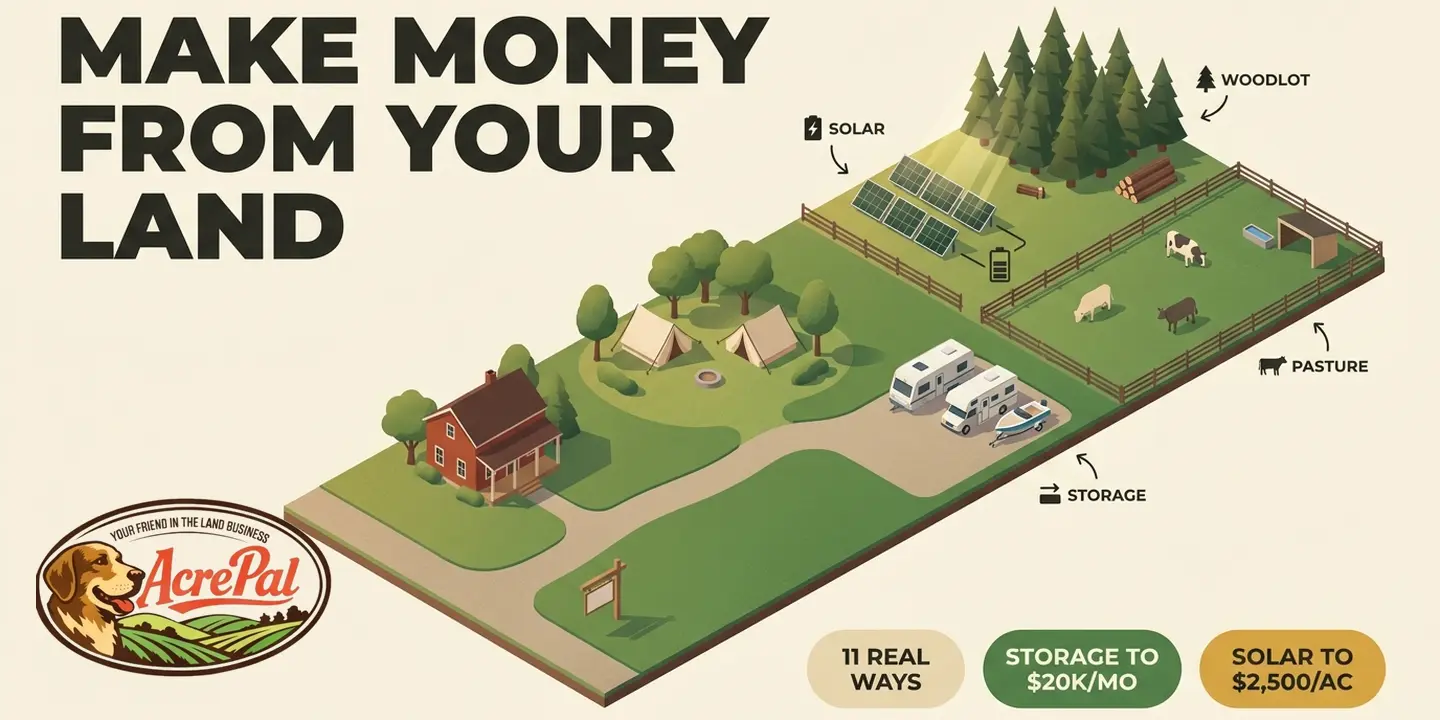
You own the acreage, and it sits there earning nothing while the property tax bill shows up every year like clockwork. Almost every guide on how to make money from your land assumes you already own an improved farm with water, power, fencing, and equipment, which leaves owners of cheap raw and off-grid parcels with no realistic path at all.
This list is built differently. It is ranked by what actually works on cheap raw or off-grid land, fastest-to-cash and lowest-capital first, and every method carries a real 2026 dollar range, an effort level, a startup cost, a time to first dollar, and an honest verdict on whether it works on bare land.
Two hard truths set the table. Road access is the gate, so a landlocked parcel with no legal access earns almost nothing until you fix that. And the arid West kills some methods that pay well in the humid South, so where your dirt sits matters as much as how big it is.
Land is also an investment, not just a yard, and the appreciation is real. USDA pegged farm real estate at $4,500 an acre in 2026, up 3.4 percent. The good news is you do not need utilities to start earning, even if you bought it with little money down.
1. Rent Bare Dirt for Camping and Vehicle Parking
You can list a plain plot of dirt today and be earning within days, with no hookups, no power, and no plumbing. This is the single fastest path to a first dollar on raw land, because it requires nothing built at all.
Peer-to-peer camping platforms do the heavy lifting. Campspot, Tentrr, Hipcamp, Campspace, and Harvest Hosts pay $10 to $50 a night per site with no hookups required. As one land monetization creator put it, campers "are not expecting electricity or plumbing, they just want to go camping." So you will not need a well or hookups to open for business.
Vehicle and equipment parking works the same way. Neighbor.com, Truck Parking Club, Spacer, Stow It, CurbFlip, and Pavement turn open space into monthly recurring income, and listing on several platforms at once pushes occupancy toward full.
The numbers are friendly for a beginner. Time to first dollar is days to one or two weeks, startup cost is near zero if you already own the land, and the effort stays low.
The verdict on raw land is a strong yes, and this is the highest-fit method on the whole list for a bare off-grid parcel. The only hard requirement is legal road access. The honest limiter is demand, which tracks proximity to towns and recreation draws, so a truly remote parcel earns less and more seasonally.
Best for road-accessible parcels near towns, lakes, trails, or highways. Skip it if the parcel has no legal access or sits hours from any draw.
2. Lease Your Land for Hunting
The average annual lease per hunter hit $7,217 in 2024, and the only things a landowner needs to collect that money are insurance and a contract. No structures, no utilities, no fencing.
Rates in 2026 run $5 to $50 or more per acre per year, and the region decides where you land in that range. The South (Georgia and North Carolina) runs $10 to $25, the Midwest runs $25 to $80, and premium Texas natives fetch $30 to $50. Forestry specialists at FRC report North Carolina climbing from $5 an acre to $15 to $18, and the Midwest jumping from $15 to $20 up to $50 to $80.
Startup stays near zero. Budget $500 to $1,000 a year for liability insurance plus a lease agreement, list on LandTrust, HuntingLocator, or BaseCampLeasing, and expect two to four weeks to first dollar. Once the lease is signed it is 100 percent passive, because hunters handle their own access.
Income tracks habitat quality, not raw acreage. Timber, brush, water, and wildlife corridors raise the rate, and while acreage is not everything, 20 or more acres commands better per-acre rates. The honest regional caveat is that arid Western parcels in Mohave County Arizona, Elko County Nevada, and Modoc County California draw lower rates because big game is sparse.
The verdict is that a hunting lease is the closest thing to mailbox money for wooded or brushy raw land east of the Rockies, and it is thinner but still worth listing across the arid West.
3. Rent Space for RV, Boat, and Container Storage
Land investor Kai Andrew points to neighbors on 5 to 6 acres who store boats, RVs, and equipment and pull $15,000 to $20,000 a month. RV storage was named America's most undersupplied real estate niche in a 2025 market analysis, which tells you how much demand is chasing how little supply.
Outdoor spaces rent for $50 to $500 a month, with an average around $130.80 and a premium 15-by-50 space near $375. Returns of 10 to 20 percent are typical, and the improvements you make (gravel, fencing, lighting) are depreciable.
Portable container storage is the even lower-lift version. A 10-by-10 unit rents for about $130 a month, needs no foundation or building permit in many rural counties, and the containers themselves can be financed and repossessed if the numbers ever go sideways. One Canadian operator dropped containers on a few road-adjacent parcels and was fully booked within six months.
Startup is low, mostly a gravel pad and basic fencing, time to first dollar is weeks once the pad is ready, and the cash flow is predictable with light management.
The raw-land verdict is yes on flat, road-accessible land, and it works with minimal grading. Income still depends on proximity to people, so remote desert parcels see little demand.
Best for flat parcels within reach of a suburb where homeowners cannot store a 30-foot Airstream or a boat at home. Skip it if the land is remote, steep, or hard to reach by trailer.
4. Buy Low and Sell With Owner Financing for Monthly Cashflow
The most reliable income from cheap land is not something you grow on it. It is the land itself, and the play other guides never mention is becoming the bank.
Start with the flip. You buy at 30 to 50 cents on the dollar and sell at market. Beginners net $2,000 to $7,000 per deal, intermediate flippers net $8,000 to $25,000, and experienced ones clear $25,000 to $50,000 or more. Two brothers documented on UpFlip scaled this to $667,000 a month and more than $8 million a year across 40-plus states, never visiting a property. Land is a real investment because it appreciates (they cite roughly 8 percent a year), does not depreciate, has no tenants, and cannot go to zero. The cheapest counties are where the margins live.
The passive version is owner financing. Instead of a cash sale, you sell your raw parcel and hold the note, taking $500 to $1,000 down and $99 to $399 a month at 9 to 12 percent over 3 to 10 years. Over the life of the note you collect 200 to 300 percent of the cash price. Buy at $4,000, sell at $15,000 with $500 down and $199 a month at 10 percent over 72 months, and you collect about $14,828. That is a 271 percent return plus monthly cashflow while you fund the next deal, and you hold the deed until the note is paid off. Land educator Mark Podolsky teaches a 3-to-1 rule, keeping one of every four deals as a note.
Sourcing is active work, but collecting on a signed note is passive, and a cash flip turns in 30 to 60 days.
This is the best fit on the list for cheap remote parcels that fail every lease test. The land does not need to do anything but be resellable. This is also our model at AcrePal. We buy cheap rural land in the West and South and sell it owner-financed across Arizona, Colorado, Nevada, California, and Florida, so markets like Costilla County Colorado fit exactly. See how we structure the deals at AcrePal.
If you own one cheap parcel and just want monthly income, sell it on terms and become the bank. If you want a repeatable business, learn to flip and keep one in four of the deals as a note.
5. Lease Your Land to a Solar Farm
The mailers keep coming, promising thousands of dollars an acre if you sign your land over to a solar developer. One landowner on X captured the dilemma. "My family has over 70 acres of farm land. We can lease it to become a solar farm at $10K an acre per year. Should we do it?"
When the land qualifies, the money is large. National rates run $500 to $700 an acre per year, high-demand states like Massachusetts, Connecticut, and New York reach $1,200 to $2,500, and Texas runs $400 to $600. Add signing bonuses of $1,000 to $5,000 an acre and annual escalators of 1.5 to 2.5 percent, and it dwarfs crop rent (a Minnesota example pays $1,000 to $1,300 for solar versus $300 to $375 for crops).
The disqualifier stops most of this audience. Developers need 10 or more acres, and 25 to 30 or more for utility scale, so you generally need at least 10 to 30 acres under 5 percent slope, within 1,000 feet of 3-phase power, and within 5 miles of a substation. Grid connection is the developer's number one cost, which is why arid remote parcels in Mohave County Arizona, Elko County Nevada, and Modoc County California typically fail. Payment is slow too, 3 to 7 years from signing to operating checks.
For raw land, solar only makes sense on a larger parcel near existing grid. It is a hard no for truly off-grid desert land.
Solar pays far more than crop rent when you qualify. For remote off-grid acreage, though, a hunting lease or an owner-financed sale beats waiting years for a check that never arrives.
6. Lease for Wind, Cell Towers, and Billboards
The per-unit numbers on infrastructure leases look almost too good, and that is exactly why the qualification math matters more than the headline.
- Wind pays $4,000 to $10,000 an acre per year during operation, or $3,000 to $8,000 per turbine per year flat, or 3 to 6 percent of gross energy revenue on a 20 to 30 year lease. The catch is the option phase, which pays only $2 to $10 an acre per year for 2 to 5 years, and you need 40-plus acres with a real wind resource to even start.
- A cell or communications tower ground lease pays rural landowners $500 to $1,500 a month, with a database average of $1,300 and a single tower generating $6,000 to $18,000 a year. It hinges entirely on a carrier needing coverage at your exact spot, and headline rents are flat in 2026, so escalator terms matter more than the starting number.
- A billboard pays the landowner 10 to 18 percent of gross sign revenue, so a rural highway sign grossing $20,000 a year pays you $2,000 to $3,600. Value is driven by daily traffic count, not acreage, which leaves low-traffic remote land with almost none.
Effort is near zero and the income is passive once signed, but the odds of qualifying are unpredictable. These are lottery-ticket leases you cannot manufacture.
If one of these offers ever lands in your mailbox, get it appraised and negotiate the escalators hard. Just do not buy or hold land expecting one to show up.
7. Enroll Marginal Land in CRP and Conservation Programs
A guaranteed government check that requires no work once you enroll is about as passive as land income gets. The catch is whether your dirt qualifies.
The USDA Conservation Reserve Program paid these 2024-2025 average rates. General CRP ran $57.10 an acre per year, Continuous CRP ran $149.20 (nearly triple), CREP ran $180, and Grasslands CRP ran $15.60. Enrolled acreage sits at a decade high, and USDA cost-shares 50 to 75 percent of the practice installation on top of the rent.
It is genuinely passive, a 10 to 15 year contract you sign once, and in some configurations it can stack with a hunting lease. Time to first dollar is 3 to 6 months after approval.
The honest disqualifier is history. General CRP requires land that was cropped in 4 of the last 6 years, and Grasslands CRP needs native or converted grassland. Arid Western vacant land with no agricultural history is ineligible, which makes this a Midwest and South play, not a desert one.
This one only works on parcels with real agricultural or grassland history. It is a firm no for raw desert scrub, which rules out much of the arid-West audience.
Best for owners of former cropland or pasture in the Midwest and South. Skip it if your parcel is desert scrub or was never farmed.
8. Harvest Timber and Pine Straw From Wooded Land
Timber only pays if you already own the trees, so this one is off the table for bare land no matter how confidently the other guides list it. If you did buy wooded acreage, it earns on two timelines.
Pine straw is the near-passive layer between harvests. It pays $50 to $125 an acre per year on basic stands and $250 to $400 on high-density longleaf, with bales moving at $0.25 to $0.30 for loblolly and $0.40 to $1.00 for longleaf. Adding pine straw lifts a 30-year timber return from $2,700 to $4,200 an acre, so the needles pay while the trees grow.
Timber itself is the long game. Slash pine harvests around 25 years for roughly $8,314 an acre of value, you need a forester to manage it, and the payback is measured in decades, not weeks.
Startup is low if the trees already exist, mostly a forester's fee, but time to first dollar is a single season for pine straw and can be decades for the timber cut.
The disqualifier is mature pines. This works in the Southeast (Georgia, Alabama, North Carolina, and forested Florida markets like Putnam County), and it does not work on bare desert or arid land. Planting from scratch to sell in 25 years is a legacy move, not an income plan.
The verdict is to buy it already forested or skip it, because you cannot grow your way into this one on any useful timeline.
9. Lease Grazing and Hay Rights
Grazing pays real money in the humid South and almost nothing in the arid West, and nobody tells you which one you own until you try to lease it.
The ceiling here is low. Pastureland rent averages about $16 an acre per year nationally and is flat, so this is low yield per acre and income comes only from scale. You lease the grazing or hay rights to a working rancher who brings the animals and the equipment, which keeps your effort near zero and puts first dollar a season away.
The regional reality changes everything. Carrying capacity runs 1 to 2 acres per animal unit in the humid Southeast, versus 25 to 50 or more acres per animal unit in the arid West. The same herd needs roughly 25 times the land out West, so the per-acre economics collapse on thin desert forage.
The same states that top homesteading lists for grassy, well-watered ground are the ones where grazing leases actually pencil out.
The raw-land verdict is yes for larger parcels with real forage, especially in the South and Midwest, and marginal for small or arid Western desert parcels where the grass is too thin to matter.
Best for larger grassy parcels in the South and Midwest. Skip it if you own a few desert acres with sparse forage.
10. Build a Glamping Stay or Event Site
Codie Sanchez turned $5,000-an-acre unwanted land into a glamping site with a target of cashflow inside 30 days. It works precisely because the model needs no infrastructure.
The math on the build is approachable. Figure $10,000 for 10 acres plus $20,000 to build out one glamping acre, so about $30,000 all-in. The $1,600 solar-powered tents run fully off-grid with no hookups, you target $200 to $300 a night, and you break even somewhere around 75 to 100 booked nights a year.
Events layer on top of the same field. Micro weddings need no barn and charge $2,000 to $6,000 an event, plus $1,000 to $2,000 a night in add-on rentals like chairs, arches, and lighting. One operator reports about 30 percent of a rural Airbnb's guests using the property for weddings.
The honest costs are real. Effort is high, or you pay an operator 10 to 20 percent of revenue, time to first dollar is 30 to 45 days if capital is ready, and the biggest risk is zoning. Confirm the county permits short-term rentals or camping before you spend a dollar, and budget for the site-prep bill for a pad, water, and a septic or composting setup.
The raw-land verdict is yes on cheap off-grid land specifically because solar tents remove the utility barrier, but only with road access, permissive zoning, and some natural draw like views, water, or trees.
If you have road access, a scenic feature, and $20,000 to $30,000 plus permissive zoning, this is the highest earner on the list. If you do not, start with the camping platforms from method one and reinvest the cash.
11. Cut Your Carrying Cost With Ag and Greenbelt Valuation
The fastest way to make more from your land is to stop losing it to taxes. A dollar of tax saved is a dollar earned, and this one compounds with every method above it.
Ag or greenbelt classification (also called present-use-value assessment) taxes land on its farm use instead of its market value, which can cut the property tax bill 50 to 90 percent. In Tennessee, a $2,000 annual bill can drop to $200 to $400 once assessed value falls 60 to 90 percent. That is money you keep every single year.
Most agricultural states run a version of it under a different name, from the Florida Greenbelt to programs across Texas and the Western states. Minimums vary, with Florida requiring 5 acres and real agricultural activity and Tennessee requiring 15 acres for forest.
The catch is that you must be actively engaged. Planning to farm does not count, and rollback taxes of 3 to 5 years apply if you convert the land out of the program.
Pair this with the due-diligence layer competitors skip. Before you monetize anything, confirm zoning permits the use, verify legal access and easements, and carry liability insurance for guests.
Unlike most methods here, this one is close to universal. Wherever a program exists and you can meet the minimum activity, it helps almost every reader on this page.
A hunting lease might net a few hundred dollars an acre. Greenbelt classification can save more than that on the tax bill, so the obvious move is to do both.
Making Money From Your Land, Frequently Asked Questions
What can I realistically make from remote desert land with no water, power, or roads?
With no legal access, essentially nothing until you fix the access. With road access, you have real options even without utilities. Tent camping pays $10 to $50 a night, a hunting lease pays $5 to $25 an acre in the arid West if wildlife is present, and selling on owner financing produces monthly income. Solar and CRP almost always disqualify remote arid parcels, so do not count on them.
How much money do I need to start?
Near zero for camping and parking listings if you already own the land, and $500 to $1,000 for the insurance and contract behind a hunting lease. Glamping runs $1,600 or more per tent plus site prep, a first land flip takes a few thousand dollars for the property, and owner financing requires owning the parcel outright so you can act as the bank. Match the method to the cash you have.
Does my land qualify for a solar lease?
Run it through the test. Developers want 10 to 30 or more acres, under 5 percent slope, within 1,000 feet of 3-phase power, within 5 miles of a substation, and zoning that permits solar. Remote arid parcels usually fail on grid distance, because connecting to the grid is the developer's single largest cost. If you clear the test, request competing offers from two or three developers before signing anything.
What is the time to first dollar for each method?
Fastest are camping and parking listings, which can pay within days, followed by hunting leases at two to four weeks. Cash land flips and glamping run 30 to 60 days, and CRP takes 3 to 6 months after approval. The slowest by far are solar and wind, at 3 to 7 or more years from signing to a real check, and timber, which is measured in decades.
What is owner financing and how do I use it to make money from land I already own?
You act as the bank. Sell your parcel with $500 to $2,000 down plus monthly payments at 9 to 12 percent interest over 3 to 10 years, and you collect 200 to 300 percent of the cash price over the life of the note. You hold the deed until the buyer pays it off. If the buyer defaults, you keep the payments already made and reclaim the land to sell again.
Is land a good investment, and what is the minimum acreage to make money?
Land appreciates roughly 4 to 8 percent a year (USDA shows 4.3 percent in 2025), carries no depreciation, tenants, or maintenance, and cannot go to zero. The minimums are low. One acre works for a hunting lease or camping, a quarter acre works for a tent site, and any size works for owner financing or flipping. Solar needs 10 to 30 acres and wind needs 40 or more.