
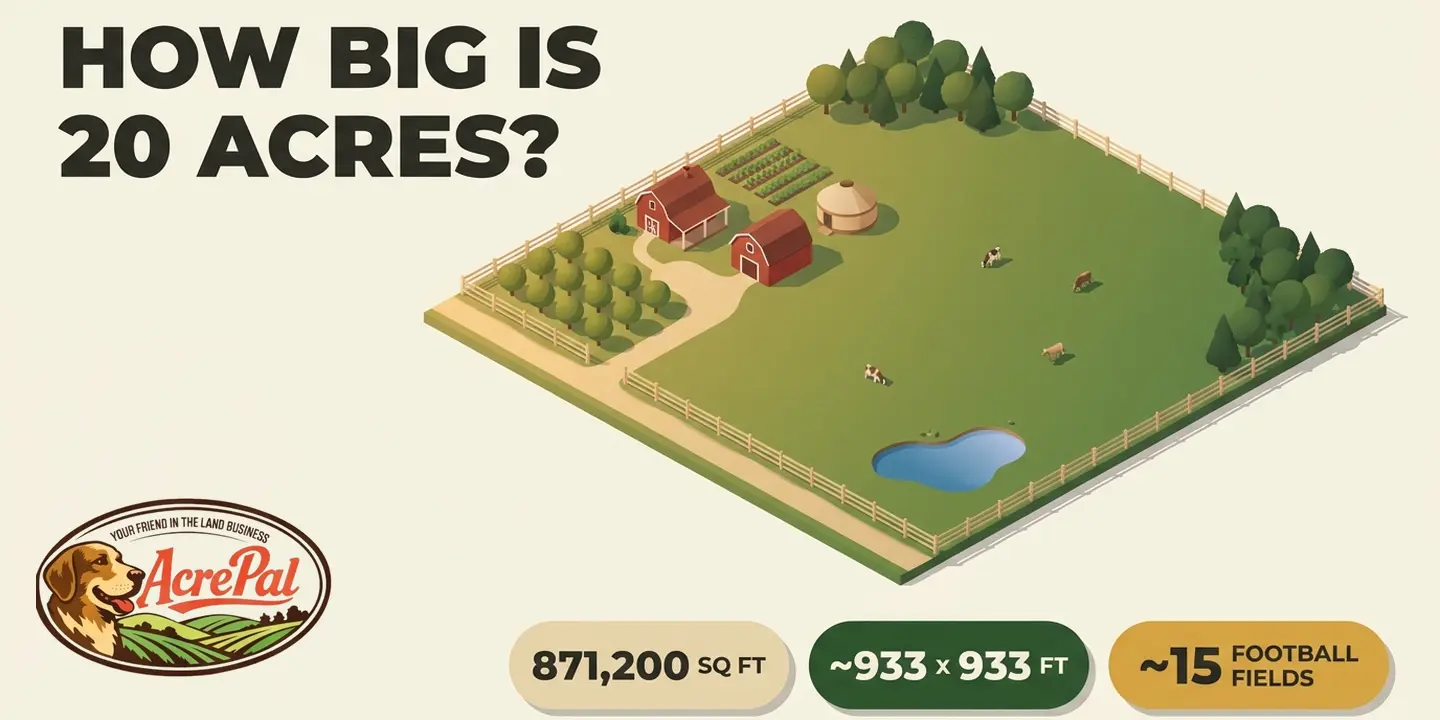
Twenty acres is 871,200 square feet, which as a perfect square works out to about 933 feet on every side. That is roughly 15 football fields laid side by side, and it equals exactly one thirty-second of a square mile. The anchor worth remembering when you ask how big is 20 acres is the diagonal. Straight across a square 20-acre lot, corner to corner, runs exactly a quarter mile.
Most pages answer this with cruise ships and tennis courts, then stop. We would rather make the size real, then show you what 20 acres actually holds, how many animals it can graze, what a parcel costs in 2026, and how regular buyers pay for it. Size is only the starting point.
The Quick Answer: 20 Acres in Numbers
One acre is 43,560 square feet, so twenty acres equals 871,200 square feet. From that single figure every other unit falls into place, and it helps to see them stacked together.
96,800 square yards
About 80,937 square meters
8.09 hectares
Roughly 0.03 square mile
Shape it into a perfect square and each side runs about 933 feet. Walk the full perimeter and you cover about 3,733 feet, which is just over 0.7 mile, or close to a 14-minute stroll at a normal 3 mph pace. Cut straight across corner to corner and the diagonal is exactly 1,320 feet, a clean quarter mile.
Surveyors think in bigger blocks. A section of land is 640 acres, or one square mile, which makes 20 acres exactly one thirty-second of a section. A classic rural layout for this size is 660 feet of road frontage running 1,320 feet deep, a long rectangle rather than a square, which is the shape most listings with frontage measurements actually describe.
Real parcels rarely come out as tidy squares, so expect odd angles, a creek that cuts a corner, or a road that clips one edge. Those are the numbers, and the shapes below turn them into something you can actually picture.
What 20 Acres Looks Like
Raw square footage is hard to picture, so borrow shapes you already know. Each of these covers roughly the same ground as 20 acres of land.
About 15 American football fields including the end zones, since one field is 1.32 acres
Around 80 standard quarter-acre suburban lots
A small subdivision of roughly 69 houses with average-size yards
Close to 10 Manhattan city blocks
About 333 tennis courts, or 8 Walmart Supercenters
Twenty acres is the size where land stops feeling like a big yard and starts being real acreage. You get genuine privacy, room for a tree buffer between you and the road, and open space you cannot see across from one corner. That shift matters more than the raw number, and it is why the same 20 acres reads as huge on foot and modest from a satellite map.
You can also feel it by climbing the ladder. It is double a wooded 10 acres, and it dwarfs a 5 acres hobby parcel. Stand it next to a 2 acres building lot and the difference is night and day. Line up the priciest suburban 3 acres parcels and 20 acres swallows about seven of them.
What 20 Acres Is Actually For
This is the size where options open up, because you stop choosing between uses and start fitting several onto one property. A few things 20 acres comfortably supports look like this.
A full self-sufficient homestead, with 10 to 20 acres being the movement's sweet spot, leaving room for a house, a barn, a greenhouse, a 1 to 5 acre garden, a woodlot, a solar array, and a wild buffer
A recreational or hunting retreat with real seclusion, like the Powell County, Montana 20 acres listed with two yurts at $120,000 and ready to earn income
A long-term hold, since rural land tends to appreciate around 4 to 6 percent a year and undivided 20-acre parcels near cities dropped about 18 percent in a decade, which makes them scarcer
A subdivide play, because a county with a 5-acre minimum lets you split 20 acres into four saleable lots
A shared buy split across a group, since a 20-acre parcel listed near $58,000 can be pooled by about 50 people at roughly $1,500 each to spread both the cost and the upkeep
Real families already live this. One Alaska household of six sits on 20 acres fully off-grid and mortgage-free, running power from a solar array and a diesel generator, heating with a wood stove, and pulling water from an on-site well through Berkey filtration, later adding a yurt for income. That whole setup fits inside this footprint with room to spare. For most buyers, 20 acres is the first size that does everything at once without needing a tractor crew to manage it.
How Many Cows Can 20 Acres Hold?
The same 20 acres might graze 13 cows or none at all, and the deciding factor is rainfall, not acreage. Forget the old "one cow per acre" line, because it only holds in a narrow band of well-watered country and falls apart everywhere else.
In humid regions like East Texas and the Southeast, average managed pasture under rotational grazing runs about 1.5 to 2 acres per cow-calf pair. That puts 20 acres at roughly 10 to 13 pairs, which is a genuine small herd. Move west onto arid rangeland in Nevada, Arizona, high-desert Colorado, or West Texas, and the math flips hard. There you may need 5 to 150 or more acres per cow, so the same 20 acres might carry only 1 to 4 head, sometimes zero without hauling in hay.
The planning method is simple once you strip the jargon. Estimate how much forage the land grows in a year, plan to graze only about half of it so the pasture recovers, then match that to what a single cow eats in a year. Run those numbers on typical dry pasture and the picture sharpens. Twenty acres at about 2 AUM per acre, grazed at 50 percent, yields roughly 20 animal-unit-months a year, and one cow-calf pair eats about 12 of those in a full season, which pencils out to only 1.7 pairs. Swap in sheep and the ratio is friendlier, since five sheep eat about what one cow does. Horses run about the same as a cow-calf pair, and they chew and trample pasture harder than cattle do.
If you are eyeing cheap high-desert acreage to run cattle, verify the stocking rate with the local extension office before you buy. The listing photo shows a pretty view, not the forage, and the carrying capacity is what feeds the herd.
What 20 Acres Costs in 2026
Twenty acres can run from under $20,000 to over $800,000, and location drives almost all of that spread. Real 2025 to 2026 listings tell the story, cheapest first.
Elko County, Nevada, 20 acres at about $17,948, roughly $897 per acre
Apache County, Arizona, 37 acres at about $19,980, roughly $536 per acre
Lassen County, California high desert near Modoc, 20.3 acres at $24,997, roughly $1,230 per acre
Luna County, New Mexico near Deming, a 10-acre tract at roughly $900 to $1,000 per acre
Powell County, Montana, 20 acres with two yurts at $120,000, roughly $6,000 per acre
Midwest cropland at $4,000 to $8,000 per acre
One pricing quirk works in your favor, and most buyers miss it. Big parcels sell far cheaper per acre than small lots do. Near Elko, a 2-acre lot runs about $3,394 per acre while 320 acres nearby runs about $156 per acre, a more than twenty-times difference. That means 20 acres is usually a better per-acre deal than a 1 or 2 acre lot in the same area. Two forces push the other way over time. Rural land has appreciated around 4 to 6 percent a year, the supply of undivided 20-acre parcels within 50 miles of cities has fallen about 18 percent in a decade, and recreational parcels with dual-use appeal carry a 15 to 25 percent premium on top.
Some of the cheapest counties on that list are exactly where we work. AcrePal sells owner-financed rural acreage in several of these low-cost counties, including Mohave and Apache in Arizona, Costilla in Colorado, Elko in Nevada, Modoc in California, and Putnam in Florida, which is one straightforward route into the cheapest markets for land.
Paying for 20 Acres with Owner Financing
Banks tend to avoid raw land, especially remote parcels, because there is no house to secure the loan. So most cheap 20-acre deals sell on owner financing, where the seller carries the note instead of a lender. Terms usually land in a predictable range, with down payments of $249 to $500 on cheap parcels, no credit check, rates around 8.99 to 12 percent, and terms of 5 to 15 years.
Real monthly numbers make the model clear.
Lassen County, California, 20 acres at $299 down, $299 a month, 8.99 percent fixed, with no prepayment penalty
Apache County, Arizona and Elko County, Nevada parcels at about $500 down and $235 to $266 a month carried by the seller
An Alaska family bought 20 acres plus a cabin for $80,000, put 20 percent down, and pays about $540 a month, now living fully off-grid and mortgage-free
Two cautions are worth saying plainly. Owner-financing rates usually run higher than a bank loan would, so you pay for the easy approval. Many of these deals are also a contract for deed, which means you do not hold title until the balance is paid off, so confirm exactly which deed you are getting before you commit.
Always convert any monthly pitch back into the total price, the interest rate, and the deed type before you sign. A low payment can still hide an expensive deal.
The Tax Break Most 20-Acre Buyers Miss
At 20 acres, you likely clear the size threshold for an agricultural or greenbelt property-tax exemption, which can cut your tax bill dramatically. Most states set the minimum around 10 acres, so 20 acres qualifies as long as you put it to real agricultural use like grazing, hay, timber, or a few head of livestock. The land is then taxed on its farming value instead of its market value, and that gap is where the savings live.
The specifics vary by state, and a few examples show the range.
Texas taxes qualifying land on productive agricultural value after active use for 5 of the past 7 years
Colorado values it on earning capacity capitalized at 13 percent, far below market, once the land has been in ag use for 2 of the last 3 years
South Carolina assesses agricultural land at 4 percent instead of the standard 6 percent, and a timber tract qualifies at just 5 acres
There is a catch. If you drop the ag use or sell the land for development, states like Texas claw back 3 to 5 years of the saved tax plus interest, known as rollback taxes. If you plan to graze or hay even part of the 20 acres, ask the county assessor about the exemption before your first tax bill.
What to Check Before You Buy 20 Acres
Cheap 20 acres is only a deal if the basics check out, and a low price often hides the reason it is cheap. Before you wire a dollar, work through this checklist.
Legal access, meaning a recorded easement or real road frontage, because a landlocked parcel is nearly worthless at any price
A boundary survey, since raw rural land rarely has a modern one and the deed, GIS, and tax records can disagree by up to 20 percent. One buyer's deed said 80 acres while the survey came back at 67, with 13 phantom acres lost to road widening, a creek that had shifted course, and a neighbor's fence treated as the boundary, a six-figure hit. A survey runs $2,000 to $4,000
Water, whether a well, a spring, or usable water rights, which in western states are often held separately from owning the surface
Topography and soil, because steep slopes and wetlands can cut the usable acreage well below what the deed reports
Zoning and restrictions, including flood zones, easements, and what you can legally build or graze
A title search for liens or back taxes, even when the seller is offering financing
Do the legwork before you fall for the view. Walk the property, pull the county GIS, and budget for both a survey and a title check. The cheapest parcel with no access is the most expensive mistake you can make on rural land.
Frequently Asked Questions
How big is 20 acres exactly?
Twenty acres is 871,200 square feet, which equals 96,800 square yards, about 8.09 hectares, and roughly 0.03 of a square mile. Shaped as a perfect square, each side runs about 933 feet, and the diagonal straight across measures exactly 1,320 feet, a quarter mile. It is also exactly one thirty-second of a 640-acre section.
How many cows can you have on 20 acres?
It depends almost entirely on rainfall. In humid regions with managed, rotational pasture, 20 acres can carry about 10 to 13 cow-calf pairs at 1.5 to 2 acres each. On arid western rangeland, where you may need 5 to 150 or more acres per cow, the same 20 acres might support only 1 to 4 head, or none without hauling hay.
How much does 20 acres cost?
Prices run from under $20,000 to over $800,000, with location driving nearly all of the difference. High-desert parcels in Elko County, Nevada or Apache County, Arizona sell near $500 to $900 per acre, while Midwest cropland runs $4,000 to $8,000 per acre. Larger parcels almost always cost far less per acre than small 1 to 2 acre lots nearby.
Is 20 acres enough for a homestead?
Yes, and it sits right in the homesteading sweet spot of 10 to 20 acres. That footprint leaves room for a house, a barn, a greenhouse, a 1 to 5 acre garden, a woodlot, a solar array, and a wild buffer, all on one property. Families already live fully off-grid and mortgage-free on 20 acres, so the size supports self-sufficiency without demanding heavy equipment.
Can I buy 20 acres with owner financing and no credit check?
Often yes, because banks avoid remote raw land, so sellers commonly carry the note themselves. Typical terms are $249 to $500 down, no credit check, rates around 8.99 to 12 percent, and terms of 5 to 15 years. Just confirm whether you are signing a contract for deed, since that means you do not hold title until the balance is paid.
Can 20 acres be subdivided?
Usually yes, depending on your county's minimum lot size. A county with a 5-acre minimum lets you split 20 acres into four saleable lots, and retail lots often sell for 3 to 10 times the bulk per-acre price. Subdivision costs typically run $5,000 to $30,000 or more, so check local zoning and survey costs before you count on the upside.