
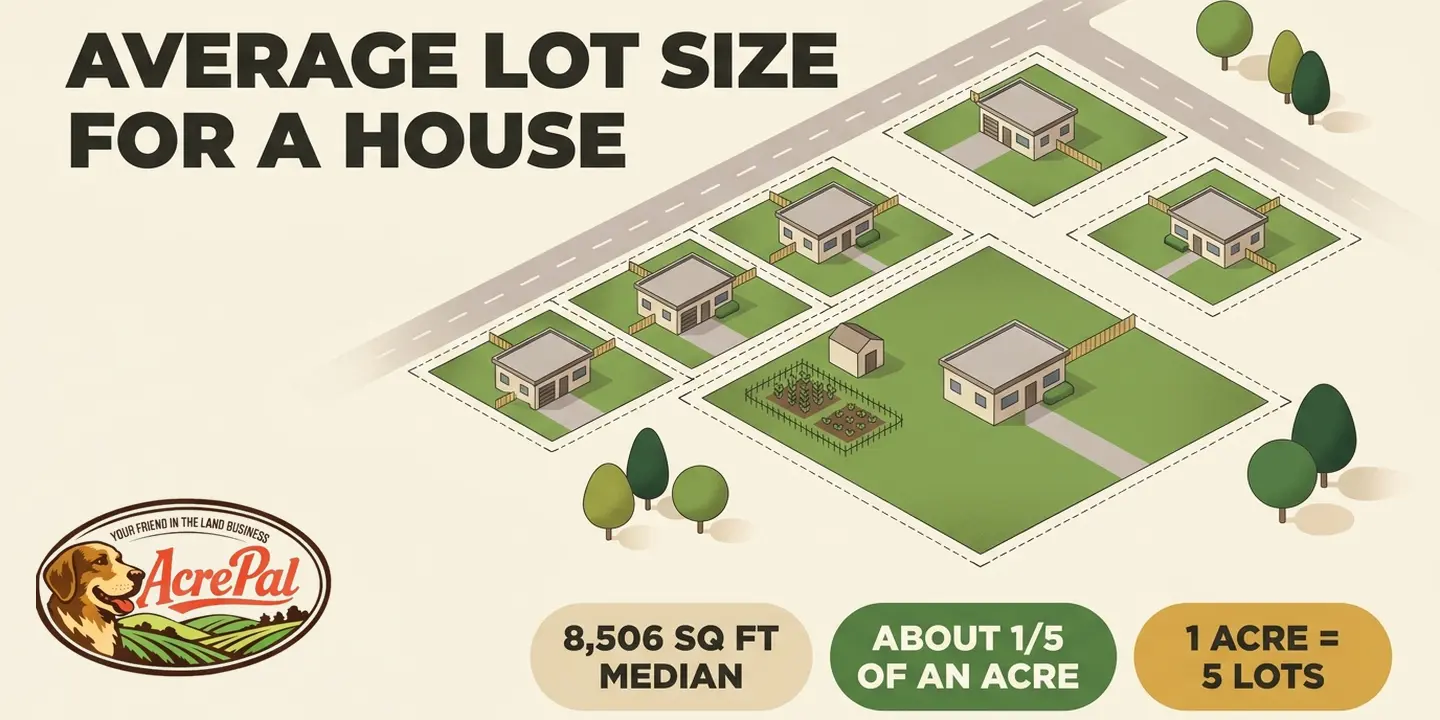
Search this question and you'll get two very different answers. One site tells you the typical lot runs more than half an acre, around 25,240 square feet. Another says it's under a fifth of an acre, closer to 8,500 square feet. Both pull from the same government data, they just measure it differently, and that gap is where most of the confusion lives.
The honest current answer is the smaller of the two. The average lot size for a house gets quoted as much bigger, but the median new-home lot in 2024 was 8,506 square feet, about a fifth of an acre, and that is the number that actually describes a typical lot people buy and build on today. The bigger figure is skewed by a few enormous parcels.
The most recent Census read backs the small-lot reality, with 41% of new for-sale homes completed in 2025 sitting on lots under 7,000 square feet. This guide walks through why the numbers disagree, how lot size shifts by region, the difference between a subdivision lot and raw acreage, and how to figure out what will really fit on a given piece of ground.
Why the Median Is the Number That Matters
The gap comes down to two different ways of averaging a pile of numbers. The median 2024 new-home lot was 8,506 square feet, which is 0.195 acre, just under a fifth of an acre. That's up slightly from 8,400 square feet in 2023 and close to the all-time low of 8,177 set in 2019. We're essentially sitting at the record-small lot today.
The mean, the plain arithmetic average, comes out much higher. A handful of multi-acre custom and estate lots drag the average up far past what a normal buyer ever sees. The economists at NAHB's Eye on Housing lean on the median for exactly this reason, and they've noted the Census masks extreme values in its public dataset, so a clean mean can't even be calculated from it. When a site quotes you a tidy 25,000-square-foot "average," it's blending in ground most people never buy.
The tell is in the custom-build number. The median lot for a custom-built home is a full acre, versus about 0.195 acre for spec and production homes. That custom tail, big lots for big one-off houses, is precisely what inflates the mean. Anyone quoting roughly 25,000 square feet or 0.58 acre is quietly mixing custom builds into a figure meant to describe ordinary subdivision lots.
These figures all track newly built homes. The full stock of existing houses skews a little larger, because a lot of it went up decades ago when developers platted roomier lots, so an older neighborhood often sits on more ground than a fresh subdivision down the road.
If you'd rather see what an acre looks like in plain terms before we go further, here's a breakdown of how big 10 acres is for scale. So which number do you trust? For a normal new subdivision lot, use the median of roughly 8,500 square feet, a fifth of an acre. Treat the 25,000-square-foot mean as skewed and set it aside.
Home Lots Have Been Shrinking for 25 Years
Lots today are smaller than they were a generation ago, and the trend is steady. The share of new for-sale homes sitting on lots under 9,000 square feet climbed from under 46% in 1999 to 65% in 2024, an all-time high. Homes on lots under 7,000 square feet went from 28% in 1999 to 40% now. The whole distribution has compressed, and the share of homes on lots over half an acre slipped from 14% in 2010 to 9% in 2024.
The reasons stack up. Builders can't get enough developed lots, with 64% of them rating developed-lot supply low or very low in a May 2025 read. Land itself keeps getting pricier, and the national median lot value hit a record $60,000 in 2024. Faced with expensive, scarce ground, builders shrink lots to keep the sticker price of the finished home within reach.
The pattern is not a pandemic blip either. The sub-9,000-square-foot share already climbed from 50% in 2011 to 61% just before COVID hit, so the compression was well underway before the housing boom.
So lots are getting smaller and more expensive at the same time, and buyers pay more for less ground. One number seems to argue the other way, the finished lot made up only 13.7% of the average new-home price in 2024, down from 17.8% in 2022.
That drop isn't because land got cheaper. Construction costs inflated faster and hit a record 64.4% of the price, which mechanically shrank land's slice. Smaller and pricier, both at once.
How Lot Size Changes by Region and Setting
National averages hide a lot of local reality, so it helps to think in bands. By setting, the working ranges look like this:
- Dense urban infill runs 3,000 to 6,000 square feet
- Standard suburban single-family runs 6,000 to 10,000 square feet, where the roughly 8,500-square-foot median sits comfortably
- Rural and exurban land starts around 1 acre and climbs from there
By Census region, the 2024 new-home medians spread out sharply. New England runs about 0.6 acre, roughly three times the national figure, driven by strict low-density zoning. East South Central sits near 0.30 acre.
The Mountain region covering Arizona, Colorado, and Nevada lands around 0.15 acre, and West South Central including Texas is about the same. The Pacific region is smallest at roughly 0.13 acre, because developable land there is scarce and expensive.
Price runs opposite to size, which surprises a lot of buyers. The Pacific has the smallest lots and the highest price, a $152,000 median lot value in 2024, while New England pairs its big lots with a $150,000 median. The cheapest ground sits in the East South Central region at roughly $48,000. Smaller does not mean cheaper, and a tight Pacific lot can cost triple a roomy one in the South.
If you want the raw conversions behind these fractions, here's a primer on how many acres are in a section of land. Some articles list the South Atlantic median at 2.0 acres, and that number does not hold up. South Atlantic new-lot values are among the lowest in the country, around a $53,000 median, which points to modest lots rather than two-acre parcels, so that figure reads like a data error you shouldn't build expectations on.
The Villages in Temecula, California, shows the suburban middle in practice. It averages just over 8,000 square feet, with individual lots running from 5,000 to more than 15,000, which lands right on the national median. If you're shopping the Pacific or Mountain West, expect tight suburban lots. If you're eyeing New England or true rural exurbs, plan for far more ground and the zoning that comes with it.
What Size House Actually Fits on a Lot
The lot's total square footage is never what you get to build on. Start with setbacks, the required gaps between your structure and each property line. Subtract the front, both side, and rear setbacks from the lot dimensions to find the buildable rectangle.
Take an 80 by 120 foot lot, which is 9,600 square feet, with a 25-foot front, 5-foot each side, and 20-foot rear setback. That leaves 70 by 75 feet, a 5,250-square-foot buildable footprint before any other limit kicks in.
Then comes the lot coverage cap, commonly 30% to 45%, which limits how much of the ground the structure can cover. At 35% coverage on an 8,000-square-foot lot, your footprint maxes out at 2,800 square feet no matter what the setbacks would otherwise allow. Coverage and setbacks are two separate gates, and you have to clear both.
For multi-story homes there's a third gate, Floor Area Ratio, or FAR, which caps total floor area across all stories combined. Los Angeles R1 zoning uses a FAR of 0.45, so a 7,500-square-foot lot allows 3,375 square feet of total floor area across every level. Whichever is more restrictive, coverage or FAR, is the one that governs your design. Zoning codes vary widely, and it's worth understanding the difference between something like R-2 zoning and denser classifications before you assume a lot fits your plan.
The national land-to-building ratio runs about 3 to 1, meaning a typical lot supports a footprint around a third of the lot area once yards, driveway, and setbacks are accounted for. Before you fall for a lot, call the local building department and ask for two numbers, the lot coverage percentage and the setback requirements. Those two figures tell you almost everything about what you can actually build.
How Big Is a One Acre Lot
One acre is 43,560 square feet. Set that against the national median new-home lot of roughly 8,500 square feet and an acre comes out to about 5.1 times larger, so one acre is essentially five typical suburban lots stitched together. That's a lot of ground by today's standard.
It's no accident that the median custom-built home sits on exactly one acre. When buyers get to choose their own lot rather than take what a developer platted, one acre is the number they gravitate to, because it fits a house, a garage, a detached shop, a garden, plus a well and septic system with the required separation between them. An acre is the classic "room to breathe" size.
Flip it around and ask how many homes fit on an acre. Under a common quarter-acre minimum you could theoretically carve about four lots from a gross acre before roads and easements, though in practice a subdivision nets closer to 3 to 3.5 homes per acre once you subtract streets and utility corridors. Dense urban eighth-acre zoning can push 7 to 8 homes per acre, while rural zoning may allow only one home per 2, 5, or more acres. The mechanics of splitting land are covered in this guide to subdividing a property, and for a feel of the raw size there's a walkthrough of how big 2 acres is.
Is one acre a lot of land for a house? By today's shrinking-lot standard, yes, comfortably. For a single home, an acre is generous.
The Minimum Lot Size to Build a House
The minimum is a floor, not an average, and utilities set it before zoning even gets a say. With full public water and sewer, urban minimums drop as low as 5,000 to 7,500 square feet, and Los Angeles sets its minimum R1 lot at 5,000. With public water but a private septic system, plan on roughly a quarter to a half acre.
With neither, on a well and septic both, plan on at least a half to a full acre of usable land. The septic drain field needs real room, and the well has to sit 50 to 100 feet from the septic to stay clean.
Zoning can then push that floor well above the average. Georgia's health standard is one acre for septic-only lots, or half an acre with public water, and some Georgia counties like Lee and Worth require a full 5 acres. Atlanta suburbs such as Milton require 2 acres. Out West the numbers climb too, with Yavapai County, Arizona's RCU-2A district at 2.5 acres, some Coffee County, Tennessee districts at 5, and remote Colorado zones running up to 35 acres.
Those cost implications add up fast, from digging a well to the combined well and septic install.
The trap catches a lot of first-time buyers. Gross acreage is not buildable acreage. Setbacks, easements, flood zones, and the drain field all subtract from the headline number, so a listing called "buildable" can leave far less usable ground than the size suggests. A small lot is fine when you have full utilities and only need a house and a yard, but you need real acreage when you're on a well and septic, want outbuildings, or the county minimum simply demands it.
Why Rural Buildable Lots Are Measured in Acres
The national median is a subdivision number. It's measured on new spec homes inside developments with municipal water and sewer already in the ground. It says nothing about raw rural land, where the buildable lot is driven by septic footprint, well separation, large agricultural setbacks, and county minimum lot sizes that commonly start at 1, 2, or 5 acres.
That's why a rural buildable lot is usually an acre and up even though a suburban house fits on a fifth of that. The acre gives room for the drain field, the well at its required distance, a driveway, and outbuildings, with no sewer or water main to tap into. Real listings show the pattern. A 2.5-acre Yavapai County, Arizona parcel runs on well and septic, half-acre unrestricted lots in Luna County, New Mexico still need a well and septic before anything gets built, and a 2-acre AG-1 lot in Clarendon County, South Carolina carries its own utilities the same way.
None of that infrastructure is cheap, and the sizing follows the cost. On raw western ground with neither water nor sewer, a well and septic together can run $15,000 to $30,000 or more before a single wall goes up. A parcel has to be big enough to hold that system and still leave room for the house, which is another reason rural lots are priced and platted around carrying their own utilities.
This is the world we work in. AcrePal sells rural, owner-financed acreage across the West and Southeast, in Arizona, Colorado, Nevada, California, and Florida, where a buildable homestead lot is measured in acres rather than square feet precisely because it has to carry its own water and septic. Owner financing means you buy the land directly from us and pay it off in monthly installments, no bank required.
Match the benchmark to the setting. Use the roughly 8,500-square-foot median when you're shopping subdivision lots, and think in usable acres when you're buying raw land. If price is your main lever, it's worth studying the best states for homesteading before you commit.
FAQ
What is the average lot size for a house?
The median new-home lot in 2024 was 8,506 square feet, about a fifth of an acre, and that's the figure that describes a typical lot. You'll often see a roughly 25,000-square-foot "average" quoted instead, but that mean is skewed upward by large estate and custom lots that most buyers never purchase. For normal shopping, trust the median.
What is the minimum lot size to build a house?
It's utility-driven first. With both public water and sewer, minimums run as low as 5,000 to 7,500 square feet. With septic only plan on a quarter to a half acre, and on a well and septic both plan on a half to a full acre of usable land. Rural zoning can then require 2 to 5 or more acres.
How many houses can you build on 1 acre?
About four under quarter-acre minimums before you account for roads and easements, and roughly 3 to 3.5 net in practice once streets and utilities eat into the ground. Dense urban zoning can reach 7 to 8 homes per acre. Rural zoning sometimes allows only one home per several acres, so the answer swings hard on local rules.
What size house will fit on my lot?
Setbacks set the outer envelope first, subtracting the required front, side, and rear gaps from the lot dimensions. Then lot coverage limits of 30% to 45%, or a Floor Area Ratio cap for multi-story homes, govern the size. As an example, 35% coverage on an 8,000-square-foot lot allows a 2,800-square-foot footprint. The more restrictive rule wins.
Are lot sizes getting smaller?
Yes, and the trend is decades long. In 2024, 65% of new homes were on lots under 9,000 square feet, versus under 46% in 1999, keeping lot sizes near their all-time low. The drivers are a persistent lot shortage and rising land cost, which push builders to shrink lots to hold finished-home prices down.