
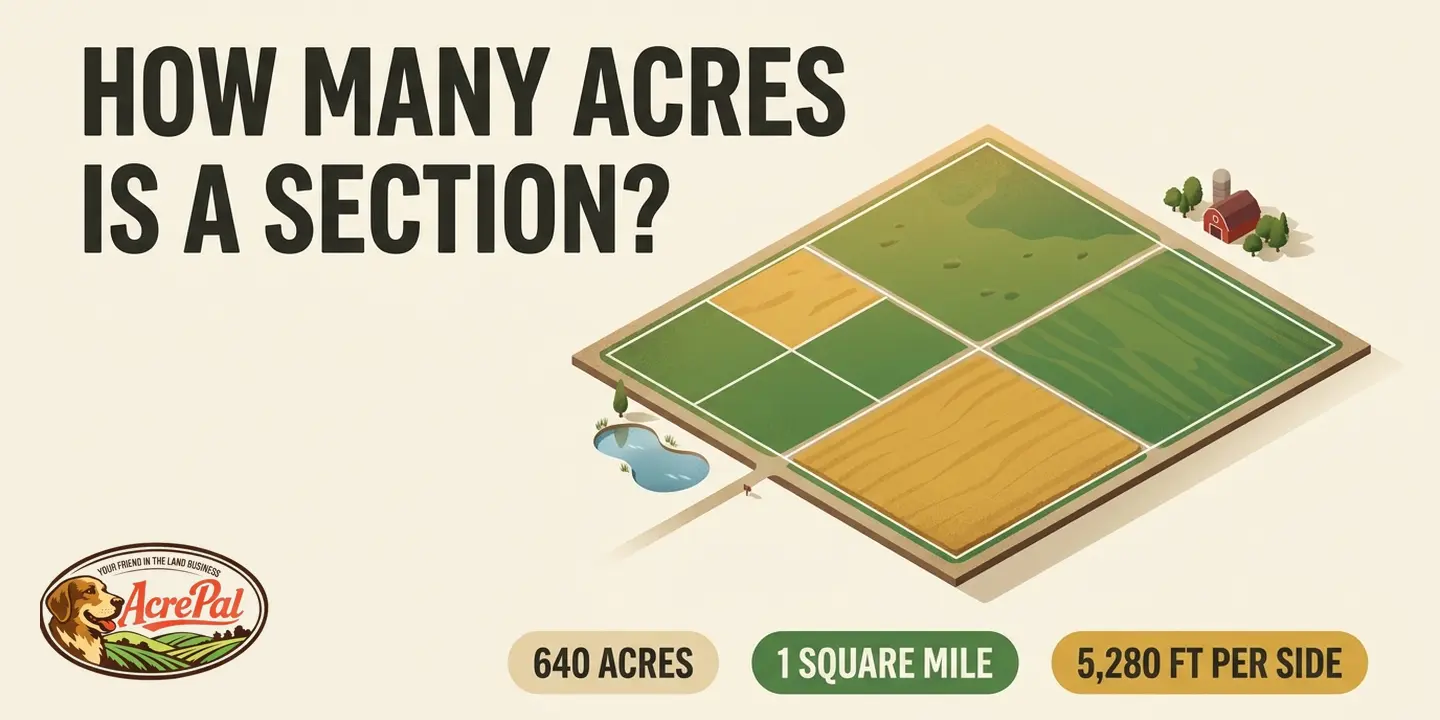
A section of land is 640 acres, one square mile, measuring 1 mile on every side. So how many acres is a section of land? Exactly 640, which works out to 5,280 feet per side, 27,878,400 square feet, and about 2.59 square kilometers or 259 hectares.
That number is where almost every other article stops, and it leaves a buyer stranded. We walk land for a living, so we will give you the parts those one-line answers skip. You will get the math laid out plainly, the clean subdivision ladder from 640 acres down to a 5-acre lot, how the word "section" actually shows up on a real deed, what a full section costs in 2026 with real dollar figures, and the difference between a section, a lot, and a plot. By the end you will be able to picture it, decode it on paper, and price it.
640 Acres, One Square Mile, and What That Looks Like
The math behind how many acres is a section of land is simple enough to check in one line, and seeing it once builds trust in every other number on this page. One acre equals 43,560 square feet, so 640 acres multiplied by 43,560 gives you 27,878,400 square feet. That is one square mile, no rounding.
Buyers picture land in straight lines, not square feet, so the per-side number matters most. Each side of a section runs 1 mile, which is 5,280 feet, or 80 chains, or 320 rods in old survey terms. In metric that whole square is about 2.59 square kilometers, or roughly 259 hectares.
Here is a section across the units people actually search for.
27,878,400 square feet
1 square mile
640 acres
Side length of 1 mile (5,280 feet, 80 chains, 320 rods)
About 259 hectares
About 2.59 square kilometers
Those figures are hard to feel, so anchor them to things you already know. One square mile is roughly 485 standard NFL football fields, since a field with both end zones covers about 1.32 acres. It is slightly smaller than New York's Central Park, which spans 843 acres, and far bigger than the National Mall in Washington at 146 acres.
Walking helps too. Crossing one mile-long side on flat ground takes about 16 to 20 minutes at a normal 3 to 3.5 mph pace, so circling the whole thing is well over an hour. A single section also holds 4 quarter sections, or 16 of the 40-acre "forties" that farmers talk about, which sets up exactly how a section breaks down. If you want a smaller anchor first, see our guides on how big 10 acres is or how big 2 acres is, since 64 ten-acre lots fit inside one section.
How a Section Breaks Down, From 640 Acres to a 5-Acre Lot
The number 640 was not picked at random. The designers of the survey system chose it because it can be halved cleanly seven times in a row and still land on a whole number of acres, all the way down to 5. That is why land in PLSS states divides into such tidy pieces, and why you keep seeing the same handful of parcel sizes in listings.
Here is the full subdivision ladder, each step exactly half the one above it.
A section is 640 acres (1 mile by 1 mile)
A half section is 320 acres
A quarter section is 160 acres (0.5 mile by 0.5 mile)
A half-quarter is 80 acres
A quarter-quarter is 40 acres (about 1,320 feet square, the "forty")
Then 20 acres, 10 acres, and 5 acres
Two of those rungs carry real history. The quarter section, 160 acres, is exactly what a settler could claim under the Homestead Act of 1862, so a huge share of rural America was first owned in 160-acre blocks. The 40-acre quarter-quarter has been the smallest piece of federal land you could buy since 1832, and it is the "forty" of American farming, the front forty nearest the house and the back forty farthest from it, usually the last field a farmer got around to working.
Mapping a listing back to acres is quick once the names click. A section holds 4 quarter sections, and each of those holds 4 forties, so 16 forties fill one section. When a listing says "the NW quarter" you know it means 160 acres, and "the SE quarter of the SW quarter" means 40. The next section shows how to read those descriptions straight off a deed.
Sections, Townships, and the Grid That Maps Most of America
A section never stands alone. Thirty-six sections stack into a township, arranged in a 6-mile by 6-mile block, which adds up to 36 square miles, or 23,040 acres. That township number is one of the most tested facts in real estate licensing, and it is worth committing to memory.
The numbering inside a township trips people up, because it does not run left to right like a book. Section 1 sits in the northeast corner, the count runs west to Section 6 in the northwest corner, then it drops one row south and snakes back east, weaving forward and back to end at Section 36 in the southeast corner. Surveyors call that a boustrophedon pattern, which means "as the ox plows."
The top two rows make it concrete.
Top row, east to west, runs 6, 5, 4, 3, 2, 1
Second row, west to east, runs 7, 8, 9, 10, 11, 12
This whole system has a name, the Public Land Survey System, or PLSS, and it does not cover the entire country. Thirty states use it, mostly those settled after the original colonies, which means the eastern states (the original 13 plus Texas, Kentucky, Tennessee, and a few others) describe land the older metes-and-bounds way instead, by walking the boundary feature to feature. Check which system your state uses before you read a deed.
The grid came out of the Land Ordinance of 1785, when a young, broke government decided to survey the frontier into clean squares before selling it. It eventually shaped about 75% of the continental United States, which is why so much of the Midwest looks like a checkerboard from a plane window. Those straight section-line roads, spaced one mile apart, are the survey itself drawn onto the land.
How to Read Section, Township, and Range on a Real Deed
Few skills pay off faster than decoding a legal description, and most buyers are never taught it. Take a real one, "NW1/4 of NE1/4 of Section 8, T.2N., R.1E." In plain English that reads as the northwest quarter of the northeast quarter of Section 8, Township 2 North, Range 1 East.
Read it from the smallest piece to the largest, which means working the quarter fractions right to left. Start with Section 8, take its northeast quarter (160 acres), then take the northwest quarter of that piece (40 acres). The township and range at the end pin down which 36-square-mile block on the map you are standing in.
The acreage formula is the part exam-takers and buyers both want. Start at 640, divide by 4 for every "quarter" in the description, and divide by 2 for every "half." So our example is 640 divided by 4 divided by 4, which equals 40 acres. A second quick one, "S1/2 of NE1/4," is 640 divided by 4 divided by 2, which equals 80 acres.
This text is not just on paper in a drawer. It lives on the recorded deed, on the county plat map, and in the county GIS or assessor parcel viewer you can usually pull up free online. Those are the places to confirm what a listing tells you.
Now the warning, because the formula gives you the ideal number, not always the real one. Earth's curvature pulls the north-south meridian lines closer together as they run north, so sections along the north and west edges of a township come up a little short. Rivers, lakes, and old Spanish land grants also refuse to fit a square grid, so surveyors carve out the leftover pieces as numbered "government lots" that can be far from 160 or 40 acres. A listing that calls itself a "quarter section" might actually be 152 acres, not 160.
The takeaway is simple. Run the formula to set your expectation, then verify the true acreage against county GIS records or the BLM's General Land Office survey plat before you sign anything. Never trust the formula alone.
How Much a Section of Land Costs in 2026
The price of a full section swings from under two hundred thousand dollars to over twenty million, and almost everything that moves it is checkable before you buy. A section is 640 acres, so you take the local price per acre and multiply. The trick is knowing which per-acre number applies.
Here is the 2026 range, cheap to premium, each figure as the per-acre price times 640.
Cheapest raw desert land in New Mexico, Wyoming, or Nevada runs under $300 per acre, so under $192,000 a section
Average undeveloped rural land runs about $1,500 to $2,500 per acre, so roughly $960,000 to $1.6 million
USDA average farm real estate in 2026 was $4,500 per acre, so about $2.88 million
Average cropland runs $6,020 per acre, so about $3.85 million
Pastureland runs $2,000 per acre, so about $1.28 million
Prime Iowa cropland averages $13,878 per acre, so about $8.9 million, with the state record at $32,000 per acre, which is $20.48 million for one section
Most buyers expect a bulk premium and get the opposite. Full 640-acre sections usually trade 20 to 50% below the published per-acre averages, because those averages are pulled up by small parcels. Tiny lots of 1 to 5 acres often cost 30 to 100% more per acre than big tracts, so buying by the section is the cheaper way to own land per acre.
What drives the number is predictable. Paved road access can make a parcel worth 2 to 5 times more than a landlocked neighbor. Water, whether a well or a live creek, adds real value, and so do utilities at the road and friendly zoning.
Cheap land carries traps, though. A parcel under $300 an acre often hides no legal access, a failed perc test that blocks a septic system, or a floodplain designation that limits what you can build. The price tag is only the start of due diligence.
For where the bargains actually are, our guide to the cheapest places to buy land breaks it down by state. AcrePal is one source of owner-financed rural parcels in markets like Mohave and Apache in Arizona, Costilla in Colorado, Elko in Nevada, Modoc in California, and Putnam in Florida.
Section vs Lot vs Plot vs Parcel, What Each One Means
These four words get used as if they mean the same thing, and they do not, which is why prices for them are worlds apart.
A section is a precise survey unit of exactly 640 acres, one square mile, defined by the PLSS grid. It is the largest and most standardized of the four.
A lot is a small, platted, buildable piece of ground, created when a larger tract is subdivided. A typical residential lot averages around 0.19 acres, though rural lots can run to a few acres.
A parcel is the broad legal term for any distinct, legally divided piece of land, at any size. Every section, every lot, and every government lot is also a parcel, so it is the catch-all word your county uses.
A plot is the informal, everyday word people use interchangeably with lot or parcel. It carries no exact legal size, so treat it as casual shorthand.
This is exactly why "how much is a lot" and "how much is a section" have wildly different answers. A small lot might run a few thousand dollars, while a full section runs into the millions, because they are not the same scale of thing. When you read a listing, check which word it uses and confirm the actual acreage.
The Bottom Line on a Section of Land
A section of land is 640 acres, one square mile, 5,280 feet on every side, and it divides cleanly down through 320, 160, 40, all the way to a 5-acre lot. On a deed it shows up as a section number with a township and range, and the quarter-by-quarter formula gives you the ideal acreage. Just remember that fractional sections are real, so you verify the true number against county or BLM records.
What it costs comes down entirely to land type and location, from under $192,000 for raw desert to more than $20 million for record Iowa cropland, with full sections usually selling below the per-acre averages. The two decisions that matter most are what you will actually use the land for and what it truly costs to buy and hold. When those line up, affordable owner-financed acreage is out there when you are ready to look.
Frequently Asked Questions About Sections of Land
What is 640 acres called
640 acres is called a section. It measures one square mile, 1 mile per side, and is the basic unit of the Public Land Survey System.
How many acres are in a square mile
There are 640 acres in one square mile, which is the definition of a PLSS section. One acre is 43,560 square feet, making a square mile 27,878,400 square feet.
How many sections are in a township and how many acres
A township contains 36 sections in a 6-mile by 6-mile grid, totaling 23,040 acres. Sections are numbered 1 to 36, from the northeast corner to the southeast.
What is a quarter section
A quarter section is 160 acres, a square half a mile per side. It is the size a settler could claim under the Homestead Act of 1862.
How much does a section of land cost
It depends on location and land type. Cheap raw desert can run under $192,000, average farmland about $2.78 million, and prime Iowa cropland $8.9 million or more. Multiply the local price per acre by 640.
Is every section exactly 640 acres
No. The 640-acre figure is the ideal. Earth's curvature, water, and old land grants create fractional sections that fall short, mostly on a township's north and west edges, so verify it in county GIS or BLM records.
What is the difference between a section, a lot, and a plot
A section is a 640-acre survey unit, one square mile. A lot is a small, platted, buildable piece, often a fraction of an acre. A plot is an informal word for a lot or parcel with no fixed legal size.
Can I buy just 40 acres instead of a whole section
Yes. Since 1832 the minimum federal parcel has been the 40-acre quarter-quarter section, and land sells at almost any size. A 40-acre tract is a common retreat or small-farm size. For a smaller scale, see our breakdown of 5 acres in square feet.