
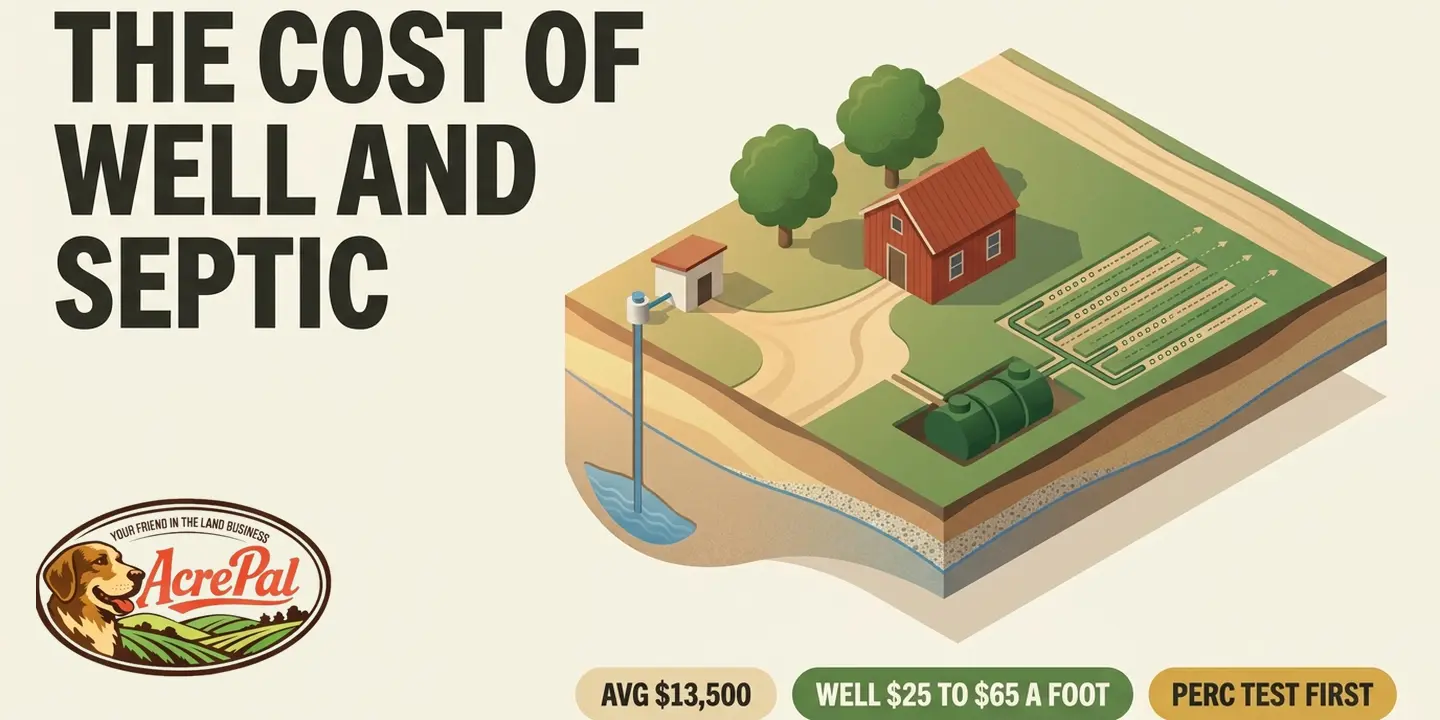
A bare parcel with no water and no waste system carries a hidden price tag most buyers never see until closing. The average cost for well and septic installation on raw land runs about $13,500 nationally in 2026, with typical projects landing between $6,600 and $21,500. Hard sites with bedrock, deep water tables, or a failed soil test routinely push past $35,000. Price this bundle before you buy, not after, because it decides whether a cheap parcel is a bargain or a money pit. In the arid West the same two systems can cost two or three times the national figure. If you are still shopping for the lowest entry point, our guide to the cheapest place to buy land pairs well with this one. The rest of this post prices the bundle piece by piece so you can judge a parcel before you sign.
The Combined Cost at a Glance
The whole bundle breaks into three moving parts, priced as a national baseline you can adjust for your county.
The well side covers everything that gets water out of the ground.
- Drilling runs $25 to $65 per foot, so a standard 200 foot well costs $5,000 to $13,000 drilled only.
- A submersible pump adds $900 to $2,500, and a pressure tank another $300 to $500.
- The electrical run from your meter to the wellhead costs $50 to $150 per foot, which adds up fast on a rural parcel.
The septic side covers everything that handles waste.
- A conventional gravity system installs for $3,000 to $10,000.
- The tank alone is $500 to $2,000, and the drain field is often the priciest single piece at $5,000 to $12,000.
- A perc test to prove the soil works runs $300 to $1,500 in most counties, plus county permits.
Then come the soft costs buyers forget before a shovel touches dirt.
- A land survey is $350 to $900, and survey plus perc plus permits can total $1,200 to $4,700 before any digging.
- Codes require 50 to 100 feet of separation between well and septic, and the connecting line at $50 to $150 per foot can add $2,500 to $15,000.
Add it all up and the honest spread is wide. A simple Midwest parcel with shallow water and good soil lands near $13,500, while a hard site climbs to $35,000 or even $60,000 and beyond. Treat every number here as a starting point, because where the parcel sits can override all of them.
The Well Side, Summarized
Depth is the wildcard that decides your well bill, and you cannot know it for certain until someone drills. Nationally you are looking at $25 to $65 per foot, climbing past $80 per foot when the drill hits hard rock. That is why a 200 foot well in the Midwest is cheap, while the same household well in the high desert can run 400 to 800 feet deep and cost several times more. Casing choice swings the number too, since steel casing for loose or fractured ground roughly doubles the cost of basic PVC.
For budgeting the bundle, plug in a moderate well around $8,000 to $13,000 in easy ground and far more in the arid West. We keep this part short on purpose. The full per foot and per depth math, casing choices, pump sizing, and how to read a driller's quote all live in our dedicated guide to the cost of digging a well in 2026. Start there once you have a target parcel and a rough depth from neighboring well logs.
The Septic Side, Priced by System Type
You do not pick your septic system. Your soil and your water table pick it for you, and each step up the ladder is a steep jump in price. A perc test measures how fast water drains through the soil in minutes per inch, or MPI, and that single number sorts you onto one of these rungs. Loamy soil at 5 to 30 MPI is ideal, 30 to 60 MPI means a larger and pricier field, and anything above 60 MPI fails and forces an engineered alternative.
The ladder runs from cheapest to most expensive, and the soil trigger sits next to each rung.
- Conventional gravity, $3,000 to $10,000. Needs loamy soil at 5 to 30 MPI and a water table at least 4 feet below the field.
- Pressure distribution, $10,000 to $18,000. For marginal soils that cannot spread effluent evenly on their own.
- Aerobic treatment unit, or ATU, $12,000 to $20,000 plus a mandatory $200 to $500 per year service contract. For thin soil sitting over bedrock.
- Mound system, $15,000 to $30,000 and up. For a high water table or heavy clay, common across Florida.
- Sand filter, $16,000 to $28,000. For coastal zones and sensitive watersheds that demand extra treatment.
- Drip distribution, $18,000 to $30,000. For steep slopes and tight lots where trenches will not fit.
The number that should scare you is the engineered multiplier. A fully engineered system costs 4 to 6 times a conventional one on the same lot, and in a regulatory hotspot like Chatham County, North Carolina near the Jordan Lake watershed, bills have reached $150,000. These are not rare horror stories. One raw land buyer on Reddit priced an alternative system at $40,000 to $45,000 against the $5,000 to $10,000 they expected. Homesteader Angela Orecchio hit barely a foot of soil over rock in Tennessee and got quoted $12,000 to $15,000 for a mound against $4,000 to $6,000 for conventional. The soil made the call, not the budget.
Make Your Offer Contingent on a Passing Perc Test
A failed perc test is not just a line item. It can strip more than half the value off a parcel and, in the worst case, make the land legally unbuildable for a home. One owner on r/Homebuilding watched their house burn down, then learned the soil failed a perc test and the county would not let them rebuild. That is the downside you are insuring against, and the insurance is cheap.
So do not merely budget for a perc test. Make your written offer contingent on a passing one, so a bad result lets you renegotiate or walk instead of owning a problem. A perc contingency turns a soil failure into leverage rather than a loss. You build that protection into a purchase a few ways.
- Ask the seller for any existing perc result and its date, since validity is set by county and runs anywhere from six months to five years.
- Request a 30 to 45 day due diligence window rather than the standard 14 to 30, because counties with pre-soak requirements and approval queues run long.
- Put explicit contingency language in the contract, not a vague verbal understanding.
- If it fails, request a price cut for the alternative system delta, ask the seller to install a permitted system before closing, or exercise the contingency and walk.
The test itself runs $300 to $1,500 for most raw land buyers, $700 to $2,000 in Colorado, and $1,200 to $3,500 in California. Schedule it for late winter or early spring when the water table peaks, because a pass under worst case conditions is bulletproof. Pair this with the rest of your paperwork homework in our guide to deed vs title, and if budget is the constraint, see how buyers structure a purchase in how to buy land with no money. Spending under $2,000 to avoid a $0 value parcel is one of the best trades in raw land.
Where the Parcel Sits Changes Everything
The national average becomes useless the moment you name a county. The same two systems swing wildly by region, and in a few places a well is not just expensive but legally or physically impossible. The ground looks very different across the markets buyers ask us about most.
- Arizona, in Mohave and Apache Counties, runs wells 400 to 800 feet deep at $14,000 to $35,000 all in, with a statewide median near $15,400, roughly double the national figure. Many drillers quote a no water clause, so you pay even for a dry hole.
- Colorado, in the San Luis Valley and Costilla County, sees roughly 600 foot wells at $18,000 to $25,000, a permit around $500, and a wait for a driller that can stretch close to a year. A marginal well is not automatically dead, since a yield as low as 0.25 gallons per minute can serve a household with storage tanks and a pressure booster.
- Florida, in Putnam County, has such a high water table that wells are shallow and cheap, but that same water table often forces a mound system, flipping the savings straight over to the septic side.
- Nevada, in Elko County, sits in basin and range country where depth varies sharply from one valley to the next.
Colorado carries a warning the brochures skip. In August 2025 the Fort Garland bulk water station stopped selling to residents outside town limits, cutting off hundreds of cistern households overnight. If you are weighing parcels there, read our roundup of cheap land in Colorado for sale with water access front of mind. We sell owner financed, off grid friendly rural land across these exact Arizona, Colorado, Nevada, California, and Florida markets, so this kind of pre purchase water and septic due diligence is baked into how we think buyers should size up a parcel at AcrePal. Name the county before you trust any average.
Do You Even Need a $20,000 Well and Septic
A drilled well plus a conventional septic system is the assumed path, but it is not the only one, and sometimes it is not the smart one. Depending on how you will use the land, off grid alternatives can cut your upfront cost hard, though each carries an honest catch worth knowing before you count on it.
- Cistern plus hauled water. Install runs $2,000 to $20,000, but you then pay $150 to $400 per load or $2,000 to $6,000 and up every year, and lenders will not treat it as a permanent water source for a mortgage.
- Rainwater catchment. Free where it is legal, but the arid West rarely gets enough rain to rely on it, and wildfire ash can contaminate a catchment for a season.
- Composting toilet plus greywater. Around $2,300 to $5,200 total against $6,000 to $30,000 for septic, and it works on land that fails a perc test, but most counties will not allow it as the only waste system for a permanent home.
- Holding tank. A legal stopgap in some counties while you build, though it needs regular pumping and is rarely a long term answer.
The honest verdict cuts both ways. Off grid can slash the entry cost, but hauled water can be cut off with no notice, as Fort Garland households learned, and most lenders require a permanent water source before they will finance anything. Model the annual cost and confirm county legality before you bank on any of these. What matters most is how you will actually use the parcel, since a full time home usually needs the full $20,000 of well and septic while a seasonal cabin may not. If self sufficiency is the goal, our guide to the best states for homesteading weighs these tradeoffs by state.
Two Parcels Priced From Bare Dirt to Working Water
Ranges are useful, but a single all in total is what lets you sanity check your own budget. Two realistic scenarios, one close to services and one remote, show the real spread when you build the number line by line.
Parcel A sits close to services in Northern Indiana, the easy case.
- Drilling a moderate 200 foot well at $40 per foot, about $8,000.
- Submersible pump $1,500 and pressure tank $400.
- A short electrical run from a nearby meter, about $1,600.
- Conventional gravity septic with tank and drain field in good soil, about $6,500.
- Perc test $1,000, county permits $500, and a survey $500.
- All in, about $20,000.
Parcel B sits on remote arid West land near Kingman, Arizona, the hard case.
- Deep well around 500 feet at $50 per foot, $25,000 drilled.
- Pump $2,500 and pressure tank $800.
- A 200 foot electrical run at $100 per foot, $20,000.
- Water softener $1,800 and reverse osmosis $2,500 for hard desert water.
- Well permit $300 and a conventional septic at $8,000.
- All in, about $60,900.
That remote total is no outlier. It matches the $52,000 one buyer documented on YouTube before breaking ground, and it sits inside the $29,000 to $52,000 realistic range for a Costilla County, Colorado parcel. Same two systems, a threefold spread, driven entirely by depth, distance, and soil. That is the whole argument for pricing the parcel before you buy it rather than after. For the wider picture of power, road, and connection costs that ride alongside water and waste, see how much it costs to get utilities on land.
Frequently Asked Questions About Well and Septic Costs
How much does it cost to put in a well and septic system on raw land?
Expect about $13,500 combined on average in 2026, with most projects between $6,600 and $21,500. That covers a moderate 150 to 200 foot well and a conventional septic in good soil. In the arid West, where wells run 300 to 800 feet, all in totals frequently reach $30,000 to $60,000 once you add pump, electrical, treatment, permits, and the perc test.
What pushes the cost past $35,000?
Four drivers do most of the damage. A deep well, since every foot costs $25 to $70 and a 500 foot Arizona well hits $25,000 drilled alone. A failed perc test that forces an engineered system at $12,000 to $45,000. A long electrical run to the wellhead. And a remote parcel where contractor travel and thin competition inflate every bid.
Do I need a perc test before buying raw land?
Yes, and you should make your offer contingent on passing one. A failed perc test means no conventional septic, forcing alternatives that cost 4 to 6 times more, and some land cannot support any approved system, which makes it unbuildable for a home. A perc contingency costs $300 to $1,500 in most counties and protects you from buying a parcel with no developable value.
How deep are wells in Mohave County, Arizona?
Typical depths run 400 to 800 feet, with all in project costs of $14,000 to $35,000. Some northern Mohave County aquifers simply do not produce water, so drillers may quote with a no water clause. Arizona's statewide median well project is $15,400, roughly double the national average.
What is the cheapest septic system option?
A conventional gravity system at $3,000 to $10,000 is the cheapest, but only if the soil percolates in the 1 to 60 MPI range and the water table sits 4 feet below the drain field. If the soil fails, the next cheapest is a pressure distribution system at $10,000 to $18,000.
What happens if the well driller doesn't find water?
In many markets you pay for the drilling anyway, especially in northern Mohave County, Arizona where some aquifer zones do not produce. Before you drill, check neighboring well logs through your state database to gauge the odds. Always ask the driller about their no water policy up front and get it in writing.