
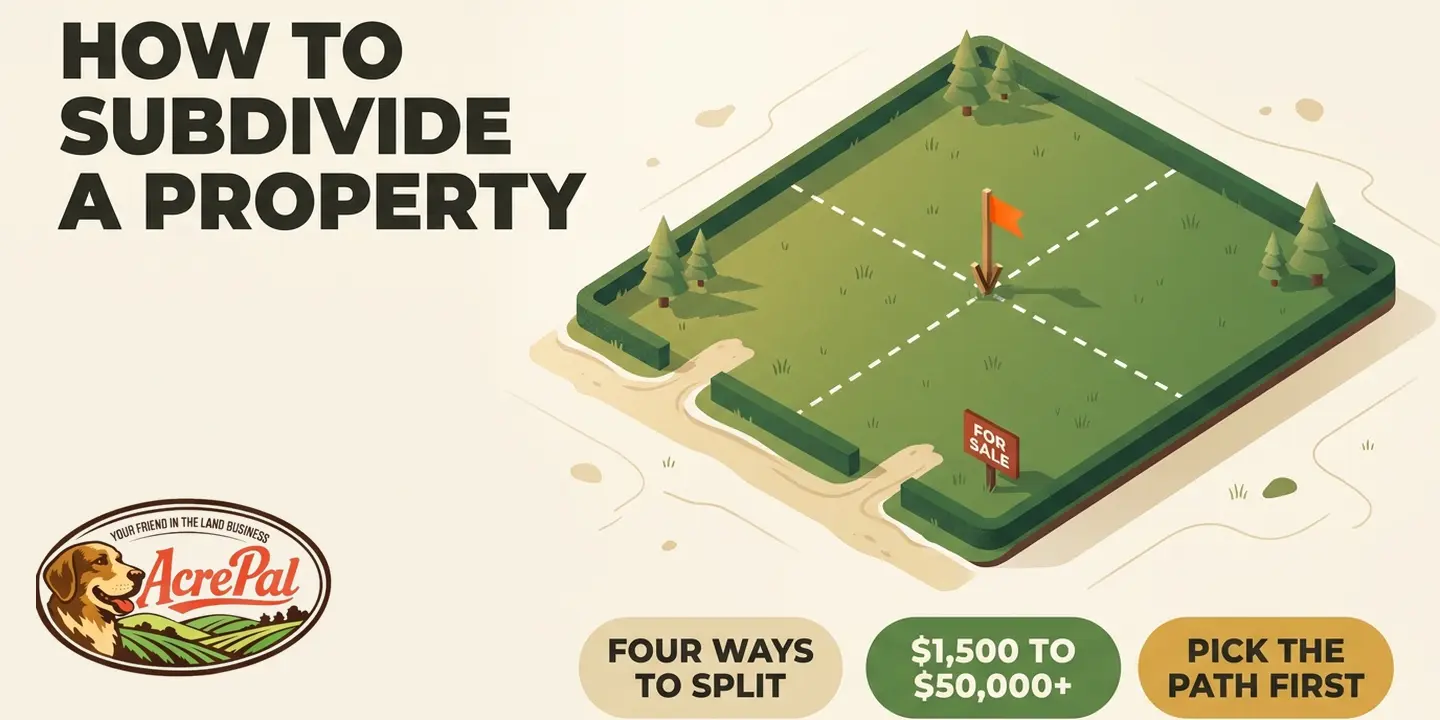
The same 20-acre split can cost you $1,500 or $50,000, and the difference is one decision you make before spending a single dollar. Most guides on how to subdivide a property walk you straight into the expensive version, the one with civil engineers, public hearings, and a year of waiting. That path is real, but for cheap rural land it is usually the wrong one.
Subdividing means turning one parcel into two or more legally separate lots, each with its own deed and parcel number, so you can sell off a piece, hand one to family, or create sellable inventory. There are four legal ways to do it. Most people splitting land they already own qualify for the two cheapest, and the whole game is picking the right one before you hire anyone. The cheapest path can clear in about six weeks for a few hundred dollars in fees, while the full plat process can run past $200,000 and take two years. The eight steps below run in the order that saves you the most money.
Step 1: Know Which Kind of Split You Actually Need
Ask a surveyor to "subdivide my land" and you might mean any of four completely different processes. They are not interchangeable, and naming yours first is what decides your cost, your timeline, and whether you ever have to sit through a public hearing.
Land subdivision is the legal division of one parent parcel into smaller parcels, sometimes called subdivided lands, each able to be sold and titled on its own. What separates the four paths is how many new lots you create and whether the county has to sign off.
- Boundary line adjustment (also called a lot line adjustment). This reshapes the line between two lots that already exist. It creates no new parcel, so it is the cheapest and fastest option at roughly $1,500 to $5,000 and about 90 days. Use it to fix an encroachment or move acreage from one lot to a neighbor, not to make something new to sell.
- Exempt plat. Several states let you divide land with a surveyor and nothing else if your lots clear a size or count threshold. No county approval, roughly six to twelve weeks. Step 3 covers exactly who qualifies.
- Minor subdivision (an administrative lot split). This creates two to about five new parcels with county sign-off but usually no public hearing and no new roads. Budget $1,630 to $15,000 and four to six months.
- Major subdivision. This is the one every other guide describes. Many lots, new roads, drainage, civil engineers, and public hearings, running $10,000 to more than $200,000 and six to twenty-four months or longer.
Most people splitting rural land they already own fall into the exempt or minor category, not the major one. The trap is assuming your split has to be the major one and pricing in engineers you will never hire. A boundary line adjustment and a major subdivision are as different as changing a tire and rebuilding the engine, and treating them as the same job is what leads to a $50,000 quote for a $2,000 problem. Figure out which of these four you need and the rest of the process falls into place.
Step 2: Confirm the Land Can Be Divided
You can spend $3,000 on a survey and still end up with nothing if the county minimum lot size or a recorded covenant makes your split illegal. Thirty minutes of homework up front prevents that.
Three checks tell you whether a division is even possible.
First, zoning and minimum lot size. Every zoning district sets a smallest legal lot, and if yours requires five-acre minimums you cannot carve out two-acre lots no matter how you draw the lines. Density and setback rules matter too. We keep the full zoning breakdown in our guide to the R-2 zone, and the residential ladder from R-1 through R-4 in the R-3 zoning definition, so start there if you are not sure what your parcel allows.
Second, the county subdivision ordinance. This document lists how many lots trigger a public hearing, the minimum road frontage each lot needs, and how many times a single parcel can be split. The fastest way to read it is to call the planning department and ask for a pre-application meeting. It is usually free, and staff will tell you upfront whether your plan is feasible before you pay anyone.
Third, private restrictions. Recorded covenants, conditions, and restrictions, or an HOA or POA, can forbid or limit splitting even when zoning allows it. These run with the land whether or not the association is active, so read your deed and pull the recorded documents at the county recorder. Our POA vs HOA guide explains how those private rules bind you, and the deed vs title breakdown covers what is actually recorded against your parcel.
Landowners often discover a deed restriction only after spending real money on a subdivision that was never going to happen. Do these three checks first, then move on.
Step 3: Check for a State Exemption Before You Hire Anyone
This is the step that can turn a $30,000 project into a $2,000 one, and almost no guide lays it out. Several states let you divide land with a surveyor only, zero county subdivision review, as long as each new lot clears a size or count threshold. Weeks instead of months, hundreds of dollars instead of tens of thousands.
The thresholds sit at a different line in each state. Verify the current rule for your state and county before you rely on it, because the numbers are load-bearing.
- Colorado. Any division into parcels of 35 or more acres each, where none is meant for multiple owners, is exempt from county subdivision regulation under C.R.S. 30-28-101(10)(b), the 1972 rule land people call Senate Bill 35. You record a land survey plat and new deeds, with no planning review or hearing. Costilla County's Rural Residential district sits right on this 35-acre line.
- Texas. Under Local Government Code Section 232.0015(f), if every resulting lot is larger than 10 acres you can divide without filing a subdivision plat, statewide. The catch is strict. If even one lot comes in at 10 acres or under, the full platting process kicks back in.
- Arizona. In rural unincorporated areas you can create up to five lots, the so-called five split, without triggering an Arizona Department of Real Estate public report. Create six or more lots each under 36 acres and you become a subdivision under A.R.S. 32-2101(54), which forces you through the public report process before you can sell. Each lot in a five split needs to be over an acre with legal road access, and the filing runs about $400 and six weeks.
- Nevada. Divisions of four or fewer lots use a parcel map under NRS 278.461. Five or more lots require a final subdivision map. In Elko County both applications carry a $400 fee.
Two caveats keep you out of trouble. The exemption is from subdivision rules only, not zoning, so you still confirm each new lot's allowed uses. And Arizona earned a reputation for "wildcat subdivisions," paper splits sold off with no real road access or water, so an exemption that skips the county does not skip your responsibility to give every lot genuine access. Check your state's threshold before you call an engineer. It may be all you need.
Step 4: Give Every New Lot Legal Road Access
The most expensive mistake in any split is creating a back lot that no car can legally reach. Sell or split off the road-fronting piece without reserving access, and the remaining parcel is landlocked. Lenders will not mortgage it, the county will not permit a build on it, and utility and septic approvals stall out. Its value craters.
Every new lot needs its own legal access, meaning either frontage on a public road or a recorded access easement. You have a few ways to provide it.
- A recorded easement or right-of-way across the retained or a neighboring parcel, written down and filed at the recorder.
- A flag lot, also called a panhandle, where a narrow strip of roughly 12 to 25 feet connects the back lot to the road.
- An easement by necessity as a legal backstop, which the law can grant when a split leaves a parcel with no way out, though needing to litigate for it is a situation to avoid.
The rule that matters most is timing. The access has to be recorded at the moment you record the split, because the split itself is what creates the landlocked condition. Wait until after and you have handed yourself a lawsuit instead of a clean easement. Access also drives your utility plan, since each lot needs its own route to power, water, and a septic site. Our guides on getting utilities to land and well and septic costs show what that runs per lot. Get access wrong and even a large, well-priced parcel can end up unsellable, because a lot nobody can finance is a lot almost nobody will buy.
Step 5: Hire a Surveyor and Get the Plat Drawn
The licensed land surveyor is the one hire you cannot skip. They legally establish the new boundary lines, write the fresh legal descriptions, and produce the plat that the county records. No survey, no subdivision.
A surveyor establishes your existing boundaries, locates any easements or encroachments, draws the proposed lot lines, and prepares the plat plus new legal descriptions for each lot. Expect $500 to $8,000 depending on acreage and how complicated the parcel is. The field work itself often runs about eight weeks, so start it early rather than treating it as a last-minute errand. If you are doing an Arizona-style exempt paper split, a title company can rewrite the legal descriptions for a few hundred dollars with no field survey at all, which is the cheapest shortcut in the whole process.
Pick your surveyor for their county relationships, not just their quote. One who already works with your planning department knows the exact application format and will flag problems before you submit, which saves you more grief than any discount on the quote ever will. A civil engineer only enters the picture on the major path, where roads and drainage need designing. For a minor or exempt split you do not need one, so do not let anyone sell you that work. That single mistaken hire can add thousands to a job that never called for it, since engineering design alone runs $2,000 to $20,000 on projects that actually require it. By the end of this step you should have a recordable survey and a legal description for every new lot.
Step 6: File With the County and Record the New Lots
This is where the split becomes legally real, and it is far less dramatic than the horror stories suggest. The public-hearing gauntlet only shows up on the major path. For a minor or exempt split it is an administrative filing and a trip to the recorder.
For a minor or exempt split, the sequence is short.
- Submit your plat, the new legal descriptions, and the application with its fee, often around $100 to $200 per new parcel.
- Wait out the county review, usually 2 to 30 days. Expect one round of revisions. Even clean minor plats tend to come back with ten or fifteen small changes, so treat that as normal rather than a setback.
- Record the approved plat, the new deeds, and any access easements at the county recorder, which runs roughly $30 per document.
Only the major path adds the heavy machinery. There you file a preliminary plat, absorb staff comments, and appear at a public hearing where neighbors can object before the final plat is approved. If that is your route, meet the neighbors before the hearing so their concerns do not ambush you.
Once everything is recorded, the county assessor assigns each lot its own parcel number and issues separate deeds and legal descriptions. Now each lot can be sold or transferred on its own. Until that final plat is recorded, though, you generally cannot sell a lot, only accept a contract contingent on approval. This is also where the difference between a deed and a title becomes concrete, since each new lot gets its own of both.
Step 7: Clear the Mortgage and Tax Traps
Two money traps live outside the county process, and both can bite after the survey is done. Neither is complicated once you know it is there.
The first is your mortgage. If any loan is recorded against the parent parcel, the lender holds a lien on the whole thing, and you cannot convey a piece of it without a partial release of mortgage. You request the release with your survey and the sale price, the lender appraises both the piece being released and the remainder to confirm the loan-to-value still works, and the release gets recorded alongside the new deed. Some mortgages prohibit partial releases outright, and splitting without consent is a default event, so this is a conversation you have with the lender before you record anything. A lender may also require a partial payoff of the loan before it will sign the release, so ask about that early.
The second is property tax. The moment the split is recorded, the assessor assigns new parcel numbers and issues a separate tax bill for each lot. More lots mean more annual carrying cost until they sell, which is easy to forget when you are focused on the upside. If you are financing the hold, our guide on buying land with little money down covers ways to keep that cost manageable. Skip this step only if you own free and clear, and even then, budget for the new tax bills.
Step 8: Decide Whether to Keep, Gift, or Sell the New Lots
You did the work to create real, separate lots. Now the payoff depends on what you do with them, and the two most common goals each have a wrinkle worth knowing.
Gifting a lot to family
Subdividing land for family is one of the oldest reasons people split a parcel, and the order matters. The lot has to legally exist first, with its own survey and deed, before you can gift it. Then the 2026 gift tax rules are friendlier than most people expect. You can give up to $19,000 per recipient per year, or $38,000 as a married couple, with no filing at all. Above that you file IRS Form 709, but no tax is owed until your lifetime gifts pass $15,000,000 per person, so most families never pay a dime.
The real trap is cost basis. A lifetime gift passes your original basis to the recipient. If you bought the land for $20,000 and it is worth $80,000 when you gift it, your child inherits your $20,000 basis and owes capital gains on the full $60,000 if they sell. Land that is inherited instead gets a stepped-up basis to market value, which can erase that gain entirely, so sometimes waiting is the tax-smart move. Some states also waive transfer tax on family gift deeds, such as Virginia under Code section 58.1-811 and Tennessee with the right affidavit.
Selling the lots
Selling is where a split earns its keep, thanks to the subdivision premium. Smaller lots sell for more per acre because more buyers can afford the total price. A 20-acre parcel worth $4,000 an acre is an $80,000 sale, but four 5-acre lots at $7,000 an acre bring $140,000, a 75 percent gain on the same dirt.
Owner financing pushes it further by turning each lot into monthly income. Sell a lot with a small down payment and payments over several years and you collect more than a cash sale while opening the pool to buyers who could never write a check for the whole thing. This is exactly the model we run at AcrePal, buying rural land across Arizona, Colorado, Nevada, California, and Florida and selling smaller owner-financed parcels that regular buyers can actually afford. If you want to see how the numbers work as an income stream, our guide on making money from land breaks it down, and the cheapest places to buy land shows where the margins are best.
Frequently Asked Questions
Do I always need an engineer and a public hearing to split my land?
No. Only major subdivisions with new roads and high lot counts require a civil engineer and a public hearing. Three faster paths skip both. An exempt plat needs only a surveyor, a minor subdivision gets administrative county sign-off without a hearing, and a boundary line adjustment just reshuffles existing lines. Most rural splits fall into these lighter categories, so you rarely need the expensive path at all.
What is the difference between a lot split, a minor subdivision, and a boundary line adjustment?
A lot split and a minor subdivision both create new parcels from a parent parcel, which means a survey, new legal descriptions, county recording, and usually administrative approval. A boundary line adjustment does not create any new parcel. It only moves the line between two lots that already exist, so it cannot add something new for you to sell. If your goal is a new sellable lot, a boundary line adjustment will not get you there.
How much does it cost to subdivide a property?
A boundary line adjustment runs about $1,500 to $5,000. A minor subdivision of two to five lots runs $1,630 to $15,000. A full major subdivision runs $10,000 to more than $200,000. The single biggest variable is whether the county makes you build roads or extend utilities, which can add $20,000 to $50,000 per mile of road and thousands more per lot for hookups.
How long does it take to subdivide land?
An exempt plat in Colorado, Texas, or Arizona takes about six to twelve weeks. A minor subdivision of a few lots takes four to six months. A standard subdivision needing county approval takes six to twelve months, and a major subdivision with engineering, roads, and hearings takes twelve to twenty-four months or more. Minor plats almost always need one revision round, so build that in.
Can I subdivide land that still has a mortgage?
Yes, but you need a partial release of mortgage from your lender first. The lender appraises both the piece you want to release and the land you are keeping to confirm the loan-to-value stays acceptable, then records the release alongside your new deed. Some mortgages prohibit partial releases entirely, so read your loan documents or ask the lender before you start.
How many lots can I create in Arizona without a public report?
Five or fewer. Under A.R.S. 32-2101(54), creating six or more lots each smaller than 36 acres makes you a subdivision and triggers an Arizona Department of Real Estate public report before you can sell any of them. Staying at five or fewer lots in rural unincorporated areas keeps you in the simpler five-split process, though your county may still apply its own lot-split rules.