
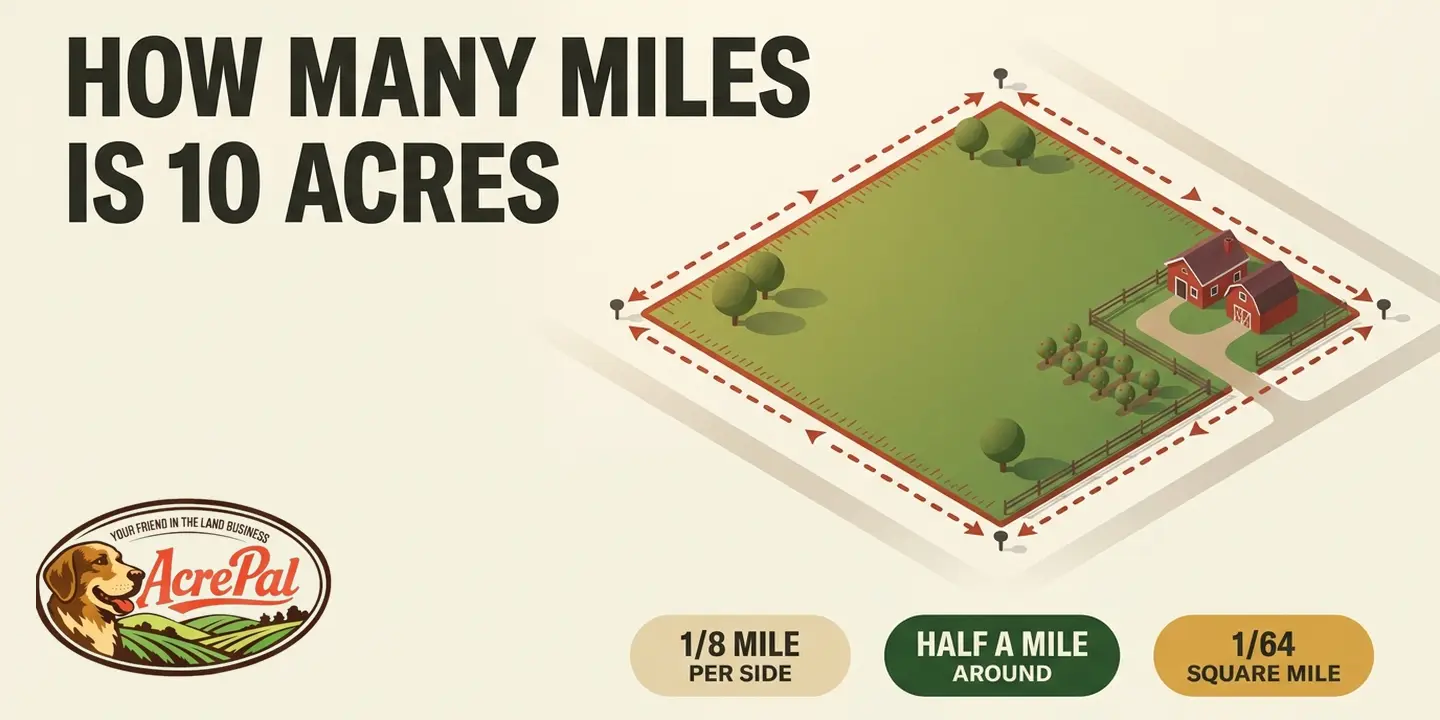
The question feels a little off, and that is because it is. Acres measure area, miles measure distance, so no single mile figure answers how many miles is ten acres. What most people want is one of three real numbers, and all three are easy to give.
For a square 10-acre parcel, the short answer is three numbers.
- One side across is 660 feet, which is 1/8 of a mile.
- All the way around the outside is 2,640 feet, which is exactly half a mile.
- As map-scale area, 10 acres is 0.015625 square miles, or 1/64 of a square mile.
The rest of this guide walks through each of those, then does the same math for 5 and 20 acres and shows what that half-mile perimeter costs to fence. If you would rather picture what 10 acres actually looks like and what fits on it, start there instead.
Why You Cannot Convert Acres to Miles Directly
An acre is a unit of area. Ten acres equals 435,600 square feet, a flat amount of ground. A mile is a unit of distance, 5,280 feet in a straight line. You cannot turn an area into a single length any more than you can turn a gallon into an inch. They describe different things.
The one place the two ideas legitimately meet is square miles, and that is where most of the confusion starts. A square mile is still an area, not a distance, so the number you get there answers a different question than the one most people are picturing.
What people usually mean is one of three questions. How far is it around the edge, which is the perimeter. How far is it across, which is a side or the diagonal. Or how big is it on a map, which is square miles.
Real searchers give this away in how they ask. One person on Quora opened with "I know this is an odd calculation, but how many miles are in 10 acres." A user on r/learnmath trying to find the distance around a farm said they "kept getting the square mile answer, which was way too low." They wanted a distance and kept landing on an area. We will take the three questions in order.
The Direct Answer: One Side, All Four Sides, and Corner to Corner
Start with a perfect square, because that is the cleanest case and the one every quick estimate assumes. Ten acres is 435,600 square feet, and the square root of that is 660 feet, so each side of a square 10-acre parcel is exactly 660 feet, which is 1/8 of a mile.
From that one number, every distance falls out.
- One side, straight across, is 660 feet, or 1/8 mile. At a normal 3 mph walking pace that is about a 2 and a half minute walk.
- All four sides, the full perimeter around the outside, is 2,640 feet, which is exactly half a mile. That is roughly a 10-minute walk.
- Corner to corner, the diagonal, is 933 feet, or 0.177 mile. Call it a 3 and a half minute walk.
Now the correction that trips up half the pages on this topic. People hear "1/8 mile per side" and call the trip around a quarter mile, usually because they added just two sides or the two dimensions of the lot. A square has four sides, so the walk around is four times 1/8, which is half a mile, not a quarter. It is an easy mistake to make and a costly one if you use it to budget fence. If you take one honest one-number answer away from this, it is that 10 acres is about half a mile around the outside.
To feel it, half a mile is a standard 10-minute walk, the kind you would not think twice about. One side, that 1/8 mile, is the length of one north-south block in Chicago's grid, which is exactly one furlong. The diagonal, at 933 feet, is a useful number in its own right, because it is the longest straight line you can walk without leaving the parcel, and it is the same 933 feet as one side of a 20-acre square. For what the space holds rather than how far around it runs, see what 10 acres looks like.
10 Acres in Square Miles (and Why That Number Feels So Small)
If you wanted the map-scale answer, the one measured in square miles, the math is short. One square mile holds 640 acres, so you divide by 640. Ten divided by 640 is 0.015625 square miles, which is exactly 1/64 of a square mile.
It feels tiny for a reason. A single square mile packs in 640 acres, so 10 acres is a thin slice of the grid you see from the air, even though it is a real amount of ground to own, fence, and walk. That 640-acre square is what surveyors call a section of land, and 10 acres is 1/64 of one.
One number here gets published wrong constantly. Some pages claim 10 acres is "about 0.03 square miles," which is nearly double the real value. The correct figure is 0.015625, and the mix-up usually comes from confusing square miles with the perimeter-in-miles number. Keep the two apart. The area is 0.015625 square miles, and the distance around the outside is 0.5 miles, two completely different quantities that get run together all the time.
For reference as we scale up, 5 acres works out to 0.0078 square miles and 20 acres to 0.03125 square miles, the same divide-by-640 rule every time. This is also why land is almost always listed in acres, not square miles. Acres keep the numbers big enough to picture, while the square-mile version of a normal parcel collapses into a string of decimals nobody can feel.
Why One Side Lands on an Exact 660 Feet
It is no accident that a 10-acre square comes out to a tidy 1/8 mile per side. The clean number is baked into how the acre was defined in the first place.
An acre was set as 1 chain by 1 furlong, which is 66 feet by 660 feet, and that equals 43,560 square feet. A furlong is exactly 660 feet, and a furlong is exactly 1/8 of a mile, since 5,280 divided by 8 is 660. So the furlong is hiding inside every acre.
Ten acres happens to equal 10 square chains, and a square of that area has a side of 660 feet, one full furlong, because 660 times 660 is 435,600. That is why this particular size lands on a clean mile fraction. An odd size does not. A parcel like 13 acres has a square side of about 752 feet, which is no neat fraction of anything.
A little history explains why the whole system lines up. Edmund Gunter designed the surveyor's chain in the 1620s so farm measures would divide evenly into miles, where 80 chains make a mile and 640 acres make a square mile. The same 660 feet still defines a north-south Chicago block. All of this clean arithmetic only holds for a true square, and real parcels rarely are one.
5 Acres and 20 Acres in Miles
The same three numbers work for the sizes on either side of 10 acres. Take a square 5-acre parcel first.
- Side across is 467 feet, or 0.088 mile.
- Around the outside is 1,867 feet, or 0.354 mile, about a 7-minute walk.
- Area is 0.0078 square miles.
And a square 20-acre parcel.
- Side across is 933 feet, or 0.177 mile.
- Around the outside is 3,733 feet, or 0.707 mile, about a 14-minute walk.
- Area is 0.03125 square miles.
Those perimeters hide a useful quirk. Doubling the acreage from 10 to 20 does not double the distance around. The perimeter grows with the square root of the area, so going from 10 to 20 acres adds only about 41 percent more boundary. Half a mile becomes about 0.71 mile, not a full mile. That is why 20 acres does not cost twice the fence of 10, and it is worth remembering when you are comparing parcels by the foot of fence rather than by the acre.
The same rule runs the other way. Dropping from 10 acres to 5 does not halve the walk around, it only shaves it to about 0.35 mile. Area falls faster than the boundary does, because you are shrinking two dimensions at once while the perimeter tracks just one.
For the deeper breakdowns, see 5 acres in square feet and what 20 acres is like. The same method sizes any parcel, right down to 2 acres or 1 acre in square yards.
The Catch: Real Parcels Are Almost Never Perfect Squares
Every number above assumes a perfect square, and the deed in your hand probably is not one. Shape sets the distance around just as much as size does, and that has real consequences for your budget.
The same acreage can wrap a very different perimeter. A long strip that measures 165 feet by 2,640 feet is still exactly 10 acres, but the distance around it is 5,610 feet, which is 1.06 miles. That is more than double the square's half mile, so more than double the fence for the identical acreage. A square is the most compact rectangle there is, and every other shape has a longer boundary.
Why parcels come out irregular has to do with how land was surveyed. Metes-and-bounds descriptions follow creeks, ridgelines, and old roads, so the corners land wherever the landscape does. Even tidy PLSS aliquot lots drift off a true square because of survey error and the way meridians converge as you go north. A 10-acre parcel is the smallest standard aliquot piece, the quarter-quarter-quarter, 1/64 of a 640-acre section, but aliquot does not guarantee square.
Treat the square numbers as a floor, the shortest possible boundary for that acreage. Use them for a compact lot, then pull the actual plat or survey and measure the real boundary length before you budget fence or plan to walk it. The listing photo or the shape on the county map tells you fast whether you are looking at a tidy square or a long, skinny run, and the difference can double your fencing bill on the exact same 10 acres.
What Half a Mile of Boundary Actually Costs You
The perimeter number turns into two decisions the moment you own real ground, fencing and time. Take fencing first. A square 10-acre perimeter is 2,640 linear feet of boundary to run.
- Barbed wire runs about $3 to $6 a foot installed, so roughly $7,920 to $15,840 to ring the whole parcel.
- Woven field wire lands a little higher, roughly $5 to $9 a foot installed, so about $13,200 to $23,760 for the same loop.
- No-climb horse mesh runs $8 to $15 a foot, which puts the whole perimeter between about $21,120 and $39,600.
The material count is concrete too. A standard barbed-wire roll is 1,320 feet, so one strand around 10 acres takes 2 rolls, and a typical 4-strand fence takes 8 rolls. Doing it yourself saves 30 to 40 percent, though you should budget real days of labor for that trade-off.
The other payoff is time on the ground. Homestead buyers routinely walk the full boundary as a due-diligence check before they sign, and on a square 10 that is about a 10-minute loop, easy to finish in one visit. That walkability is part of what makes 10 acres a manageable first parcel.
A lot of the affordable, owner-financed 10-acre parcels sit in the arid West, in states like Arizona, Colorado, and Nevada, where dry air also lets barbed wire last the longest, and that rural land is exactly what we sell at AcrePal. Fencing is only one line item. If you are pricing a raw parcel, weigh it against where land is cheapest and what a well costs to dig.
FAQ
How far around is 10 acres?
A square 10-acre parcel is 2,640 feet around, which is exactly half a mile. That holds only for a perfect square. Any rectangle or irregular shape has a longer boundary, so a narrow strip of the same 10 acres can run well over a mile around the outside.
How long does it take to walk 10 acres?
Walking the boundary of a square 10-acre parcel takes about 10 minutes at a normal 3 mph pace, since the perimeter is half a mile. Straight across one side is about 2 and a half minutes. Both times stretch out on rough, hilly, or heavily wooded ground where you cannot keep a steady pace.
What is 10 acres in square miles?
Ten acres equals 0.015625 square miles, which is exactly 1/64 of a square mile. You get it by dividing the acreage by 640, because one square mile holds 640 acres. Watch out for pages listing 0.03 square miles, which is nearly double the real figure and simply wrong.
5 acres is how many miles?
A square 5-acre parcel measures about 467 feet per side, which is 0.088 mile, and about 1,867 feet around the outside, which is 0.354 mile. That perimeter is roughly a 7-minute walk at a normal pace. As area, 5 acres is 0.0078 square miles.
How many miles is 20 acres?
A square 20-acre parcel is about 933 feet per side, which is 0.177 mile, and about 3,733 feet around, which is 0.707 mile. Note that 20 acres is not twice the distance around 10 acres, only about 41 percent more, because perimeter grows with the square root of area.
Why is one side of a 10-acre square exactly 660 feet?
Because 660 feet is one furlong, and the furlong is built into the definition of an acre, which is 1 chain by 1 furlong, or 66 feet by 660 feet. A furlong is also exactly 1/8 of a mile. That is why a 10-acre square lands on such a clean fraction of a mile instead of some awkward decimal.