
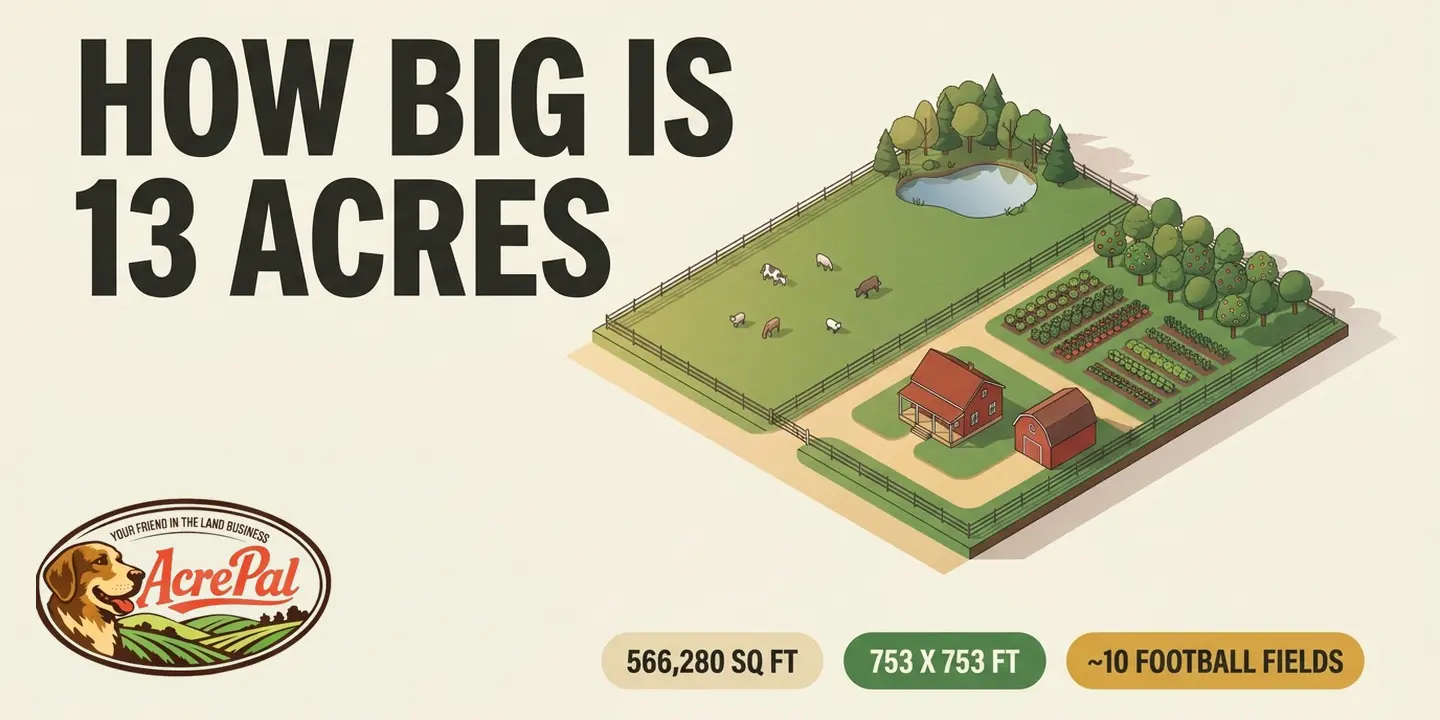
13 acres is 566,280 square feet, a square roughly 753 feet on each side, with a perimeter near 3,010 feet, about 0.57 miles to walk the fence line, and a diagonal near 1,064 feet corner to corner. For an anchor you can actually feel, that is just under 10 NFL football fields counting the end zones. Size is the easy part, so this guide also covers what 13 acres looks like next to land you already know, what actually fits on it, how many animals it holds by region, and what it costs in 2026.
One honest note up front. Thirteen is an odd survey size, not a standard 40-acre quarter-quarter, and that quirk creates a few buyer traps we save for the end.
13 Acres in Numbers, the Exact Size
The math is simpler than it looks, and one figure floating around online is flat wrong. One acre is 43,560 square feet, so 13 acres is just that figure times 13. Everything else is a conversion of the same number.
- 566,280 square feet, the figure most buyers search for.
- 52,609 square meters.
- 5.26 hectares.
- 0.0203 square miles, which is about 2 percent of a full 640-acre section.
- As a square, about 752.5 feet per side, which rounds to roughly 753 by 753 feet.
- A perimeter of about 3,010 feet, or roughly 0.57 miles.
- A diagonal of about 1,064 feet corner to corner.
For anchors you can picture, 13 acres is about 9.8 NFL fields including the end zones, since each field covers 1.32 acres. It is also roughly 7 soccer pitches or about 4 baseball fields.
One widely copied figure deserves a direct correction. Some pages state a square 13-acre plot measures 790 by 790 feet, and that is simply wrong. Run the multiplication and 790 squared comes to 624,100 square feet, which is 14.33 acres, not 13. The correct side is the square root of 566,280, which lands at 752.5 feet.
You can check it either direction. 752 squared is 565,504 and 753 squared is 567,009, so the true side sits right between them at 752.5 feet. If a listing or calculator hands you 790, distrust the rest of that page.
One last thing about shape. A perfect square is the easy way to picture the area, but real 13-acre parcels are rarely square. Most are long rectangles or L-shapes carved to follow a road, a ridge, or a creek.
What 13 Acres Looks Like Next to Land You Know
Numbers stay abstract until you stack them against places you have already stood. Lay about 9.8 NFL football fields in a 2 by 5 grid, each one 360 by 160 feet, and you have 13 acres. It also works out to roughly 7.4 FIFA soccer pitches, about 4 baseball diamonds, somewhere between 4 and 6 city blocks, or around 52 quarter-acre suburban lots side by side.
One benchmark tends to surprise people. The grounds of Windsor Castle cover about 13 acres, so the whole footprint of one of the most famous castles on earth would fit inside the fence line you are picturing.
For the feel of standing on it, drop yourself in the center of a square 13 and every boundary sits about 376 feet away, close enough to see clearly but far enough to feel like room. A full lap of the fence is about 0.57 miles, a short walk rather than a hike.
Scaling up or down is easy from here. It is a bit over three times a 4-acre lot, about 30 percent bigger than a 10-acre parcel, and roughly two-thirds of a 20-acre parcel. Follow those links for what each of those sizes is actually good for. This page stays focused on the 13.
The Acreage Ladder, From 1 Third of an Acre to 250 Acres
Every acreage is just a multiple of the same 43,560-square-foot acre, so once you have that constant, you can place any parcel fast. The full ladder runs like this, each rung showing its square footage and the side of a perfect square plot.
- 1/3 acre. 14,520 square feet, about 120.5 feet per side.
- 4 acres. 174,240 square feet, about 417.4 feet per side.
- 5 acres. 217,800 square feet, about 466.7 feet per side.
- 6 acres. 261,360 square feet, about 511.2 feet per side.
- 7 acres. 304,920 square feet, about 552.2 feet per side.
- 9 acres. 391,740 square feet, about 625.9 feet per side.
- 12 acres. 522,720 square feet, about 723.0 feet per side.
- 15 acres. 653,400 square feet, about 808.3 feet per side.
- 16 acres. 696,960 square feet, about 834.8 feet per side.
- 18 acres. 783,480 square feet, about 885.1 feet per side.
- 20 acres. 871,200 square feet, about 933.4 feet per side.
- 24 acres. 1,045,440 square feet, about 1,022.5 feet per side.
- 26 acres. 1,132,560 square feet, about 1,064.2 feet per side.
- 36 acres. 1,568,160 square feet, about 1,252.3 feet per side.
- 45 acres. 1,960,200 square feet, about 1,400.1 feet per side.
- 53 acres. 2,308,680 square feet, about 1,519.4 feet per side.
- 100 acres. 4,356,000 square feet, about 2,087.1 feet per side.
- 250 acres. 10,890,000 square feet, exactly 3,300 feet per side.
The rungs in the 36 to 53 range all sit close to a standard 40-acre forty, so if that is your target, read how big 40 acres is for the survey and cost story behind that size.
People also want to know whether a size counts as a lot, and the honest answer depends on what you compare it to. Five acres is the beginner-homestead sweet spot, roughly the most one person can work by hand, and a well-run 5 can grow about 8,500 pounds of food a year, enough to feed around four people. Twenty acres is a lot for a single household and enough for a full self-sufficient operation, but only if you have a plan for every part of it, because mowing, fencing, and taxes scale with the ground. One hundred acres is a lot by any measure, carrying 50 to 66 cow-calf pairs in the humid Southeast yet only about 2 in the arid West.
If you are weighing a smaller starter parcel instead, 3 acres has its own guide.
What You Can Actually Do With 13 Acres
Thirteen acres is a serious homestead, about 2.6 times the 5-acre beginner threshold. It is big enough to do real things and still small enough for a family to run, though you will want a tractor and basic equipment to keep up with it. A full homestead layout fits with room to spare.
- House pad, about 1 acre.
- Market garden, 1 to 2 acres.
- Orchard, about 1 acre for 50 to 100 trees.
- Chicken and pig area, about half an acre.
- Livestock pasture, 4 to 6 acres.
- Woodlot or pond site, 1 to 3 acres.
- Barn and shop pad, about half to 1 acre.
Real owners are already living every version of this. One 13-acre parcel in Missouri runs as a private deer-hunting property with multiple stand locations, and a single sit there has turned up seven-plus deer. A 13-acre off-grid lot in Maine's western foothills carries 1,500 feet of road frontage, an established driveway, and a brook, pitched as a private retreat or future cabin build.
Thirteen also lands dead center of the 10 to 15 acre boutique-vineyard sweet spot, and at 4 tons of grapes an acre it can produce roughly 3,380 cases, about 40,560 bottles a year. As a horse property it holds 6 to 7 horses at 2 acres each, up to 10 to 13 with rotational grazing.
You can also split it. Zoning permitting, a 13 divides into as many as 13 lots at a 1-acre minimum or 2 lots at a 5-acre minimum. If income is the goal, whether from grapes, boarding, or a subdivision, see how to make money from your land, and if you are still choosing a region, compare the best states for homesteading first.
How Many Cows and Horses 13 Acres Really Holds
You will read online that 13 acres holds a small herd. In the arid West, that number can honestly be zero. The gap comes down to rainfall and how much forage the ground grows, not the acreage on the deed.
Ranchers measure it in animal units. One animal unit is roughly a 1,000-pound cow with her calf, and how many of those 13 acres feeds swings hard by region.
- Humid Southeast tame pasture. About one pair per 1 to 2 acres, so roughly 6 to 13 pairs on 13 acres.
- Texas pasture. Native grass runs 8 to 15 acres per animal unit, so about one unit, while improved tame pasture at 3 to 6 acres per unit gives 2 to 4 pairs.
- Arid West and desert Southwest. Often 25 to 50-plus acres per pair, so 13 acres carries a fraction of one animal, sometimes none.
Horses follow the same logic. Two acres per horse is the common Extension standard, so 13 acres supports 6 to 7 horses on good pasture, climbing to 10 to 13 if you rotate them across 3 or 4 paddocks and feed hay. A horse eats about as much forage as a cow, while goats and sheep pack in tighter per acre. Before you count on any of these numbers, confirm the local rate with your county extension office, because your soil and rainfall beat any national average.
What 13 Acres Costs in 2026
The price swing on 13 acres is enormous, from about $3,900 to roughly $195,000 for the exact same acreage depending on where it sits. Real 2026 prices break down by market.
- Cheap arid West in Arizona, Nevada, and New Mexico. Raw land at $300 to $500 an acre, so about $3,900 to $6,500, usually the cheapest places to buy land.
- Costilla County, Colorado. A median near $1,575 an acre, so about $20,475.
- Southeast pasture. Around $3,000 to $6,000 an acre, so about $39,000 to $78,000.
- US farmland average. About $4,500 an acre per USDA NASS 2026 figures, so roughly $58,500.
- Desirable near-metro land. From $8,000 to $15,000-plus an acre, pushing 13 acres up toward $195,000.
Owner financing is what makes the cheaper parcels reachable. Down payments run as low as $999 or around 10 percent, there is usually no credit check, interest typically sits at 8 to 12 percent, and terms stretch from 60 to 360 months. On that $20,475 Costilla County parcel, 10 percent down is about $2,047, and 8 percent over 72 months lands the payment around $320 a month.
Be honest with yourself about the trade. Owner financing at 8 to 12 percent costs meaningfully more than a roughly 6.5 percent bank loan over the life of the note, and you hold equitable title rather than legal title until the final payment clears.
If a western parcel is what you are picturing, AcrePal sells owner-financed rural land across the West on acrepal.com, in the Arizona, Colorado, and Nevada markets where these parcels are common. The sticker is not the whole cost either. Budget for legal access, a well at $10,000 to $60,000, and utilities on top.
Before You Buy 13 Acres, the Due Diligence That Matters
The odd size is the first clue. Standard survey divisions come in 640, 160, 40, and 10-acre pieces, so 13 acres is not a clean aliquot part of a 640-acre section. A 13-acre parcel is almost always a metes-and-bounds tract carved from a larger parent, or an irregular government lot near a river or boundary.
If a listing calls a 13-acre parcel a quarter-quarter, that is a red flag, because a real quarter-quarter is 40 acres. Demand a current survey with a metes-and-bounds legal description.
From there, work the checklist.
- Confirm legal road access or a recorded easement. A parcel with no legal access is worth very little.
- Order a current survey, not just a plat. Slope, wetland, and floodplain all count toward deed acreage but not usable acreage, so 13 deed acres can be only 8 you can actually build on.
- In western states, verify water rights separately under prior appropriation. Oregon landowner Gary Harrington was jailed 30 days and fined $1,500 for building unpermitted reservoirs on his own property.
Then there is the tax angle, which cuts specifically for and against 13. In most states 13 acres clears the common 10-acre threshold for an agricultural or greenbelt assessment, and in Florida there is no minimum at all, so a bona fide farm use can drop the assessed value and the tax bill 50 to 90 percent. The exception bites in Tennessee, where the greenbelt minimum is 15 acres, so a 13-acre parcel falls 2 acres short and pays full freight.
If the ag break matters to you there, target 15 or more. And remember that changing the use later can trigger rollback taxes for prior years.
How Big Is 13 Acres, Frequently Asked Questions
How big is 13 acres in square feet?
Exactly 566,280 square feet, which is 13 times 43,560. That figure is unambiguous, so any calculator that gives you a different number is wrong. In metric it comes to 52,609 square meters or 5.26 hectares.
What are the dimensions of a square 13-acre lot?
About 752.5 by 752.5 feet, which rounds to roughly 753 feet per side. The perimeter runs about 3,010 feet, close to 0.57 miles, and the diagonal is about 1,064 feet corner to corner. Ignore the common 790 by 790 figure, because 790 squared equals 14.33 acres, not 13.
How many football fields is 13 acres?
About 9.8 NFL football fields counting both end zones, so just under 10. Each field including its end zones covers 1.32 acres, and 13 divided by 1.32 lands right at 9.8. Picture roughly ten fields in a 2 by 5 grid.
Is 13 acres enough for a homestead?
Yes for most homesteads. There is room for a house, barn, garden, orchard, small livestock, and a woodlot, and it is 2.6 times the 5-acre beginner size. It is not enough for commercial cattle in the arid West, but it is ideal for a boutique vineyard.
How many cows or horses can you keep on 13 acres?
It depends on rainfall. In the humid Southeast, 13 acres carries roughly 6 to 13 cow-calf pairs or 6 to 13 horses with good management. In the arid West, the same 13 acres supports a fraction of one animal or none, so confirm your local rate before buying.
How much does 13 acres cost in 2026?
Anywhere from about $3,900 for remote western desert to around $195,000 near a metro. Figure roughly $20,475 in Costilla County, Colorado, and about $58,500 at the US farmland average of $4,500 an acre. Owner financing is common on the cheaper western parcels.