
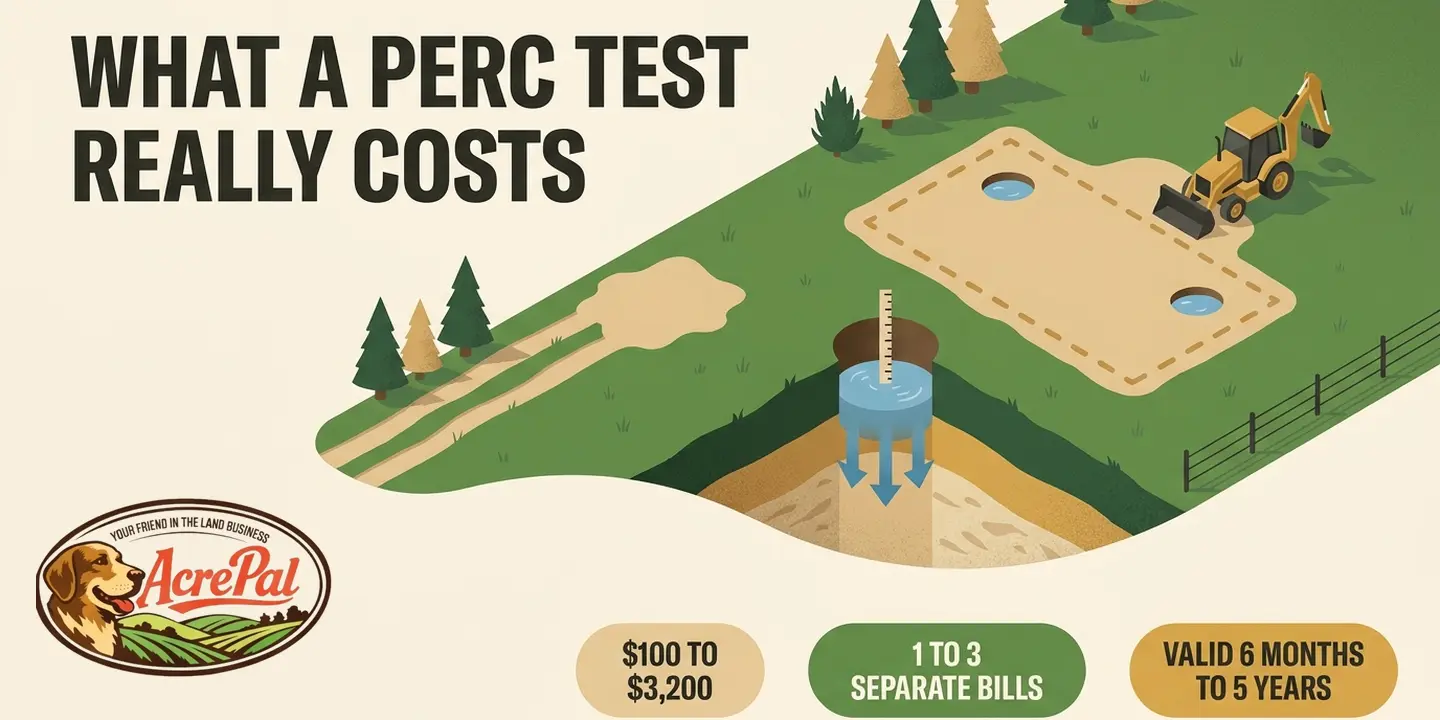
Six well-known sites publish a price for the same service and none of them come close to agreeing. CostHelper documents real county fees of $175 to $300. Fixr puts the national average at $725. Bob Vila and PrimeLandBuyers both pass along HomeAdvisor's $750 to $1,850 range and its $1,300 average, and Land Limited goes as high as $3,000 for complex sites.
That is roughly a 17x spread on the cost for perc test work, and none of them explains why their number sits so far from everyone else's.
The confusion gets expensive fast. If the soil will not take a septic system you get no permit, and with no permit there is no house. A parcel you were valuing as a homesite is really a recreational parcel. Land educator Elias Yoder puts that gap in dollars, roughly $50,000 for land that percs against $8,000 for a visually identical piece that does not.
The spread is not regional noise. A perc test price is a stack of one to three separately billed pieces, and your county's law decides which pieces you pay for. Below are the real published county fee schedules, a way to screen a parcel at no cost before you spend anything, and what to do if it fails.
The Short Answer on Perc Test Cost in 2026
Most raw land buyers should budget $300 to $1,500 until they have confirmed how their own county handles it. Plenty of buyers pay less than that floor, and we show you real $100 tests below. Budget the higher number anyway, because the cheap counties are the ones you can identify with a phone call, while the expensive ones are the ones that surprise you.
The reason the range is so wide has almost nothing to do with how big your parcel is. It has to do with which county the parcel sits in.
Real reported prices cluster into three bands, drawn from what buyers actually paid and what counties actually publish.
- The low band runs roughly $100 to $300. Buyers reported single hand auger tests at $100 in Wonder Valley, California, $100 in Winston-Salem, North Carolina, and $100 in Dadeville, Alabama. Guthrie County, Iowa charges $175 to $225 for its own perc test process, and Caroline County, Maryland charges $270 to $300. These are complete prices, not partial ones.
- The middle band runs roughly $325 to $900. Charles County, Maryland publishes its fee schedule openly, and as of January 2026 it lists $325 for a conventional trench test, $375 for a conventional sandmound, $400 for an alternative trench, and $720 for an alternative sandmound. A buyer in Dunkirk, Maryland reported $850 all in, which was $600 of backhoe work plus a $250 county inspector fee. A 2.25 acre hand auger test in Carnesville, Georgia came to $500, and a 47 acre parcel in Roanoke, Virginia came to $900 with soil analysis included.
- The high band runs roughly $1,400 to $3,200. A one acre test in Indiana, Pennsylvania came to $1,450. A test in Pennsburg, Pennsylvania came to $2,000. A three acre site in Massachusetts came to about $3,200.
Whatever your number turns out to be, it is one line inside the larger cost of making raw land livable, alongside power, water, and legal access. The jump from $100 to $3,200 is not soil and it is not acreage. It is how many separate bills your county generates.
Why the Published Numbers Disagree, You Are Looking at a Billing Stack
Two Pennsylvania buyers were each billed an $800 county fee. One finished at $1,450 and the other at $2,000, because in neither county was the county fee the whole bill. A perc test charge is made of up to three separate pieces, and which pieces you get is decided by law rather than by your soil.
- A county application, evaluation, or witnessing fee.
- A private licensed contractor's fee to physically dig the holes.
- In some states, an engineering or septic design fee stacked on top.
Real itemized invoices show the arithmetic. The Pennsburg, Pennsylvania buyer who paid $2,000 paid an $800 county evaluation plus a $1,200 private professional fee. That one acre Indiana, Pennsylvania test at $1,450 was an $800 application fee plus a $650 excavation fee. The Massachusetts site that came to roughly $3,200 was about $2,000 of engineering, about $1,000 of excavation, and a $200 town fee.
The stacking is designed in, not accidental. Calvert County, Maryland says so in its own Percolation Testing Guidance Document. Only a licensed septic installer may dig the holes, and only under the supervision of a county Licensed Environmental Health Specialist, and that installer will have their own fee for the excavation in addition to the county application fee. That is a health department telling buyers in writing that its fee is not the whole cost.
The stack is not universal, though, and it would be dishonest to pretend otherwise. Those $100 tests in Wonder Valley, Winston-Salem, and Dadeville were genuinely one fee, one visit, one bill. In permissive counties the cheap end is real.
That leaves the famous $1,300 average. HomeAdvisor's own cost page lists septic planning requirements among the things its $750 to $1,850 range covers, which would explain a number sitting well above every bare government fee we found. We could not verify their methodology or sample, so treat that as a reasonable inference rather than settled fact.
HomeAdvisor is also a home services marketplace rather than a land site. Its typical user already owns a house and wants a system installed or replaced. You are standing on bare dirt asking a single question, which is whether this parcel will take a septic system at all.
Your State and County Decide Who Digs and What You Pay
Does your county perform the perc test itself, or does it require you to hire a private licensed professional? That one phone call moves your price more than acreage, hole count, and soil type combined.
Where the county runs or witnesses the test, as Maryland does, a Licensed Environmental Health Specialist supervises while a licensed septic installer digs, and you pay both. Where no county run test exists, one private professional handles the soil evaluation and the system design together. That second model covers most of the arid West, and prices start higher because no cheap government line item exists to begin with.
Six real places show how far apart the two models sit.
- Apache County, Arizona does not run a standalone perc test. The process is a uniform site investigation designed by an ADEQ trained professional and submitted with a Notice of Intent to Discharge permit package.
- Mohave County, Arizona requires an approved site evaluator from the county's own Appendix F list in the Owner Builder Packet. That evaluator bills you directly, not the county.
- Modoc County, California requires a registered engineer, geologist, environmental health specialist, certified soil scientist, or an approved C36, C42, or Gen A licensed contractor to perform or supervise the soil test. County witnessed tests in California commonly run $400 to $1,200.
- Costilla County, Colorado publishes a $500 OWTS permit fee, but the soil test itself is done by a private San Luis Valley contractor whose fee is not publicly published.
- Nevada is the outlier. Nothing in state law prohibits a homeowner from running their own percolation test, though the health authority may still require an engineer to verify the results.
- Virginia sits at the strict end, where only an Environmental Health Specialist, a Certified Professional Soil Scientist, or an Authorized Onsite Soil Evaluator may perform the evaluation.
Most of those are counties we sell land in, so we get this question constantly. Call the county environmental health office before you budget anything.
Screen the Parcel for Free Before You Spend Anything
You can get a real read on a parcel's odds before you spend a dollar. The NRCS Web Soil Survey at websoilsurvey.nrcs.usda.gov is free, covers the whole country, and shows a Septic Tank Absorption Fields rating for any mapped parcel.
The rating is a stoplight. Green means Not Limited, yellow means Somewhat Limited, red means Very Limited. Red is a reason to slow down before paying for a formal test, not a verdict.
The whole check takes about five minutes.
- Locate the parcel by address, coordinates, or a drawn area of interest.
- Pull up the Septic Tank Absorption Fields thematic map and read the rating.
- Open the companion soil report to see the soil types in that map unit, their percent composition, and the specific limiting properties such as depth to a restrictive layer.
NRCS is blunt about the limits of its own tool. This is a broad planning resource, and an on site visit with a real test is still required before any system can be designed or permitted. Map unit data also misses variation inside a single parcel, which matters because perc results are specific to the exact spot you dig.
Two other signals cost nothing. Prior perc records at the county health department are public documents you can simply ask for, and neighboring septic permits show what the county has already approved nearby. Water supply is the other big unknown on raw land, so what a well costs is worth screening at the same time.
What Happens on Test Day and What the Numbers Mean
Most people picture a hole in the ground and a bucket of water. Roy Hunter, a licensed Virginia septic contractor, says the industry retired that method 20 to 25 years ago in favor of soil morphology, which reads soil color, texture, and consistency layer by layer. Everybody still calls it a perc test, and water based timing is still common in many jurisdictions, so you may get either.
Charles County, Maryland requires a minimum of three holes for new construction, one groundwater test plus two perc holes. In the Calvert County version, a licensed septic installer digs with a backhoe or extend a hoe that reaches 18 feet or more plus a hand auger, while the county's Licensed Environmental Health Specialist reads the soil profile with a perc stick and measuring tape.
Percolation rate is measured in minutes per inch, or MPI, meaning how many minutes the water takes to drop one inch. Lower is faster drainage.
- Most jurisdictions treat roughly 1 to 60 MPI as the workable window for a conventional system, with about 5 to 30 MPI considered ideal. That holds across UNL Extension, Inspectapedia, and county code.
- Too fast is also a fail. Below roughly 1 to 5 MPI the soil drains so quickly it does not treat the effluent before it moves through, which matters on sandy desert parcels.
- The ceiling is not universal. Charles County, Maryland requires under 30 MPI, notably stricter than the 60 MPI ceiling common elsewhere, and Ohio allows a wider 3 to 60 MPI window.
Massachusetts required 1 inch per 30 minutes before amending it to 60 in 2004, New Hampshire requires 60, and Vermont requires 120. Identical soil can pass in one of those states and fail across the line, which a University of Massachusetts Amherst publication calls a perc rate lotto.
Season Rules, Why a Cheap Summer Test Can Be Worthless
Dry soil drains fastest, which makes an August test the easiest one to pass. That is exactly why several jurisdictions will not let you take it then.
Maryland's COMAR 26.04.03.02 requires wet season percolation testing and site evaluations for subdivision of land to be performed only at the time of year when the highest water table is expected. Two counties confirm the window independently. Calvert County describes roughly March through May, and Caroline County Health Department says water levels are expected to be highest generally between January and May.
A drain field has to work in a wet spring, not just in August, so the county tests the worst case on purpose. A dry season pass measures the easy conditions and would not satisfy Maryland code for a new construction or subdivision lot.
There is an exemption, and it explains a lot of the confusion online. Tests for repair or replacement of an existing failing system may be done any time of year, usually with just one hole. That content was written for repairs, not for raw land.
That timing lands squarely on the buyer in two ways.
- Missing the seasonal window can push your purchase timeline back by months rather than weeks, which collides with the due diligence clock covered further down.
- Calvert County's own guidance warns that failing to have a surveyor stake the property lines or the proposed test locations before the scheduled date can bump the property out of the wet season queue entirely.
Winter testing also costs more, per Fixr, since frozen ground requires extra equipment.
What a Passing Result Actually Buys You and How Long It Lasts
You can pass the perc test and still not be allowed to build. Calvert County, Maryland puts it in bold in its own guidance, that a passing percolation test alone does not mean the property is buildable. Charles County, Maryland requires a Sewage Easement Plat, prepared by a Maryland registered surveyor, to be approved before the lot counts as buildable.
This is not a technicality. On a Houzz forum thread, a property had a passing perc test but no septic permit. The buyer's offer required the seller to deliver the completed septic approval, the seller refused, and the buyer's agent called permit in hand a must have to close.
Validity is the second trap.
- Charles County, Maryland voids a satisfactory result after six months unless the Sewage Easement Plat is approved inside that window. Once it is, the lot is permanently buildable, which is why those two rules are really one rule.
- Calvert County, Maryland gives two years, renewable with a Request for Renewal form and a fee. Renewal is granted at the discretion of the approving authority and can be denied if neighboring development, drainage changes, or a local history of septic failures raise concerns.
- Orange County, North Carolina issues a five year Improvement Permit.
Six months, two years, five years. It is county code, and renewal is not guaranteed.
Then there is the test a seller hands you. A land use attorney warns publicly that when a seller says it percs, that test may be 15 years old and measured against standards that have since changed. Results are also specific to the spot that was dug, so a pass on one corner of the parcel does not travel with you if you move the septic site.
Who Pays and How Much Time Your Due Diligence Window Really Needs
A standard land contract can hand you an investigation period of 17 days. In a county that only tests from January through May, 17 days is not a due diligence window, it is a formality.
By default the buyer pays, because the buyer is the one who needs the buildability answer before closing. It is negotiable, and a motivated seller marketing land as readily buildable will sometimes pay for a test upfront to make the listing more attractive.
A thorough land due diligence investigation typically runs 30 to 60 days, and a perc test adds two constraints on top of that. Seasonal windows can close for most of the year, and in a government witnessed county you wait on the health department's schedule behind a licensed installer with a backhoe. Ask about scheduling lead time and seasonal windows before you agree to a due diligence period, not after.
Earnest money on land deals typically runs 1 to 5 percent of the purchase price and is negotiable. It is refundable when you exit under a valid contingency such as a failed perc test, and at risk if you walk after the window expires with nothing left to rely on.
Generic buyer guidance phrases the clause as the purchase being contingent upon the property successfully passing a percolation test suitable for septic installation. Treat that as a structure, not as legal language, and have your own attorney or agent draft the real thing. We cover how to structure an offer around a perc contingency in more depth, and the same window is where your title and ownership checks belong.
If the Land Fails, Work the Options Cheapest First
A failed conventional perc test is not a demolition notice on your plans. It means the cheap system is off the table and everything from here costs more. Work the options cheapest first.
- Retest a different spot on the parcel. Perc results are specific to where you dig, not to the property line. One buyer passed at contract, relocated the planned septic site, and paid for a fresh test there. Budget another full test.
- Retest in a different season if your county allows it, though a marginal wet season result may be the honest one. Cost is another full test plus the calendar delay.
- Find out what actually failed. In arid ground the culprit is often caliche or hard clay, not a high water table. Arizona does not permit horizontal leach field trenches in those conditions, and ADEQ's alternatives are a vertical seepage pit below the restrictive layer or an elevated mound built above the caliche. Very sandy soil can fail for draining too fast.
- Price the engineered system. Aerobic Treatment Units run roughly $10,000 to $25,000 installed plus a mandatory maintenance contract of about $400 to $800 a year. Engineered alternatives generally run $5,000 to $15,000 or more above a conventional system, and we break the full ladder down in our well and septic cost guide.
- Walk away. When the engineered premium plus the land price exceeds what a comparable perking parcel would cost outright, the parcel has answered your question. PrimeLandBuyers puts the discount on non perking land at roughly 30 to 50 percent, a rule of thumb rather than a measured statistic, and the $50,000 versus $8,000 gap points the same way.
None of that makes non perking land worthless. It still works for recreation, agriculture, conservation, or a sale to the neighbor whose acreage it would round out. It is just not a homesite.
Perc Test Cost FAQ
How much does a perc test cost in 2026?
Budget $300 to $1,500 if you are buying raw land. Real reported figures run as low as $100 in permissive counties and as high as about $3,200 where engineering is bundled in. The spread comes from how many separate pieces your county bills for, which can be one, two, or three.
Who pays for a perc test, the buyer or the seller?
The buyer, by default and convention, because the buyer is the one who needs the buildability answer before closing. It is negotiable, though. A motivated seller marketing land as readily buildable will sometimes pay for the test upfront and hand over a passing result, because it makes the listing easier to sell.
How long is a perc test good for?
There is no national answer. Charles County, Maryland voids a result after six months unless a Sewage Easement Plat is approved in that window, Calvert County, Maryland gives two years with a renewal that can be denied, and Orange County, North Carolina issues a five year Improvement Permit. Confirm your own county before assuming anything.
Can I do a perc test myself?
It depends entirely on the state. Nevada law does not prohibit a homeowner from performing their own percolation test, though results may still need engineer verification. Maryland requires a licensed installer to dig under the supervision of a Licensed Environmental Health Specialist, and Virginia requires an Authorized Onsite Soil Evaluator or a Certified Professional Soil Scientist.
What is a good perc rate for a septic system?
Roughly 1 to 60 minutes per inch is workable for a conventional system in most jurisdictions, and about 5 to 30 MPI is considered ideal, per UNL Extension, Inspectapedia, and county code. Percolation that is too fast fails as well, since very sandy soil does not treat effluent properly. Charles County, Maryland requires under 30 MPI.
Does a passing perc test mean I can build?
No. Calvert County, Maryland states in its own guidance that a passing percolation test alone does not mean the property is buildable. A septic construction permit is a separate approval that comes afterward, and real buyer and seller disputes have turned on exactly that gap.