
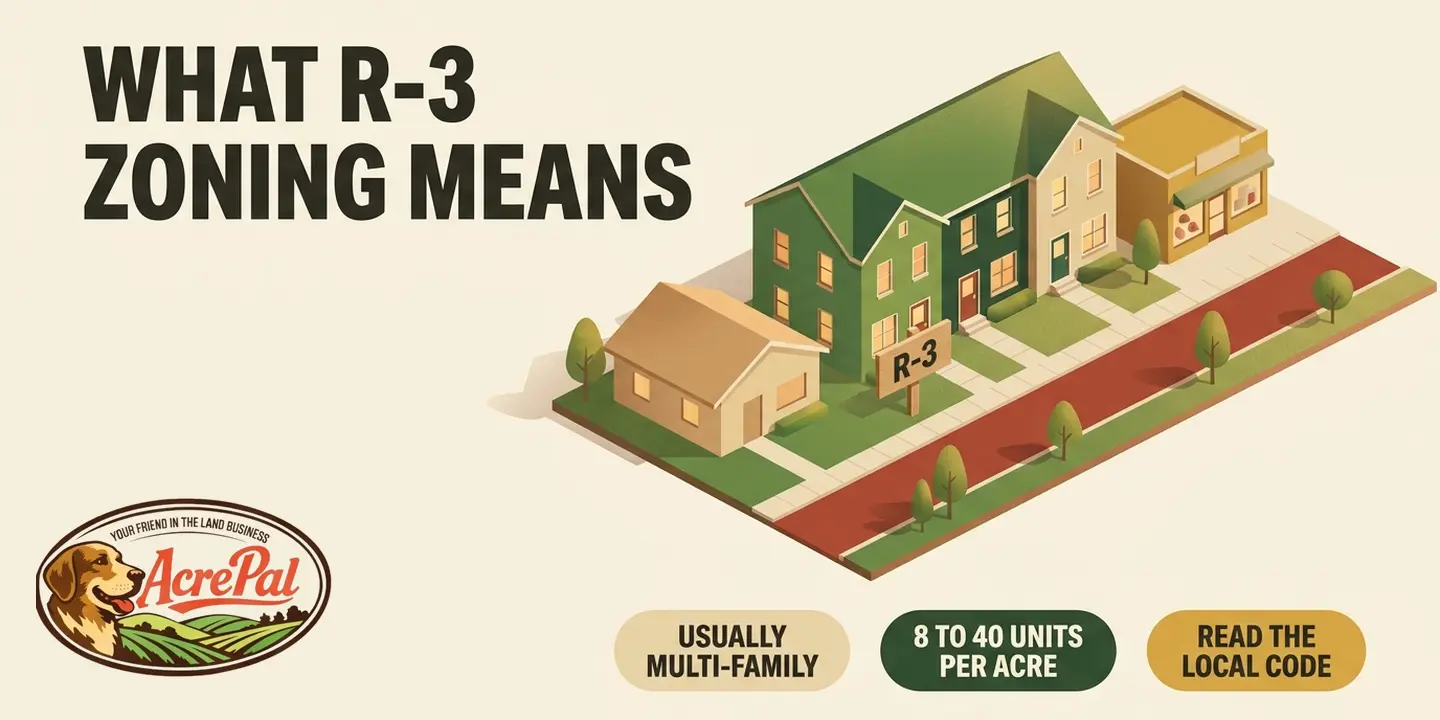
You spotted R-3 on a listing or a county GIS map, and now you want to know what it actually means and what you could build there. The short answer is that R-3 zoning usually points to medium-density multi-family housing, things like triplexes, fourplexes, and small apartment buildings. That is right most of the time, but not a rule you can count on.
The number is a local index, not a fixed law, and in some counties R-3 is single-family only. So you cannot read your development rights off the digit alone, and every source you check seems to give a slightly different answer.
This guide clears that up. You will get the real definition, what R-3 lets you build, the density and height numbers that decide how many units actually fit, how R-3 sits on the R-1 through R-4 ladder, why cheap rural land is almost never R-3, and how to treat an R-3 parcel as a build-to-rent play instead of a homestead.
What R-3 Zoning Means (And Why the Number Can Fool You)
In one Georgia county, R-3 means single-family homes only. In Los Angeles, the same label means apartment buildings. Same two characters, completely different rules.
Start with the letters. The R stands for residential. The number is a position in that specific jurisdiction's zoning schedule, and those schedules generally climb from R-1 (lowest density) up to R-4 or R-5 (highest). In most major-city codes, R-3 lands in the middle and means medium-density multi-family, so triplexes, fourplexes, small apartment buildings, and townhouses.
That is the common case, not the universal one. Plenty of codes assign R-3 to something else entirely.
- Lamar County, Georgia titles its R-3 zone "Single-Family Residential, High Density." It permits site-built detached houses only, with a 1,200 square foot minimum floor area and, in its most restrictive form, a 2-acre (87,120 square foot) lot minimum. No duplex, no apartment.
- Susquehanna Township, Pennsylvania calls R-3 "High Density Single-Family Residential" and caps density at 8 units per acre. It exists to recognize older neighborhoods near Harrisburg that were built on smaller lots. Still single-family.
- Urbana, Illinois makes R-3 a "Single and Two-Family" district, so detached houses and duplexes, no apartments by right.
- Clayton, Missouri defines R-3 as a "One and Two-Family Dwelling District," so single homes and duplexes but no apartments.
- Plummer, Idaho simply calls its R-3 "Urban Residential."
There is a second trap worth naming. Some buyers assume the number is a unit count, that R-3 means three units. It does not. As one Chicago investor put it, brokers will say "it's R3 zoning," and buyers wrongly hear two units or four units baked into the label. A two-unit building sitting in an R-3 district is still bound by R-3 rules, and the digit does not add or subtract units on its own. It is an index into a document, nothing more.
So treat R-3 as a pointer, not an answer. Read the district's official title and its list of permitted uses before you form any opinion about what the land can become. Never price an R-3 parcel on the assumption it allows apartments until you have read that county or city's actual ordinance.
What You Can Build on R-3 Land
You picture a fourplex or a small apartment building on your R-3 lot, then find out the local code allows far fewer units, or in some places, none at all. That gap between the label and the rulebook is where buyers lose money.
In a standard multi-family R-3 code, like Los Angeles, Anchorage, or Junction City, Oregon, the by-right menu is generous. You can typically build:
- A single-family detached house
- A duplex, triplex, or fourplex
- A townhouse
- A small apartment building
- An accessory dwelling unit (ADU) in most codes
Then there are conditional uses, which need a permit and usually a public hearing before you can proceed. These often include daycare homes, churches, group homes, and sometimes small-scale commercial. In a single-family R-3 code like Lamar County, Georgia or Susquehanna Township, Pennsylvania, the only permitted use is a detached house, full stop.
One habit saves you here. Every ordinance sorts uses into three buckets, permitted by right, conditional (permit plus hearing), and prohibited. Find that list for your exact district and you will know precisely what the land allows. For any purchase above a few thousand dollars, it is worth a phone call to the planning department to confirm those uses out loud before you sign.
One more pattern helps you spot R-3 on a map. It usually functions as a transitional or buffer zone, sitting between single-family neighborhoods and busier commercial corridors. That is why R-3 tends to cluster along arterial streets and at the edges of established neighborhoods.
R-3 is best when you want to build a small rental building and the code allows it. Do not assume apartments, or even a duplex, until the use list confirms it in writing.
R-3 Density, Height, and Lot Coverage: The Numbers
Two lots can both carry an R-3 label, and one of them holds four times as many units as the other. The zone name tells you the category. The dimensional standards tell you the real capacity.
Typical multi-family R-3 codes land in these ranges:
- Density: roughly 8 to 40-plus dwelling units per acre
- Maximum height: commonly 35 to 45 feet, about three stories
- Lot coverage: often around 55 percent
- Minimum lot area per unit: the real lever that decides unit count
- Parking: 1 to 2 spaces per unit
Real code numbers make this concrete. Anchorage, Alaska states a range of 15 to 40 units per acre, with a 40 percent lot coverage cap, a minimum lot of 6,000 square feet for one to four units, and 9,000 square feet plus 1,000 more per unit above seven. Los Angeles City R3 requires 800 square feet of lot area per unit, so an 8,000 square foot lot pencils to about 10 units before you subtract for parking and setbacks, with 55 percent coverage and a 45 foot height cap. LA County's unincorporated R-3 is tighter, requiring 1,452 square feet per unit and capping height at 35 feet. Susquehanna Township, Pennsylvania limits its R-3 to 8 units per acre.
Setbacks quietly shrink that math further. LA City R3 wants a 15 foot front setback, a 15 foot rear, and at least 5 feet on the sides, and Anchorage adds a 20 foot front on smaller buildings. Those strips come straight off your buildable footprint.
Watch two numbers above all others, the minimum lot area per unit and the parking requirement. Together they decide the real unit count, not the zone name. To size up a parcel fast, divide the lot area by the code's square-feet-per-unit figure to get a ceiling, then subtract for parking and setbacks to land on a realistic number.
R-3 vs R-1, R-2, and R-4: The Residential Zoning Ladder
The whole residential ladder fits in one place, and one caveat keeps you out of trouble.
- R-1: single-family detached homes, the lowest density (roughly 4 to 9 units per acre, about 40 percent lot coverage, 30 to 35 foot height)
- R-2: adds duplexes and two-family homes (around 50 percent coverage)
- R-3: adds triplexes, fourplexes, and small apartments in most codes (around 55 percent coverage, 8 to 40-plus units per acre, 35 to 45 foot height)
- R-4: larger apartment buildings and mid-rise (around 60 percent coverage, 40 to 100-plus units per acre)
- R-5: high-rise and very high density (Los Angeles requires just 200 square feet per unit here, versus 400 in R-4 and 800 in R-3)
Los Angeles gives you a clean anchor for the pattern. Its lot-coverage tiers step up right alongside the number, with R1 at 40 percent, R2 at 50, R3 at 55, and R4 at 60. Higher number, more of the lot you can cover, more units. The square-feet-per-unit rule tightens the same way, halving from 800 at R3 to 400 at R4 to 200 at R5, so each rung roughly doubles the density ceiling.
One caveat matters more than the rest. The ladder is a rule of thumb, not a law. Some codes flip or skip numbers, so a higher digit does not guarantee more density. We keep the deep R-2 breakdown, including the manufactured-home trap, in our full R-2 zone guide, so head there when R-2 is your focus.
If you are shopping affordable acreage, the numbered R-zones probably are not even your ladder. Cheap land tends to sit under rural codes instead, things like RR (rural residential), RE (residential estate), RA (residential agricultural), and AG (agricultural). Those, not R-3, are where most inexpensive land lives, which sets up the next section.
Use the ladder to orient yourself, then read the actual ordinance for the exact rung.
Why Cheap Rural Land Is Almost Never R-3
R-3 barely exists out where land is cheap. It is an urban and town-core designation that lives inside incorporated cities and densely settled areas, not open desert or open range.
The county codes back this up. Cochise County, Arizona zones roughly 90 percent of its unincorporated area as RU (Rural), split into five districts that require anywhere from 2 to 36 acres per parcel, with no R-3 anywhere in that rural schedule. Costilla County, Colorado uses Agricultural (A) and Estate Residential (ER) as its main rural districts, again no R-3. Elko County, Nevada uses AR (Agricultural-Residential), which allows about one home per acre or more plus hobby and recreational farming, and has no R-3 in its unincorporated code.
So if you do see R-3 on a rural listing, treat it as a flag. Usually it means the parcel sits inside a small incorporated town, or the county uses R-3 to mean something unusual. Either way, it is worth confirming before you assume anything.
This is where our own inventory fits the picture. At AcrePal, we sell rural and recreational parcels across Arizona, Colorado, Nevada, California, and Florida, and those parcels are rural-residential, agricultural, or unzoned. They are essentially never urban R-3, because R-3 is a city development zone, not a place to put a cabin or a manufactured home. If your goal is raw acreage, our guides on the cheapest places to buy land and the best states for homesteading will serve you far better than an urban zoning code.
Put simply, R-3 answers a city-development question. For raw acreage, the codes you actually need to decode are RR, RE, RA, AG, or no zoning at all.
R-3 as a Build-to-Rent Play, Not a Homestead Zone
R-3 land is a place to build something that pays you rent, not a place to homestead.
Where R-3 is a multi-family zone, it is the entry point to a small rental building, a duplex, triplex, or fourplex. Because those are four units or fewer, you can often finance them with a residential loan (FHA, conventional, or DSCR) rather than a commercial one, and you can house-hack by living in one unit and renting the rest. The economics are real and worth knowing before you buy.
- Ground-up multi-family construction runs roughly $120 to $250 per square foot.
- A well-run duplex nets about $200 to $500 per month per rented unit after expenses.
- Cash-flow investors often target cap rates of 7 percent or higher in stable markets, and settle for 4 to 6 percent in appreciation markets.
- Up-zoning a parcel to R-3 can lift its land value by 20 to 100 percent or more.
There is also upside most buyers miss. Many jurisdictions grant a density bonus of 20 to 35 percent extra units when you set aside a slice of affordable housing, and California's state law can push that as high as 80 percent near transit. In Los Angeles, an R-3 lot inside a Transit Oriented Communities zone can add up to 70 percent more units on top of the base standards, plus lighter parking rules.
R-3 also carries a catch. It brings scrutiny that single-family building never sees. Parking minimums of 1 to 2 spaces per unit eat into the lot fast, and structured spaces can add $10,000 to $30,000 each. Design review and neighbor opposition can add 6 to 18 months to a project. And as one urban-economics commentator put it, multi-family zoning is often "in name only," because parking rules, financing hurdles, and local politics keep those units from ever getting built.
If you want the income side spelled out, our guide on how to make money from your land covers rental strategies, and the piece on what it costs to get utilities on land covers the development side.
Buy R-3 for a rental-building plan you can actually execute, not as a place to live off-grid. Price in the parking, the review process, and the financing friction before you commit.
Before You Count on R-3: Verify It and Watch for Deed Restrictions
A parcel can be zoned R-3 for apartments and still be legally limited to a single house. Two quick checks protect you before you trust any R-3 label.
First, confirm what R-3 means in that exact place. Pull the parcel on the county or city GIS, then read the district's official title and its permitted, conditional, and prohibited use list. Do not assume from the number, since you already know it swings from apartments to single-family only depending on the code.
Second, and this is the one that catches people, check the title for recorded deed restrictions or CC&Rs. Zoning and CC&Rs both bind the same parcel at the same time, and the stricter of the two governs. So a subdivision covenant limiting the land to a single-family home overrides R-3 multi-family rights until that covenant is legally removed. Our guides on POA vs HOA and deed vs title explain how these recorded restrictions and the title interact.
If R-3 is not what a parcel carries and you want it anyway, up-zoning is possible but not casual. A rezone runs roughly 60 to 90 days and $5,000 to $15,000 in a simple small market, and it can climb into six figures and stretch to three years when it is contested, once you add public hearings, traffic studies, and a land-use attorney.
For the complete parcel-verification walkthrough, we keep the full checklist in our R-2 zone guide. Make any offer that depends on R-3 multi-family rights contingent on the ordinance and a clean title confirming those rights in writing.
R-3 Zoning FAQ
What does R-3 zoning mean?
R-3 is a local residential zoning district. In most codes it means medium-density multi-family housing, so triplexes, fourplexes, and small apartments. But the number is a local index, not a universal rule, and some codes make R-3 single-family only. Read your specific jurisdiction's ordinance before assuming what it allows.
Is R-3 always multifamily?
No. Several codes make R-3 single-family. Lamar County, Georgia and Susquehanna Township, Pennsylvania both use R-3 for single-family high-density homes, and Urbana, Illinois defines R-3 as single-and-two-family. Always check the district's official title, because the digit alone does not tell you whether apartments are allowed.
What can you build on R-3 zoning?
In a multi-family R-3 zone, you can usually build anything from a single-family house up to a small apartment building, plus ADUs, with daycares, churches, and group homes allowed as conditional uses. In a single-family R-3 zone, you can build only a detached house. Read the permitted use list for your district.
What is the difference between R-1, R-2, R-3, and R-4?
The number is a density tier. R-1 is single-family and lowest density, R-2 adds duplexes, R-3 adds triplexes, fourplexes, and small apartments, and R-4 allows larger apartment buildings. In Los Angeles, lot coverage runs 40, 50, 55, and 60 percent across those tiers. Still, the exact mapping is local, so confirm it.
How many units per acre does R-3 allow?
It varies widely. Anchorage, Alaska allows 15 to 40 units per acre. Susquehanna Township, Pennsylvania caps its R-3 at 8. Los Angeles theoretically allows up to about 54 units per acre under its 800-square-foot-per-unit rule, but parking and setbacks usually bring the real number down to 15 to 30.
Can deed restrictions block multifamily on R-3 land?
Yes. CC&Rs and zoning both apply to a parcel at the same time, and the stricter rule governs. A recorded single-family deed restriction overrides R-3 apartment rights until it is legally removed. Always check the title report for restrictions before you count on multi-family development, even when the zoning clearly permits it.