
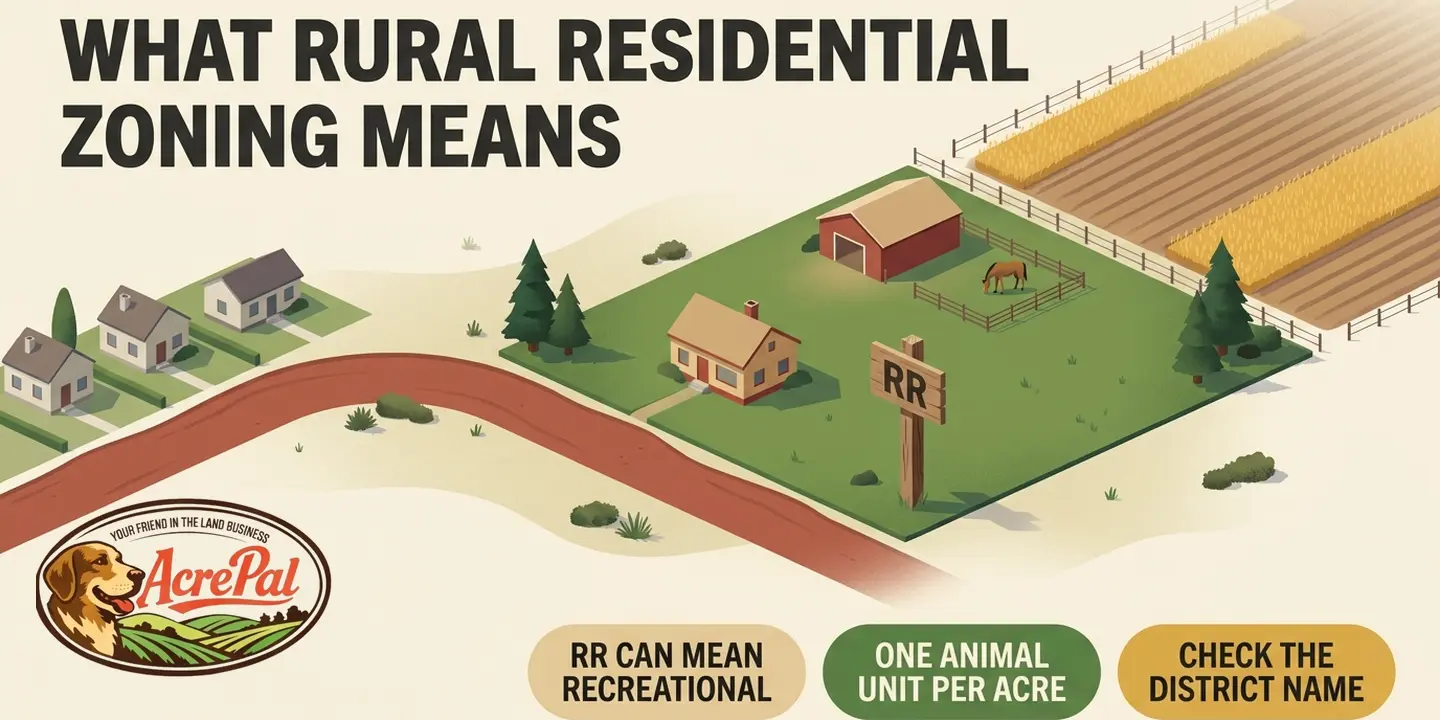
The listing says RR. The county map shades your parcel Rural Residential, and you are already picturing the house, the shop, and a couple of horses out back. In Clackamas County, Oregon, RR does not stand for Rural Residential at all. It stands for Recreational Residential, and the district that county does call rural residential is named RRFF-5.
That is the trouble with residential rural zoning as a search term. The word order flips by county too, since most codes write rural residential zoning and at least one writes it the other way around. Every page answering this question lands on some version of "it varies by jurisdiction, check your local ordinance," which is true and quits exactly where you needed help.
So we read the ordinances. Every number below comes from a named county's own code with the section number attached. One of those districts caps how big your lot may be. One county will not let you divide the same land twice. One animal limit works out to exactly one cow.
RR Does Not Always Stand for Rural Residential
There is no national zoning code. Every county writes its own abbreviations, so RR is a local decision rather than a standard.
Clackamas County, Oregon last amended Section 316 of its Zoning and Development Ordinance on September 9, 2024. The heading reads, verbatim, "RURAL AREA RESIDENTIAL 1-ACRE (RA-1), RURAL AREA RESIDENTIAL 2-ACRE (RA-2), RECREATIONAL RESIDENTIAL (RR), RURAL RESIDENTIAL FARM FOREST 5-ACRE (RRFF-5), FARM FOREST 10-ACRE (FF-10), AND FUTURE URBAN 10-ACRE (FU-10) DISTRICTS."
Read the parentheses. RR is Recreational Residential. The district Clackamas calls rural residential is RRFF-5, Rural Residential Farm Forest 5-Acre. RA-1 and RA-2 are Rural Area Residential at one and two acres, a third thing again.
The county then uses the phrase three ways at once. Section 316.02 calls all six districts collectively "the rural residential and future urban residential zoning districts." So rural residential is an umbrella term, a specific district name, and RR belongs to something else entirely.
Those districts are not interchangeable either. Note 11 says "In the RA-2, RRFF-5, FF-10, and FU-10 Districts, livestock is permitted as described under the use category of farm uses. In the RA-1 and RR Districts, livestock is permitted as described under the use category of livestock." Same word, two different regulatory routes, one ordinance.
Crook County, Oregon inverted the letters the same way. Its Title 18 chapter list titles Chapter 18.88 "Rural Residential Zone, R-5," Chapter 18.92 "Rural Residential Zone, R-10," and Chapter 18.108 "Powell Butte Rural Residential Zone, PBR-20," while Chapter 18.44 is "Recreation Residential Zone, RR-1 and RR-5." Those titles are all we will claim from Crook, since the chapter bodies would not load.
The word order moves too. Bannock County, Idaho names its district Residential Rural rather than Rural Residential.
So the two letters on the zoning map are a label, not a definition. Find the district's full name in the ordinance and trust that instead.
What the Number Means in RR-2, RR-5, and RRFF-5
In every rural residential district we opened, the numeral in the district name is the minimum acreage. RR-2 means two acres. RR-5 means five. Take that to your own listing and then confirm it, because it is a drafting convention rather than a law of nature, and the ordinance's dimensional standards table is the only proof.
The Village of Kronenwetter, Wisconsin states it outright. Its Rural Residential RR district covers RR-2 and RR-5, described as the Rural and Open Space District, with a minimum lot size given as "2 or 5 acres." The governing text is Chapter 520 of the village Municipal Code, and the village's own fact sheet says Chapter 520 prevails wherever the two disagree, so Chapter 520 is what you cite and what you read.
Clackamas County runs the same convention across a whole family of districts. RA-1 is one acre, RA-2 is two acres, RRFF-5 is five acres, and FF-10 and FU-10 are ten acres. Crook County's chapter titles carry the same numerals in R-5 and R-10, though we cannot tell you what those chapters require.
The same format means the opposite thing in urban residential codes, where an identical-looking numeral is a density tier instead of an acreage. R-2 is a density classification, which our guide to the R-2 zone covers in full. R-3 sits further up that same ladder, and our R-3 zoning explainer walks it.
Two conventions, one format, opposite kinds of meaning. If the listing says RR-5, work from five acres and confirm it in the dimensional table. If it says R-5, assume nothing until you have read the district's full name.
Rural Residential Minimum Lot Sizes, With Real County Numbers
Rural residential is supposed to mean room to spread out. Dane County, Wisconsin has a rural residential district that forbids you from going large.
Dane County's RR-1 Rural Residential District sits at Section 10.241 of the county's Chapter 10 zoning code. The zoning division's fact sheet was last revised December 18, 2023. Section 10.241(4) sets the minimum at one acre and the maximum at "less than 2 acres, excluding right-of-way," with a minimum lot width of 100 feet.
RR-1 is no edge case. The county calls it a "Zoning district for single family homes with agricultural uses."
The verified spread, in districts the counties themselves call rural residential or residential rural.
- Dane County, Wisconsin RR-1, minimum one acre, maximum under two acres
- Village of Kronenwetter, Wisconsin RR-2, minimum two acres, and RR-5, minimum five acres
- Bannock County, Idaho RR, minimum five acres
- Clackamas County, Oregon RRFF-5, minimum five acres
That beats an average. The guide ranking first for this question runs roughly 2,400 words and contains exactly one quantity, setbacks "typically ranging from 20 to 50 feet," with no county or code section attached.
Zoning is not the only gate. Bannock County, Idaho Zoning Ordinance No. 1998-1 sets its Residential Rural minimum at five acres in Section 327, then adds, verbatim, "Larger lot sizes may be required by the Health Department." Section 322 shows why, listing the "suitability of land to safely handle individual well and sewage systems on lots 5 acres or more in size" among the factors for where the district goes.
Septic feasibility can impose a bigger practical minimum than the code prints, so price it before you write an offer. Our well and septic installation costs breakdown covers the numbers. Bannock also sets a single-family residence 30 feet back from a local road right of way, 50 from an arterial or collector, 30 at the rear, 10 at the side, with a 35 foot height cap.
Dane County will not let you reach two acres. Bannock will not let you buy under five. Both districts answer to the same two words on a listing.
Livestock on Rural Residential Land: The Animal Unit Math
You picked rural residential because you wanted two horses and a few head of cattle. In Dane County, Wisconsin, an RR-1 owner gets one animal. Not one of each. One.
The formula sits in Sections 10.004(85) and 10.103(18). "The number of livestock kept is limited to one (1) animal unit for each full acre." An animal unit is "the equivalent of 1 cow; 4 hogs; 10 sheep or goats; 100 poultry or rabbits; 1 horse, pony, or mule; or an equivalent combination thereof."
Run it against the lot. RR-1 caps out below two acres, so the parcel has exactly one full acre to count. One animal unit. One cow, or one horse, or ten sheep, or a hundred chickens.
Clackamas County caps the other end. Note 21(a) on equine facilities says "The number of horses shall be limited to no more than one horse per acre or five horses in total, whichever is less." Buying more acreage stops helping at five horses.
One village answers the question two ways. In Kronenwetter, "Keeping of Farm Animals on Residential Lots" is "Allowed as a conditional use in RR-2 Zoning District," and a by-right accessory use in RR-5. So the two acre version needs a hearing for what the five acre version allows outright. Footnote 1 adds that "Agricultural Related Use" is "Not permitted in RR-2 Zoning District."
The setbacks then decide where the barn can physically go. Dane County requires livestock housing 100 feet from Residential or Hamlet districts, 50 from Rural Residential districts, and 10 from everything else. Bannock puts farm animal structures 30 feet from a local road right of way, 50 from an arterial or collector, 30 rear, 30 side, capped at 15 feet tall, and requires all structures to sit 100 feet "from any stream or riparian area." On a narrow parcel with a creek, that can leave nowhere legal to build.
A neighbor already keeping animals is not proof it is legal. A grandfathered use, an unpermitted one, and a violation nobody has reported yet all look identical from the road. A recorded covenant can also ban livestock the county permits, which our POA versus HOA guide explains.
The animal unit line and the structure setbacks decide whether your animals are legal, not the acreage on the listing. That goes double if a full homestead is the plan.
What Can You Build on Rural Residential Land
A permitted use table lists what you may do and never lists what you may not, so silence reads like room to move. Clackamas County closes that door in five words. ZDO 316.03(A) says "Uses not listed are prohibited."
The legend in 316.03(B) is just as blunt. P is primary, A accessory, C conditional, CPUD conditional inside a planned unit development, X prohibited, and a blank cell is not a maybe.
Clackamas Note 8 lets each lot of record be developed with only one of a detached single-family dwelling, a duplex which is conditional and only in RA-1, a manufactured dwelling, a prefabricated structure, or a single room occupancy. One lot, one dwelling, one type. Note 10 gates other uses with "This use is permitted only on lots larger than five acres." Our R-2 zone guide covers the manufactured home trap and the verification checklist.
The plan that dies most often is the detached shop with a bathroom. Dane County Section 10.102(2)(a) requires the principal residence to exist or be under construction first. Then two flat sentences. "Sanitary fixtures are prohibited in accessory buildings." "No living spaces are allowed in accessory buildings." Then the permit threshold. "A Zoning Permit is required for every building larger than 120 square feet in size."
Anything smaller on a non-permanent foundation is exempt only if it clears setback, height, and coverage. No plumbing, no living space, and a permit the moment the shed passes 120 square feet. The barn conversion and the shop apartment both die in one subsection.
Dane County caps building coverage at 30 percent on an interior lot and 35 percent on a corner lot, holds residences to 2.5 stories or 35 feet and accessory buildings to 16 feet, and sets no height limit on agricultural buildings. The barn may legally stand taller than the shop.
An ADU is possible. Section 10.241(3) lists attached accessory dwelling units as a conditional use, so attached rather than detached, plus a hearing. Get a bathroom in a detached building answered in writing before your inspection period closes.
Can You Split a Rural Residential Parcel Later
"Such subdivisions are prohibited from further division." That is Bannock County, Idaho, Section 326, on the conventional subdivision method with a five acre minimum and individual well or septic. The split you make is the last one that land will ever get.
The alternatives carry their own triggers. Bannock's Open Space Designed Subdivision runs at a density of one dwelling to 2.5 acres, and it is required rather than optional if any one of three conditions is true. The average net lot size falls under five acres, or 25 percent or more of the subdivision sits above 5,000 feet in elevation, or the subdivision contains important wildlife habitat. That elevation trigger is the kind of condition a buyer would never think to check.
The PUD route is narrower still. It requires municipal water and sewer, is available only within an Area of City Impact, and runs a minimum PUD size of ten acres against a maximum of 100 lots or dwelling units and 100 acres. Municipal water and sewer are exactly what most rural parcels do not have.
Dane County breaks the same assumption from the opposite direction. RR-1 caps the lot below two acres and permits a single family home one per parcel, so there is nothing to divide and nothing to add.
Two named counties, two different answers, and your county may do something else. Our walkthrough of how to subdivide a property covers the mechanics. Both answers live in a section of the code no buyer has any reason to open unless somebody tells them to.
Right to Farm Laws Protect Your Neighbor, Not Your View
Spray drift on the laundry line, manure in August, a combine running at four in the morning. None of it is a violation you can act against. It is somebody's protected legal right.
Bannock County, Idaho applies its Residential Rural district to underdeveloped land serving "as buffer areas between Agriculture districts and urbanizing areas," which drops new residents alongside working farms.
According to the National Agricultural Law Center's 2019 overview "State Right-to-Farm Provisions," by Alexandra Lizano and Rusty Rumley, "All fifty states have enacted right-to-farm statutes." They protect farmers from nuisance suits where "an individual moves to an area where a farming operation previously exists," or where the farm has run substantially unchanged before the suit. They codify the common law "came to the nuisance" defense, which gave farmers only "mixed success" until legislatures stepped in.
They do not work the same way twice. "There exists substantial variation across the country," and as of the Center's 2019 count, protection triggers three ways.
- Statutes of repose, used by 25 states. The farm stops being a nuisance once it has operated for a set period, typically between one and three years.
- First in time provisions, used by 19 states. The operation is not a nuisance if it was established before the surrounding uses.
- Area zoned for agriculture, used by 9 states. The farm must sit in an area formally zoned for it.
The protection has limits. The vast majority of states condition it on compliance with state and federal law and on good agricultural practice, and an operation with an adverse effect on public health and safety may still be a nuisance. Some statutes preempt conflicting local ordinances, so a county rule you are counting on may not survive the state one. None of the pages competing for this search raise any of it.
Find out what is grown or raised next door and how long it has been there. The statute assumes you already knew.
Most Rural Land Is Not Zoned Rural Residential
You can search this term for a week, drive out to the county you want to buy in, and never find the phrase on its zoning map.
Mohave County, Arizona is one of the counties we sell land in at AcrePal, and it has no Rural Residential zone. Section 11 of the county Zoning Ordinance establishes every zone there. The list runs A General, A-R Agricultural Residential, R-E Residential Recreation, R-1, R-2, R-MH, R-RV, R-O/A and more. No Rural Residential, no RR on it.
The functional equivalent is A-R. Section 15 states that "The A-R zone is primarily intended to allow single-family residential uses on suburban and rural parcels, and also allow domestic livestock, other personal agricultural endeavors, and other uses listed below."
Section 35.B sets A-R at a one acre minimum lot area, 35 foot maximum height, and setbacks of 15 feet front, 5 feet side, and 15 feet rear. Section 15.C is direct. "Horses and cows may be maintained for private use."
In Mohave the zone letter is not even the whole story. Section 11.B creates a "lot area combining zone," used whenever a parcel's minimum lot area is set larger than the Section 35 default. That larger minimum is stamped on the zoning map beneath the zoning classification, as R-1 / 10M.
So the zone letter alone does not give you your minimum lot size. Read the number under it.
Modoc County, California does have a Rural Residential RR zone, in Title 18, Chapter 18.30.
AFM Real Estate is the one competing page that names real acreage, citing Oregon exclusive farm use minimums of 40 to 160 acres and telling readers to request a zoning verification letter. It is worth your time. Its limitation is that every classification it covers is agricultural, A-1, A-2, EA and EFU, RA and AR, and RR never appears.
Read your county's establishment of zones section before you assume the label exists, then match your parcel to the map by assessor parcel number.
Rural Residential Zoning FAQ
Is residential rural zoning the same as rural residential zoning?
Usually yes, and the word order is not standardized. Bannock County, Idaho names its district Residential Rural while most codes write Rural Residential. Section 321 describes it as "established to provide low density, single-family residential areas in rural settings," the same idea other counties file under the opposite word order.
Does RR always stand for rural residential?
No. Clackamas County, Oregon assigns RR to Recreational Residential and names its rural residential district RRFF-5. Crook County, Oregon titles Chapter 18.44 "Recreation Residential Zone, RR-1 and RR-5" while titling its rural residential zones R-5 and R-10. The letters on a zoning map are local shorthand, so the district name in the ordinance is your answer.
What is the minimum lot size for rural residential zoning?
There is no national number. In districts a county itself calls rural residential, we verified one acre in Dane County, Wisconsin RR-1, two acres in Kronenwetter, Wisconsin RR-2, five in Kronenwetter RR-5, five in Bannock County, Idaho, and five in Clackamas County, Oregon RRFF-5. Dane County also caps its lots below two acres, and Bannock warns the health department may require more.
Can you keep livestock on rural residential land?
Sometimes, and far less than most buyers expect. Dane County, Wisconsin allows one animal unit for each full acre, where an animal unit equals 1 cow, 4 hogs, 10 sheep or goats, 100 poultry or rabbits, or 1 horse, pony, or mule. In Kronenwetter, farm animals are by right in RR-5 and require a conditional use permit in RR-2.
Can you build an ADU or a second home on rural residential land?
Rarely by right. Dane County, Wisconsin lists attached accessory dwelling units as a conditional use, so a hearing and an approval rather than a permit over the counter. Clackamas County allows each lot of record only one dwelling type, a detached single-family dwelling, a manufactured dwelling, a prefabricated structure, a single room occupancy, or in RA-1 a duplex by conditional use.
Is rural residential zoning the same as agricultural zoning?
No. Rural residential is a residential district that tolerates limited agriculture. Bannock County, Idaho applies its Residential Rural district as a buffer between agriculture districts and urbanizing areas, and its permitted uses exclude hog farms, feed lots, and agricultural support uses. Mohave County, Arizona has no rural residential zone, and its closest equivalent is A-R Agricultural Residential at a one acre minimum.