
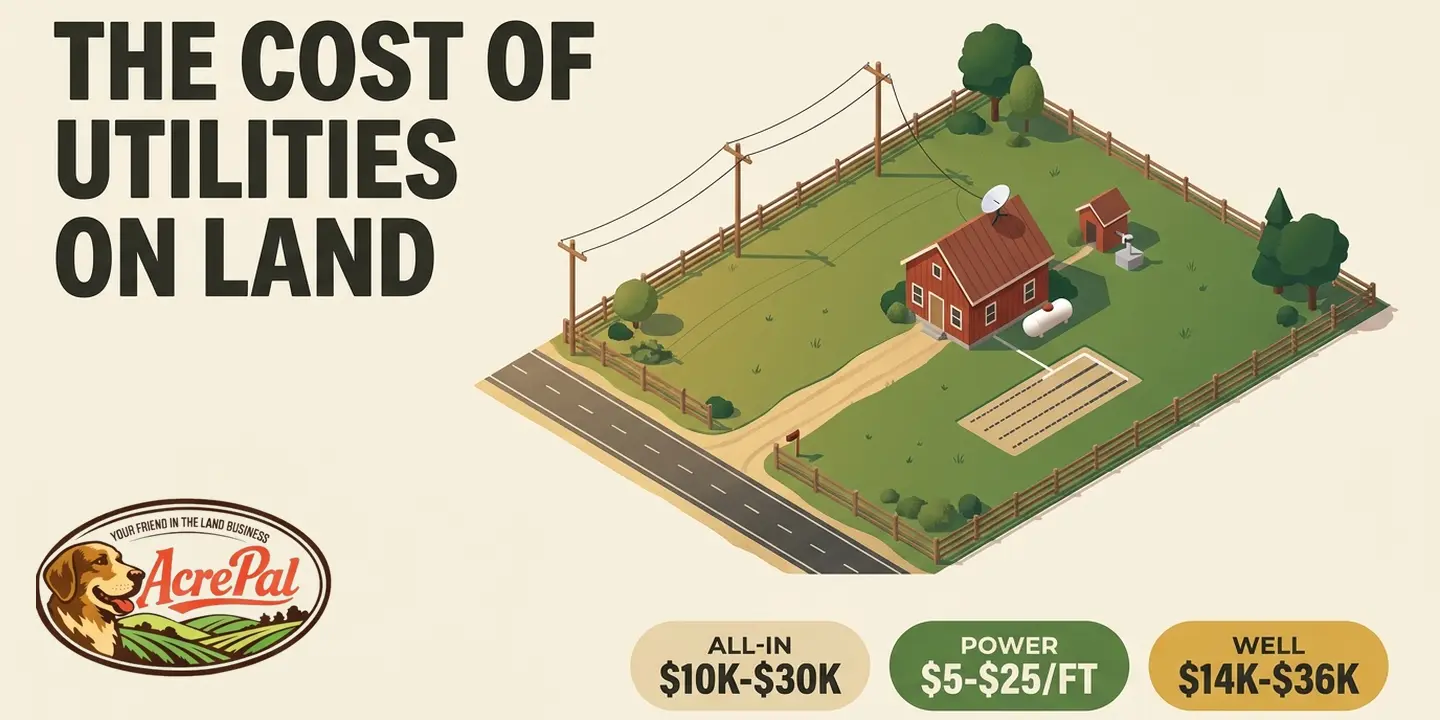
How much does it cost to get utilities on land? For most rural parcels, budget $10,000 to $30,000 all-in for power, water, septic, gas, and internet combined. The national average lands near $20,400, and the full range runs from about $5,500 on a parcel next to existing infrastructure to $80,000 or more on a remote one.
Why is the spread so wide? Almost all of it comes down to one thing you can check before you buy. How far the parcel sits from existing power, water, and roads, plus the soil and geology underneath it. A lot 50 feet from a power pole in sandy loam can come in under $10,000. The same house a mile out on granite bedrock can blow past $80,000.
This guide prices each utility with real 2026 numbers, then does the part almost every other guide skips. We price two whole parcels from start to finish and compare going off grid against paying for a line extension.
If you are still shopping and want to keep the raw land price low so you have room in the budget for utilities, our guide to the cheapest places to buy land pairs well with this one.
Running Electricity to Your Land and the Free Footage Trick
The first stretch of power line can be free, which is the most useful thing to know before you call your utility.
Pioneer Electric Cooperative in Kansas gives a free quarter mile of line, or 1,320 feet. Beyond that, single-phase overhead is $6.50 per foot and single-phase underground is $10. A half-mile overhead extension works out to $5,940 as a lump sum, or about $129 a month on their payment plan. A full mile is $20,592 lump sum, or roughly $386 a month over 60 months.
That allowance is a real buying tactic, not a technicality. If your build site falls inside the free zone, your line extension drops to zero and you pay only for the service panel and meter.
Not every co-op uses footage. Bluebonnet Electric in Texas gives a fixed $1,950 construction allowance per lot instead, and you pay everything above it. Allowances vary between co-ops and are trending smaller, so ask about yours specifically.
Use these industry-wide numbers to sanity-check any quote.
- Overhead line costs $5 to $15 per foot. Underground is $10 to $25 per foot.
- Each utility pole adds $1,200 to $5,600 on a rural extension.
- Remote extensions in tough terrain can hit $15,000 to $60,000 per mile.
- Three-phase power runs far more, roughly $9.50 to $15 per foot, so confirm single-phase covers your needs.
Before you commit, do three things.
- Choose overhead over underground when you can, since underground roughly doubles the cost.
- Get the co-op's current per-foot rate and free-footage allowance in writing.
- Check whether the line has to cross a neighbor's land. If it does, the utility will not extend service until a recorded easement is in place, and buyers often discover that too late.
Water Costs, Drilling a Well vs Tapping City Water
Rural water comes down to two paths, and the "cheap" one surprises people.
Start with the well. Nationally a well runs $7,500 to $15,000 at $25 to $65 per foot. Colorado averages about $10,500, with depth-based totals near $14,000 at 200 feet and $19,000 at 300 feet. The arid West is where it gets expensive. Mohave County Arizona wells typically finish at 300 to 650 feet and run $14,000 to $36,000 all-in. In hard granite country like San Diego County, real jobs came in at $50,200 for a 420-foot well and $78,500 for a 580-foot one. We break these numbers down further in our guide to the cost of digging a well in 2026.
A well is not just the hole. Budget a pump ($300 to $2,000), a pressure tank ($500 to $2,000), electrical hookup ($1,000 to $3,000), and a county permit ($200 to $600) on top of the drilling.
Now the city tap, and the surprise. Denver Water raised its System Development Charges on January 1, 2026, after holding them flat since 2013. A single-family home connection now costs about $4,490 in that one charge alone, before a single foot of trenching, and larger taps climb past $12,000. That blows past the $1,000 to $6,000 most guides quote.
It gets worse. Impact and capacity fees can add another $1,000 to $12,000 per permit on top of the tap fee, so a city connection is not automatically the cheap option. Some arid basins also restrict new wells, which we return to below. If Colorado is on your list, our roundup of cheap land in Colorado for sale is worth a look.
Septic, Sewer, and Why the Perc Test Comes First
A $300 to $2,000 soil test decides whether your septic system costs $8,000 or $30,000, so it comes before everything else.
That test is the percolation test, or perc test, and it measures how fast the soil drains. Anything from 1 to 60 minutes per inch passes. Too sandy (under 1) or too clayey (over 60) fails, and the sweet spot is 5 to 30 minutes per inch.
If your soil passes, a conventional septic system runs $6,000 to $15,000, with most jobs landing at $8,000 to $10,000. That total splits into five line items.
- Perc test $300 to $2,000.
- Permits, design, and engineering $500 to $2,500.
- Tank and materials $1,000 to $5,000.
- Drain field $2,000 to $10,000 or more.
- Labor and excavation $2,000 to $8,000.
If the soil fails, the alternatives balloon. A mound system runs $15,000 to $30,000, an aerobic treatment unit $10,000 to $20,000, and a drip system $15,000 to $25,000. Some counties permit no alternative at all, which makes the parcel effectively unbuildable for full-time living. A failed perc can add $10,000 to $35,000 to your total.
Run the test in late winter or early spring when the water table is highest. That is the honest worst case, so soil that passes then passes year-round. In the West the test runs $500 to $1,200.
Make your offer contingent on a passing perc test, which we cover in the verification section. Most arid-West parcels have no city sewer at all, so septic is your only path anyway.
Natural Gas and Propane for Rural Property
The gas line you were counting on probably is not coming. On most rural and arid-West parcels, natural gas mains simply do not exist, so this decision is really about propane.
Where natural gas is available, it runs $15 to $50 or more per foot, the first 100 feet is often free, and a full extension from the street lands at $2,000 to $10,000 plus. Out on raw Western land, that pipe is usually miles away or absent entirely.
Propane fills the gap and installs anywhere. Tank size and placement drive the install price.
- 500-gallon above-ground tank $1,000 to $2,500 installed.
- 500-gallon underground tank $2,000 to $6,000.
- 1,000-gallon underground tank $8,500 to $12,000, plus excavation at $50 to $200 per cubic yard.
Be honest about the ongoing cost too. A 500-gallon fill runs $700 to $1,500, and remote or mountain spots with few suppliers pay more. Above-ground is cheapest but a visible eyesore that may need setbacks from your buildings. Underground hides the tank and works better for a permanent home, but it costs three to five times as much.
Rural Internet and Why Starlink Usually Wins
This is the one utility that got easy. Remote no longer means disconnected.
Starlink is the reason. In 2026 the Standard dish is $349 one-time (or $10 a month to rent), the Mini is $249, and residential plans run $50 to $120 a month for 100 to 300 Mbps. It works anywhere with a clear view of the sky.
The caveats are real. Some markets add a congestion fee of $100 to $1,000, trees and terrain can block the signal, and latency is higher than fiber. None of that changes the bottom line for most raw parcels.
Everything else trails behind on either coverage or price.
- Fixed wireless runs $100 to $700 to set up, but only where a nearby tower already has coverage.
- Fiber extension costs $1,000 to $10,000 or more, lowest latency and highest price, rarely available rurally.
- A cellular hotspot needs almost no hardware but is slower and data-capped.
Coverage reaches our counties, including Mohave AZ, Costilla CO, Elko NV, and Modoc CA. Test the signal on-site at the exact coordinates, not a nearby town, because a ridge or tree line changes everything.
How to Check Utilities Before You Buy the Land
The cheapest way to save $30,000 on utilities happens before you sign, not after, yet almost nobody does it in order.
Sellers and brokers love the word "nearby." It can mean across the street or miles away, and a vague claim is never binding. Only a written utility estimate counts. Work the pre-offer playbook in this order.
- Get the exact parcel number (APN) and GPS boundary coordinates from the county GIS portal or a tool like MapRight.
- Call the electric co-op with those coordinates and ask four things. Is the parcel in their territory, is there a line at the frontage, how many feet to the nearest connection, and what is their current per-foot rate and free-footage allowance. Get it in writing.
- Call county Planning and Zoning for the public water service area, tap and capacity fees, or well-permit availability and any groundwater moratorium.
- Make your offer contingent on a passing perc test.
- Pull the plat map and title report to confirm no third-party easement is needed for the line. Our explainer on the difference between a deed and title walks through what those documents show.
- Get written estimates from each utility and add 15 to 20 percent contingency.
- Test cell signal and run a Starlink availability check on-site.
One term worth knowing is the will-serve letter. It says a utility could serve the parcel under current conditions, but it does not lock in cost or timing. Treat it as the first step, not the last, and always follow it with a written cost estimate. Plan on 6 to 16 weeks per utility from application to hookup, so start at or before closing.
Two Real Parcels Priced Out, Close to the Road vs Remote
Two identical houses, two wildly different utility bills. The parcel decides it, not the utility company. We priced both end to end.
Parcel A sits close to the road with utilities at or near the frontage.
- Electricity within the free-footage allowance, plus a service panel and meter under $3,500.
- Water from a shallow well around $14,000, or a city tap in the low-to-mid five figures.
- Conventional septic $8,000 to $10,000 after a passing perc.
- A 500-gallon propane tank $1,000 to $2,500.
- Starlink $349.
- Realistic all-in, roughly $22,000 to $31,000 depending on well versus tap.
Parcel B sits a half mile to a full mile out, fully off grid.
- Line extension $20,000 to $40,000 (Pioneer's full mile is $20,592, and Tierra Grande in New Mexico quotes $20,000 per half mile).
- A deep well $24,000 to $50,000 or more (the Mohave and San Diego granite examples from earlier).
- Septic $8,000 to $10,000, or a mound system $15,000 to $30,000 if the perc fails.
- Underground propane and Starlink.
- Realistic all-in, $54,000 to $80,000 or more.
Same house, and the parcel you chose set the utility bill. In Costilla County, a $5,000 lot can need $24,000 to $48,000 of off-grid systems, so development runs several times the land price. That is also why parcel size and layout matter, and our breakdowns of how big 10 acres is and how big 20 acres is help you picture where a build site and a well can actually go.
Going Off Grid vs Paying for a Line Extension
When the power line quote is brutal, is a full off-grid system actually cheaper? On cheap Western land, that is the real decision.
Use a simple framework. Under a $10,000 line quote, take the grid. Between $10,000 and $20,000, get solar quotes and compare. Over $20,000, off-grid solar deserves a serious look.
Know the replacement cost first. A modest off-grid cabin system runs $15,000 to $30,000, a full-home setup runs $45,000 to $65,000, and a fully autonomous system can hit $115,945, a real Arizona build with 13.6 kW of panels and 9 Powerwalls, versus $44,139 for the grid-tied equivalent.
Break-even comes down to the monthly bill. Off-grid kills both the electric bill and any 60-month co-op payment, so a $20,592 line plus roughly $100 a month can lose to a paid-off solar array over 7 to 10 years. One caveat. Solar does not solve water or septic, and those costs are identical either way.
Across the West, the details shift county by county.
- Most arid-West parcels have no city sewer or natural gas at all.
- Costilla County CO buyers plan solar, propane, and a cistern, and 300-plus sunny days make solar strong.
- Elko County NV mostly lacks roads, power, and water, so budget for everything.
- Mohave County AZ wells run deep, and the Hualapai basin has an irrigation non-expansion area limiting new agricultural wells.
Most of the rural parcels we sell at AcrePal are already off grid, which is why we tell buyers to budget the systems up front, and why owner financing lets you buy the land cheap and phase the utilities in over time. If you are weighing where to settle, our guide to the best states for homesteading lines up the tradeoffs.
Frequently Asked Questions About Utility Costs on Land
How much does it cost to get utilities on land, total?
For a standard rural parcel with decent utility proximity, plan on $10,000 to $30,000 all-in, averaging around $20,400. Extremes run from about $5,500 near existing infrastructure to $80,000 or more on a remote lot needing a long line extension, deep well, and alternative septic. Distance is the biggest driver by far.
What is a will-serve letter and should I get one?
A will-serve letter is a written statement from a utility saying it could serve your parcel under current conditions. It does not guarantee service, lock in a cost, or commit to a timeline. Treat it as the first step in your research, then request a formal written cost estimate before you close.
Can I get a mortgage on land without utilities?
Usually not for a primary residence. Conventional loans typically require a permanent potable water source, so a parcel with no permitted well or city connection may not qualify. In Mohave County AZ, parcels without a permitted well sell for 8 to 22 percent less, so the missing well costs you twice.
What is a perc test and do I need one before buying?
A perc test measures how fast soil drains to see whether conventional septic will work, and it runs $300 to $2,000. You need one if you plan to install septic and there is no city sewer, which describes most rural land. Make your offer contingent on passing, because a failure can add $10,000 to $35,000 or make the lot unbuildable.
How far ahead should I plan for utility installation?
Budget 6 to 16 weeks per major utility from application to hookup. Electric line extensions usually schedule 4 to 12 weeks out, and septic permits take 2 to 6 weeks after the perc test. Well drilling itself is only 1 to 3 days, but rural driller availability can add weeks. Start at or before closing rather than waiting.
Is it cheaper to go off grid than run electricity to land?
For a modest cabin, a $15,000 to $30,000 solar setup can beat a $20,000-plus line extension once you kill the monthly bill. For a full-autonomy home, a system at $115,000 or more usually does not pencil out against the grid. The tipping point sits around $15,000 to $20,000 in grid-extension cost. Above that, get competing solar quotes.