
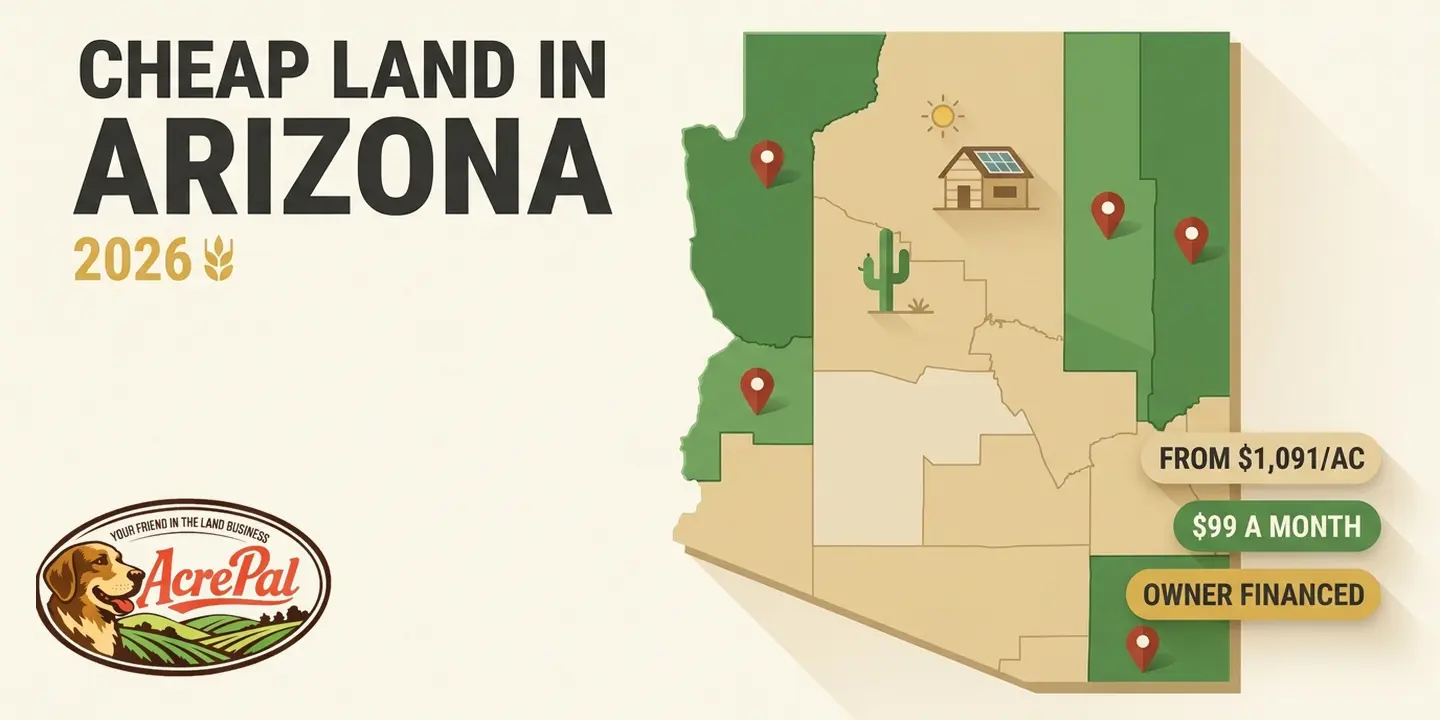
Search for the best Arizona counties to buy land and you will get Maricopa, Pima, and Coconino, where raw acres run from $15,000 to more than $27,000 apiece. That is useful if you are chasing appreciation near Phoenix. It is the opposite of what you want if you are trying to buy cheap land in Arizona.
The genuinely cheap land sits in the far corners of the map. In Mohave and Apache counties, raw desert acres run $1,000 to $3,000, and sellers finance them from about $99 a month. Compare that to Maricopa County's roughly $27,605 an acre and it is easy to see why budget buyers look outside the metro. Arizona has more affordable land than almost any western state, and it charges no state income tax on top of that, but every cheap parcel is cheap for a reason, usually water, access, or distance.
Here are the five cheapest counties with real 2026 prices, then the honest reality of what it takes to make one livable. If you want the national picture first, our guide to the cheapest places to buy land covers the whole country.
1. Mohave County: The Cheapest Big Supply
Most cheap-Arizona journeys start in Mohave, and for good reason. It has the most owner-financed inventory in the state, the lowest property taxes, and the simplest rules for putting your own water on the land.
The median price sits around $2,502 an acre, and one to five acre desert parcels routinely sell for $1,000 to $5,000 with owner financing from $99 a month. Some listing services put the average even lower, closer to $1,597 an acre. The action is around Golden Valley, Dolan Springs, and Yucca, all close enough to Kingman for supplies. Mohave is the largest county in Arizona at roughly 13,470 square miles, so the sheer supply of cheap parcels is hard to beat. Most of the county also sits outside Arizona's managed groundwater zones, so drilling your own well is straightforward, which we get into in the water section below.
A couple more things make Mohave the default starting point. Its property tax rate is the lowest in the state at 0.485 percent, so a $10,000 parcel costs roughly $48 a year to hold. And Golden Valley sits at about 3,500 feet, which takes the edge off the summer heat that punishes the low desert, while Arizona's 300-plus sunny days keep off-grid solar viable year round.
A lot of buyers use Mohave exactly this way. They buy two or three cheap acres in the Golden Valley or Kingman area, park an RV as a home base in a proper zone, then travel the rest of the year. It is one of the most affordable footholds in the West.
The tradeoffs are real. Wells here are deep, often 400 to 800 feet, which makes them pricey to drill. And if you plan to live in an RV full time, Mohave restricts that to specific R-RV zones rather than any parcel, so confirm the zoning before you commit. Start your search here if you want the widest selection of cheap, buildable desert land in Arizona.
2. Apache County: The Cheapest Price Per Acre
If you want the absolute lowest number, drive to the northeast corner. Apache County cheap land averages around $1,091 an acre, likely the cheapest per-acre pricing in Arizona, though average listings across all parcels sit closer to $28,000.
The land is concentrated around Concho, St Johns, Chambers, and Sanders, out near the New Mexico line. Owner financing starts around $169 a month, and a 1.32-acre parcel near Concho recently listed for $8,000 cash. Around Concho you can find 1-acre lots on payment plans close to $145 a month, which is about as low as land ownership gets anywhere in the country. The price is not the only draw. This is high desert at 5,000 to 7,000 feet, so summers are noticeably cooler than the low desert, and the landscape is juniper and piñon rather than bare sand. Structures under 200 square feet can go up without a permit. And the median property tax is only about $653 a year, with Bortle 2-3 dark skies overhead that put the Milky Way in view on any clear night.
The honest tradeoff is isolation. One land YouTuber described St Johns as a town where the Dollar Store is the Walmart, and a hospital can be a 45-minute drive. Wells run 250 to 800 feet, so figure $12,000 to $40,000 to put water in the ground, and internet and services thin out fast once you leave the main roads.
Apache is best for a cooler-climate off-grid homestead where you value quiet and price over convenience. Buy two to five acres, drill or haul water, add solar, and place a small structure or a manufactured home, and you have a working homestead for a fraction of what the same setup costs almost anywhere else. Skip it if you need services and hospitals close by.
3. Navajo County: High-Desert Value Near the Rim
Navajo County splits the difference between rock-bottom Apache and higher-supply Mohave. The median runs around $2,034 an acre, cheaper than neighboring Cochise and only a little above Mohave, and the land sits near real communities rather than empty desert.
Holbrook anchors the north, while Snowflake and Taylor form an established off-grid and homestead community to the south, one of the real epicenters of off-grid living in the state. The Mogollon Rim keeps summers milder than the low desert, though winters do get cold at elevation, so plan for both. The Painted Desert and Petrified Forest give the area genuine scenery that most cheap-desert counties cannot match. Owner financing shows up here through several sellers, so you are not limited to cash deals. For a buyer who wants cheap land but not total isolation, Navajo is a strong middle option.
One permitting quirk is worth knowing before you buy. Navajo County will not issue occupancy permits for converted structures, so a shed-to-cabin or shipping-container conversion may never get signed off as a legal dwelling. Plan on a code-compliant build or a permitted manufactured home instead, and the county is otherwise easy to work with. Watch for tribal-land adjacency in some areas too, since it can complicate access and drilling permits. Navajo is best for buyers who want affordable land near an actual town and are ready to build the right way.
4. Cochise County: The Off-Grid-Friendly Southeast
If your top priority is off-grid freedom, Cochise has long been the friendliest county in Arizona. Desert-land prices run a little higher, around $3,179 an acre median, but you get more latitude to build the way you want.
The land clusters around Willcox, Pearce and Sunsites, and the Portal area against the Chiricahua Mountains. Cochise has historically offered owner-builder permits, which let you act as your own general contractor, and the southeast corner catches up to 15 inches or more of monsoon rain in spots, which gives you the best rainwater-harvesting odds in the state. It also has some of the darkest skies in the country. Portal is home to Arizona Sky Village, a community built around stargazing and bird watching. Winters are milder here than in high-elevation Apache or Navajo, and the border-country cost of living stays low.
That monsoon rain matters more than it sounds. Where western counties get 5 to 10 inches a year, southeastern Cochise can pull 15-plus inches from the summer monsoon, which is what makes rainwater harvesting a real water strategy here rather than a token gesture.
Two honest notes. The Douglas area sits inside an Irrigation Non-Expansion Area, which adds some groundwater rules, and the newer Willcox groundwater zone tightens things in parts of the county. Southeast Arizona groundwater can also carry arsenic, so budget to test any well for it before you buy. Cochise is best for hands-on off-grid builders and stargazers who want room to experiment.
5. La Paz County: Cheap Colorado River and Snowbird Land
One Arizona county swells into a city of RVs every winter and nearly empties out every summer. La Paz has just 4.5 people per square mile, and Quartzsite, sitting right on Interstate 10, is a legendary snowbird and boondocking hub with established off-grid culture.
Prices track Mohave, and the bonus is real. Wells are actually shallower and cheaper, roughly 200 to 700 feet and $9,000 to $28,000, which is real money saved against Mohave's deep basins. The whole county sits outside Arizona's managed groundwater zones, so exempt-well permitting stays simple. The Colorado River corridor on the west side adds recreation and value. For a buyer who wants a cheap winter base with neighbors who already live off-grid, La Paz is hard to beat.
The upside of buying near an established snowbird hub is that the off-grid culture is already built in. Neighbors know where to haul water, which parcels flood, and how to run a rig off solar, so you are not the first person figuring it out on an empty stretch of desert.
The catch is the summer. One land tour described Quartzsite as looking like Mars in July, with regular days over 110 degrees, and that is not far off. Most buyers here use the land from November through March and go elsewhere when it heats up. La Paz is best as a cheap seasonal base, not a year-round low-desert home.
6. The Water Gamble: The Cost That Makes Cheap Land Cheap
The buyers who lose money on cheap Arizona desert almost always lose it on water. This is the single biggest hidden cost, and it is the main reason these parcels are cheap in the first place.
Arizona treats land and water separately, with surface water and groundwater governed by different rules. Groundwater inside the state's Active Management Areas, which cover Phoenix, Tucson, Prescott, Pinal, Santa Cruz, and a few newer zones like Douglas and Willcox, is tightly regulated. The good news for cheap-land buyers is that most affordable parcels sit outside those areas. Out there you can drill an exempt domestic well, one that pumps up to 35 gallons per minute, with just a Notice of Intent to the Arizona Department of Water Resources and a $100 fee under A.R.S. 45-454, and the driller files a completion report when the well is done.
The gamble is depth and quality. Mohave wells often run 400 to 800 feet and cost $14,000 to $35,000, and while some parcels hit water shallow, others drill deep and come up dry. Rural groundwater can also carry arsenic or fluoride, so budget $300 to $600 to test it before you drink from it. Smart buyers pull the ADWR well database by parcel number and check neighbor well logs within a half mile to see likely depth before they ever make an offer. If a well is out of reach for now, hauling is the common stopgap, about 2 to 3 cents a gallon into a 2,500-gallon cistern, which runs roughly $4,800 to $9,600 a year if you haul everything. Our full breakdown of well drilling costs walks through the numbers by depth. The rule is simple. Never write an offer before you verify the water source.
7. Legal Access and the Landlocked Trap
The most heartbreaking cheap-land mistake is buying a parcel you can drive to but have no legal right to reach. In Arizona, physical access is not the same as legal access.
Many of the very cheapest parcels were split off larger ranches decades ago, in the wildcat subdivisions of the 1960s and 70s, before A.R.S. 11-831 required a recorded public right of access for new land divisions. That leaves them landlocked, with no legal easement across the neighboring property even if a dirt road runs right to the corner. A landlocked parcel cannot get a building permit or a loan, and fixing it means negotiating an easement or petitioning a court for an easement by necessity under A.R.S. 12-1202, which requires proving reasonable necessity and is slow and far from guaranteed.
The fix is simple and belongs at the front of your due diligence. Demand a title report that shows recorded legal access before you buy, and confirm the road to the parcel is a legal right of way, not just a track across someone else's ranch. A cheap parcel that cannot show recorded access is not a bargain at any price, no matter how good the sticker looks. These parcels are usually old lot splits, so our guide to subdividing property explains how access is supposed to be created, and the deed vs title breakdown covers what that title report actually shows.
8. Septic, Power, and What You Can Actually Build
On a lot of cheap Arizona parcels, the dirt itself is the problem. After water and access, three more costs finish the picture of what it really takes to make the land livable.
Septic comes first. A standard system runs $8,000 to $15,000, but before you install one you need a passing percolation test, which itself costs $750 to $1,850. Arizona desert often hides caliche, a natural-concrete soil layer that fails that perc test and forces an engineered system at $15,000 to $35,000 or more. Roughly 15 to 25 percent of rural sites fail a standard perc test, so make your offer contingent on one passing. Power is next. Extending the grid runs $26,400 to $79,200 per mile of overhead line, with each utility pole adding $1,200 to $5,600, so if the nearest pole is far, an off-grid solar and battery system at $21,800 to $34,500 for a medium home is usually cheaper. Arizona's 6 to 7 kWh of daily solar and 300-plus sunny days make that math work, and the 30 percent federal solar tax credit runs through 2032 to soften the cost further.
Zoning decides the rest. Most cheap parcels are zoned Rural or General Rural, which usually allow a manufactured home on a permanent foundation with HUD-compliant skirting, but RV living as a permanent residence is limited. Mohave, for example, restricts it to specific R-RV zones or an annual permit. Confirm your plan with the county before you buy. For the full cost detail, see our guides on well and septic installation and getting utilities to land, plus what the rural zoning codes allow.
9. How to Actually Buy It: Owner Financing With No Bank
You almost never need a bank to buy cheap Arizona land. Banks want 30 to 50 percent down on raw land and often reject it outright, so most cheap parcels change hands a different way.
That way is owner financing. You put down a small amount, often $149 to a couple thousand dollars and frequently under $300, then make a low monthly payment, usually $99 to $249, though bigger parcels can run up toward $575. Terms run 3 to 7 years, there is no credit check, so a thin or bruised credit file does not shut you out, and closings happen in 7 to 14 days instead of the month or two a bank takes, with closing costs that typically land at 2 to 5 percent of the price. A few things to check before you sign. Confirm whether the deed transfers at signing or only at payoff, verify the parcel boundaries at the county recorder, and make sure the land has the recorded legal access from the access section above.
This is exactly how we work at AcrePal. We sell owner-financed rural parcels in Arizona counties like Mohave and Apache, along with Colorado, Nevada, California, and Florida, with low monthly payments and no bank in the middle. For most of our buyers, that turns a piece of land they thought was out of reach into a payment that fits next to a phone bill. If you want the full playbook, our guide on buying land with no money down breaks the process down step by step, and the cheapest places to buy land shows how Arizona stacks up against other markets.
Frequently Asked Questions
What is the cheapest county to buy land in Arizona?
Apache County is the cheapest per acre, averaging around $1,091. Navajo County runs about $2,034 an acre and Mohave County about $2,502, with Mohave offering by far the most supply and owner financing from $99 a month. All three are a fraction of Maricopa County near Phoenix, where land runs about $27,605 an acre, and cheaper still than Pinal County, where listings average close to $39,858 an acre.
Can I drill a well on cheap Arizona land?
Usually yes, if the parcel is outside an Active Management Area, which most cheap land is. You file a Notice of Intent with the state water department, pay a $100 fee, and drill an exempt domestic well that pumps up to 35 gallons per minute. Expect $14,000 to $35,000 in Mohave County, where wells run deep, and less in shallower areas like La Paz, where the range is closer to $9,000 to $28,000.
Is owner financing for cheap Arizona land legit?
Yes, it is the standard way cheap land sells. There is no bank and no credit check, monthly payments start around $99, and closings happen in 7 to 14 days. Protect yourself by confirming whether the deed transfers at signing or at payoff, verifying the parcel at the county recorder, and checking for recorded legal access before you commit.
Can I live off-grid legally in Arizona?
Yes, with some rules. Solar, rainwater harvesting, and graywater systems are legal with permits, and a septic system is required for a permanent residence. RV living depends on zoning. Apache County allows structures under 200 square feet without a permit, and Cochise County is historically the most lenient. Always confirm the specific rules with the county before you build.
What hidden costs make cheap Arizona land cheap?
Four big ones. A well runs $14,000 to $35,000 in the deep-well counties, a septic system runs $8,000 to $15,000 and far more if caliche soil fails the perc test, extending grid power costs $26,400 to $79,200 per mile, and a landlocked parcel with no legal access cannot be built on at all. Each can cost more than the raw land itself.
Why is Mohave and Apache land cheap while Maricopa is expensive?
Three reasons. The cheap counties are hours from Phoenix and its jobs, services, and hospitals. Outside the managed water areas, you have to solve water yourself with a well or hauling. And most cheap parcels have no utilities at all. Near Phoenix, water infrastructure is built in, but the Phoenix area now carries a documented 100-year groundwater deficit of 4.86 million acre-feet, so the state has stopped approving new groundwater-based development there.