
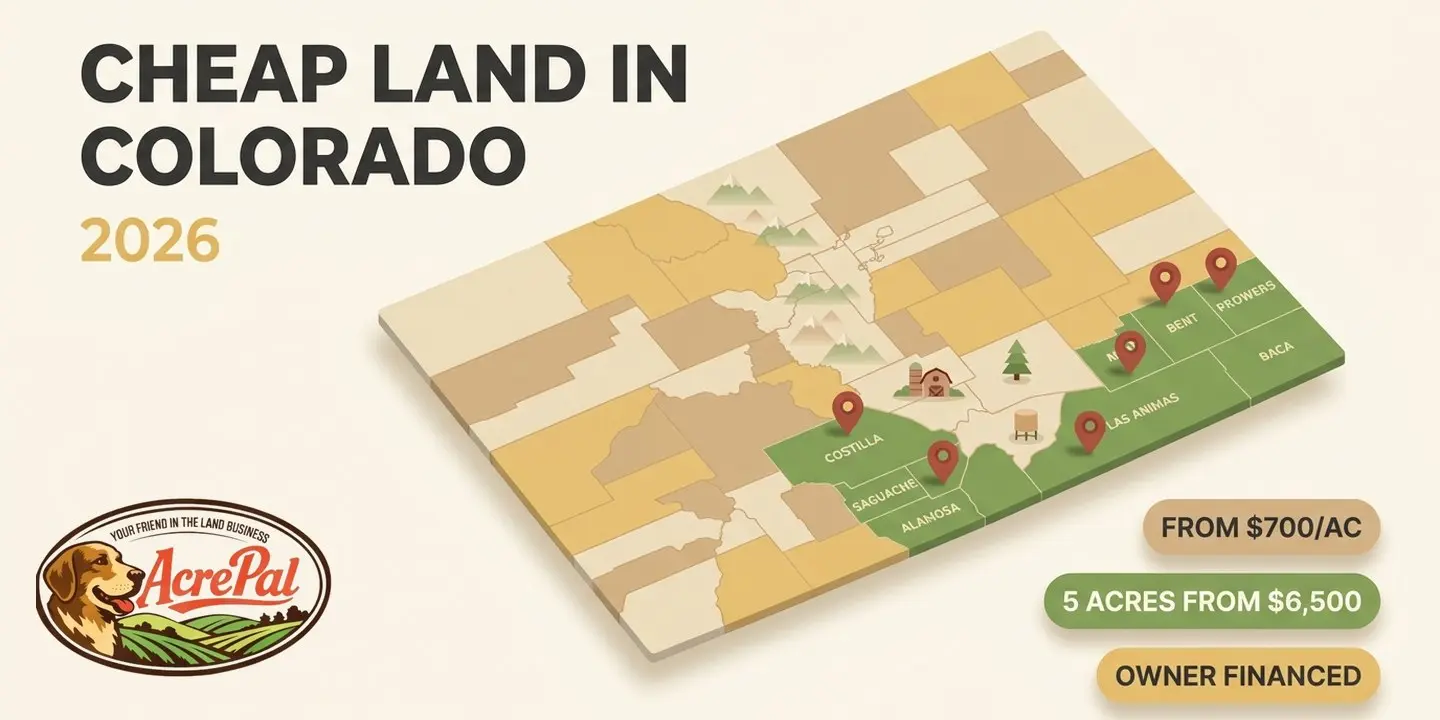
Cheap land in Colorado for sale runs roughly $700 to $2,500 per acre in the right counties, with owner financing that starts around $99 down and about $122 a month. That is a real price, not a bait number, and property tax on a 5-acre lot runs about $74 a year. A 5-acre lot in Costilla County goes for about $6,500 cash, or $200 down and $122 a month for five years, with no credit check. The cheapest parcels are cheap for reasons most listings quietly leave out, mainly water rights, road access, and build rules, so this guide ranks the counties cheapest first and names the catch on each one.
Why Statewide Colorado Land Prices Mislead Cheap Land Buyers
Say "Colorado land" and most people picture a $2 million ski-town lot. That average is real, and it is useless to you. Statewide and Front Range numbers get dragged sky-high by Denver-area and mountain-resort ground that can run anywhere from $45,000 to $2 million an acre.
The genuinely cheap land sits in two pockets far from all that. One is the San Luis Valley in south-central Colorado. The other is the eastern plains out toward Kansas. Across those areas, agricultural and rural acreage trades between $600 and $5,000 an acre, and the cheapest counties land squarely in the $700 to $1,600 range.
So read county prices, not state averages. It is the same cheapest-first logic we used nationally in our guide to the cheapest place to buy land, applied to one state. Here is how the cheap Colorado counties stack up, cheapest to hold at the top.
1. Baca County, the Absolute Cheapest Land in Colorado
Nine hundred fifty dollars an acre. That is the median for Baca County, the lowest raw per-acre price in the state, with vacant parcels dipping to $700 to $1,000 an acre out on the plains. At that median a 40-acre plains parcel pencils out near $38,000, and under $30,000 on the cheapest ground. Property taxes run about 0.41 percent, and the county holds roughly two people per square mile.
Cheap has a reason, and Baca does not hide it well once you look. The land is flat, semi-arid eastern prairie with limited water, no mountain views, and no hunting reputation to speak of. The county carries a 20.1 percent poverty rate and thin local services. You are a long way from anything.
That profile is exactly why land bankers like it. When you never plan to live on a parcel, you want the lowest possible dollar in and the lowest carrying cost, and scenery is beside the point. Larger 20 to 40 acre flat plains parcels stack up cheaply here, and if you are unsure what that footprint even looks like, our breakdown of how big 20 acres is makes it concrete.
Best for land bankers who want the lowest dollar-in in Colorado and plan to hold, not use. Skip it if you want to live, farm, or hunt on the ground you buy.
2. Las Animas County, Cheap Acreage With Real Hunting Access
Baca wins on price, but Las Animas gives you something to do with the land. At the low end, vacant parcels still hit $700 to $1,000 an acre, so the entry point is nearly as cheap. The all-listings median looks scary at $3,964 to $5,279 an acre, though that figure is skewed hard by big ranches, with ranch land itself closer to $2,000 an acre. Property taxes here are just 0.24 percent, the lowest in our sampled set, across roughly 234 listed properties.
The upside is the reason to look. Las Animas sits inside Game Management Unit 851, a trophy elk unit with over-the-counter archery, second, and third rifle tags, plus mule deer, pronghorn, and bear. It borders Costilla and sits near Trinidad for groceries, fuel, and a hospital.
One honest note. Unit 851 is about 88 percent private land, so owning your own parcel is how you lock in guaranteed access. Read the actual parcel price too, never the ranch-skewed average, and small 3 to 5 acre lots near Trinidad are where the real deals hide, which is easier to picture once you know how much 3 acres of land actually is.
The cheapest way into a trophy elk unit, as long as you buy by the parcel and not by the average.
3. Bent and Prowers Counties, Flat Plains Built for Solar
Stand on a Bent County parcel and you can walk a straight line for several hundred yards without meeting a rock, a gulch, or a drop-off. The horizon just keeps going. That table-flat ground is the whole pitch. Bent runs a median of about $2,378 an acre and neighboring Prowers about $2,566, both with roughly four people per square mile and property taxes near 0.39 percent.
Flat, firm soil means you can set a manufactured home or a cabin without earthmoving or a foundation fight. Bent also gets some of the most consistent, unobstructed sun in the state, well over 300 bright days a year, which makes off-grid solar predictable in a way mountain lots never are. Spring gusts can top 60 miles per hour out here, so racks and roofs need wind-rated anchoring.
Now the honest catches. There are no mountain views out here, electricity rarely reaches far into the prairie, and most cheap parcels have no year-round maintained road, so verify winter access before you sign. Most buyers skip wells entirely and go cistern plus hauled water. If you are weighing a big 40-acre plains parcel against something smaller, our look at how big 10 acres is helps you right-size first.
Baca is cheaper and Costilla has the views, but Bent and Prowers are the easiest place in Colorado to actually put a home on the ground without a bulldozer.
4. Costilla County, the San Luis Valley Value Pick
Costilla County shows up in every cheap-land video ever made, which is exactly why it deserves the honest breakdown instead of the hype reel. Start with the numbers. Unimproved 5-acre lots run $6,499 to $9,999 cash, roughly $1,300 to $2,000 an acre, and lots with power already at the road climb to $15,000 to $18,000 for 5 to 6 acres. A 5.76-acre corner lot in Sangre de Cristo Ranches with power at the lot line recently listed at $18,000, about $3,125 an acre.
Owner financing is everywhere here. Common deals look like 5 acres at $6,500 cash, or $200 down and $122 a month for 60 months, and an RV-friendly 5-acre lot at $6,499 cash, or $149 down and $149 a month. Down payments run $99 to $299, with no credit check.
The value stack is what separates Costilla from the raw-price floor. Property taxes are the lowest in Colorado, about $74 a year on a 5-acre lot. You get Sangre de Cristo mountain views toward Blanca Peak and Mount Lindsay, over-the-counter elk in Unit 851, and 280 to 300 sunny days a year for solar. Land here has appreciated about 35 percent over five years, and lots inside Sangre de Cristo Ranches carry private access to Mountain Home Reservoir for fishing and boating.
We sell land in Costilla County ourselves at AcrePal, so this read comes from closing real deals here, not from a spreadsheet. Why is it cheap? Well permits, camping limits, and build minimums, all of which we unpack fully in the three sections below rather than glossing over. If you are eyeing this ground as an off-grid base, our guide to the best states for homesteading puts the tradeoffs in national context.
Best for off-grid homesteaders and hunters who want views, solar, and rock-bottom taxes and can live with hauled water. Skip it if you need a drilled well or plan to live in an RV full time.
5. Saguache County, Cheap Raw Land With a Well Catch
The listing average says $6,900 an acre. The raw land tells a very different story. That $6,225 to $6,930 median is inflated by big farms and ranches in the county mix, while genuine raw parcels start near $900 an acre.
One example is a 40-acre parcel at $4,499 cash, about $112 an acre, or $5,599 financed with $1,680 down at $149 a month. Saguache borders Costilla and Alamosa, and it has appreciated about 40 percent over five years, the strongest in the valley.
Here is the catch worth the whole section. The Saguache Subdistrict's augmentation plan, the mechanism that would let new non-exempt wells replace the water they pull, was flat-out denied for inadequate replacement water. So on top of the standard San Luis Valley moratorium, new wells here face an extra barrier that the other subdistricts cleared.
Best for off-grid buyers already committed to cistern and hauled water who want the lowest raw-land dollar in the valley and the strongest appreciation. Just go in knowing the well door is closed tighter here than anywhere else in the region.
6. Alamosa and Conejos Counties, Valley Land Near Services
Pay a little more here and isolation stops being part of the deal. Alamosa large tracts start around $2,000 an acre for flat, arable ground that actually farms and ranches. Alamosa is the commercial hub of the San Luis Valley, so land near town runs higher while raw acreage further out drops back toward that floor. Conejos next door plays the same role at a similar band.
This is also the tier just above the floor. Huerfano County starts near $5,000 an acre, and Pueblo and Fremont sit a notch up for buyers who want more services or Front Range proximity. You pay for the pavement and the hospital, and for some people that is worth every dollar.
Best for buyers who want flat, arable valley ground with a town, a hospital, and a hardware store within reach, and will pay a small premium to skip total remoteness. To close the ranked list in one line, cheapest to hold is Baca, best off-grid value is Costilla, and easiest access to services is Alamosa.
The Colorado Water Catch Every Cheap Land Buyer Has to Understand
The number one reason a cheap Colorado parcel turns into a useless one is water, and almost no listing says a word about it. Get this part wrong and the rest does not matter. Here is the whole picture.
Colorado runs on prior appropriation, "first in time, first in right," which means water rights are legally separate from owning the dirt. No water rights, no development value.
Division 3, the San Luis Valley, has banned new non-exempt wells since 1975, tightened it in 1981, and still enforces it in 2025 across roughly 7,500 wells.
The plat-date trap is the killer. Costilla parcels platted after June 1972 generally cannot get a well permit at all, and most cheap subdivisions like Sangre de Cristo Ranches and San Luis Valley Ranches were platted right in that window, so verify the exact plat date before you buy.
The 35-acre line matters. Parcels under 35 acres can at best get an exempt household-only well where permitted, with no outdoor irrigation, while 35-acre-plus parcels can qualify for a Domestic and Livestock permit covering a garden and animals.
Rainwater is not the loophole. Colorado caps collection at 110 gallons, the 2025 repeal bill HB 25-1106 died 12-0 on February 13 2025, and in the valley's 7 to 10 inches of annual rain that cap is about four days of drinking water for one person.
The real fix is a cistern plus hauled water. Budget $1,000 for a basic tank up to $4,000 winterized, a $500 county cistern permit, and self-haul at about $25 per 500 gallons, which pencils out near $80 to $150 a month for a household.
If your plat date allows a well, drilling runs $50 to $75 a linear foot, roughly $7,000 at 100 feet and $12,000 at 450 feet, and our guide to the cost of digging a well in 2026 walks the math. Otherwise, budget for a cistern and hauled water from the start and you will never be blindsided.
What You Can Actually Build, Camp, and Live In
You cannot just park an RV and live on your cheap Costilla parcel, and here is exactly what the county allows, using its strict, well-documented rules as the worked example.
Short-term camping is 14 days within any 3-month period on the same parcel with no permit, which pencils out to about 56 days a year, and an RV counts as camping.
Permanent RV living is never allowed in Costilla County, no matter the parcel size.
An RV during active construction needs a $350 permit, good for 90 days and renewable to 18 months, but only after you hold an approved OWTS septic permit, a permitted well or cistern, an active building permit, and proof of ownership.
Any single-family dwelling, tiny homes included, must be at least 600 square feet, and mobile homes are allowed in A, RR, ER, and UR zoning with foundation and age rules.
Septic means an OWTS permit at $500, engineer-designed, installed and inspected before any occupancy permit, and the process was upheld by the 10th Circuit in 2024.
HOA reality splits by subdivision. Forbes Park charges a mandatory $290 a year with a 3-person architectural control committee, while Sangre de Cristo Ranches runs an optional $25-a-year POA that does not actively enforce its covenants.
That $25 versus $290 gap is real money over a decade, and non-enforcement cuts both ways, freedom to build how you like and zero protection from a neighbor who does the same. A 5-acre Costilla parcel is a legal weekend and hunting base the day you close, and a legal homestead only after you stack septic, water, and a building permit on top.
Owner Financing, What the Monthly Math Actually Looks Like
That $122-a-month land payment is smaller than most car payments, and it is worth seeing the full number anyway. Take the common Costilla deal. Five acres at $6,500 cash, or $200 down and $122 a month for 60 months, comes to $7,520 financed. That roughly $1,020 spread is the built-in financing charge, an implied effective rate of about 7 percent since no rate is disclosed separately.
A second common structure shows the pattern plainly. That RV-friendly 5-acre lot at $6,499 cash runs $149 down and $149 a month for 60 months, which comes to $9,089, a spread of about $2,590 over the cash price. Expect a one-time documentation fee of roughly $250 to $399 on top of your down payment, with payments usually on autopay through ACH.
The wider range holds across most listings.
Down payments run $99 to $299.
Monthly payments run $122 to $263.
Terms run 55 to 84 months.
No credit check, no bank, no income verification.
The mechanics are plainer than a mortgage. The seller holds the deed, or uses a land contract, until your final payment clears, and the deed transfers to you on payoff, which is the practical difference our deed vs title guide spells out. Ask for an early-payoff clause with no penalty in writing before you sign. Owner financing is how a $6,500 parcel becomes a $122-a-month decision, so lock the payoff terms down on paper and the rest is easy.
The Bottom Line
Match the county to yourself and the choice gets simple. A cheapest-to-hold land banker leans Baca or the eastern plains. An off-grid homesteader who wants views and hunting leans Costilla. A buyer who wants the easiest build and the best solar leans Bent or Prowers. Anyone who wants services and arable ground leans Alamosa.
Then run this checklist before you wire a dollar.
Plat date and well eligibility, pre versus post June 1972, since that one date decides your entire water plan.
Road access, including the honest winter and 4x4 reality, not just the summer satellite view.
Power at the road or not, verified by street name, since it swings value by $10,000 or more.
Zoning and APN confirmed through the county assessor, not the listing.
HOA or POA and the annual dues, Forbes Park at $290 versus Sangre de Cristo Ranches at $25.
Property tax, which should sit under about $100 a year on a 5-acre lot.
Cheap Colorado land is real value when you buy the right county for the right reason and verify the six things above. Skip the checklist and you are buying someone else's problem.
Cheap Colorado Land, Frequently Asked Questions
What is the cheapest county to buy land in Colorado in 2026?
Baca County is cheapest at a median near $950 an acre, with vacant plains parcels as low as $700. It is flat, remote, and water-limited, which is why the price is what it is. For off-grid value rather than raw price, Costilla is the stronger pick at $1,300 to $2,000 an acre with mountain views and hunting.
Can I drill a well on cheap land in the San Luis Valley?
Almost never on cheap subdivided parcels. The Division 3 moratorium has blocked new non-exempt wells since 1975, and Costilla lots platted after June 1972 generally cannot get one, which covers most cheap subdivisions. Plan on a cistern of $1,000 to $4,000 plus hauled water at about $25 per 500 gallons, roughly $80 to $150 a month.
Can I live in an RV while I build?
Only in a limited way. Costilla allows 14 days of camping, RV included, per 3-month period with no permit. Longer stays during active construction need a $350 permit, and only after you hold an approved septic permit, a permitted well or cistern, and an active building permit. Permanent RV living is never allowed in the county.
How does owner financing work and what does it really cost?
You put $99 to $299 down and pay $122 to $263 a month for 55 to 84 months, with no credit check and no bank. No interest rate is stated, so the cost hides in the price spread. A 5-acre lot at $6,500 cash financed at $200 down and $122 a month for 60 months totals $7,520. The seller holds the deed until you pay it off.
Does Costilla County have an HOA?
It depends on the subdivision. Forbes Park has a mandatory POA at $290 a year with an architectural control committee that must approve your plans. Sangre de Cristo Ranches has an optional $25-a-year POA whose covenants exist but are not actively enforced. Other subdivisions vary, so always request the CC&Rs before you close.
Why is Costilla land so cheap?
It is not for lack of value. Well permits are unavailable on most post-1972 parcels, camping is capped at 14 days per 3 months, dwellings must hit 600 square feet, and winters drop below minus 4 at 7,500 to 8,800 feet. Costilla is also Colorado's poorest county with thin services. The views, solar, and elk hunting stay genuinely excellent, so the right buyer wins.
Can I collect rainwater in Colorado?
Yes, but only up to 110 gallons, which is two 55-gallon barrels, under a 2016 state law. A 2025 bill to remove that cap failed 12-0 in committee on February 13 2025. In the San Luis Valley's 7 to 10 inches of annual precipitation, 110 gallons is about four days of drinking water for one person. Do not build your water plan around rain collection.
Is cheap Colorado land a good investment?
It can be. Costilla land has appreciated about 35 percent over five years and Saguache about 40 percent, with property taxes near $74 a year making it nearly free to hold. The risk is that water and build restrictions cap the ceiling on some parcels. The best-appreciating lots have power at the road, maintained access, and a rare eligible well permit.